
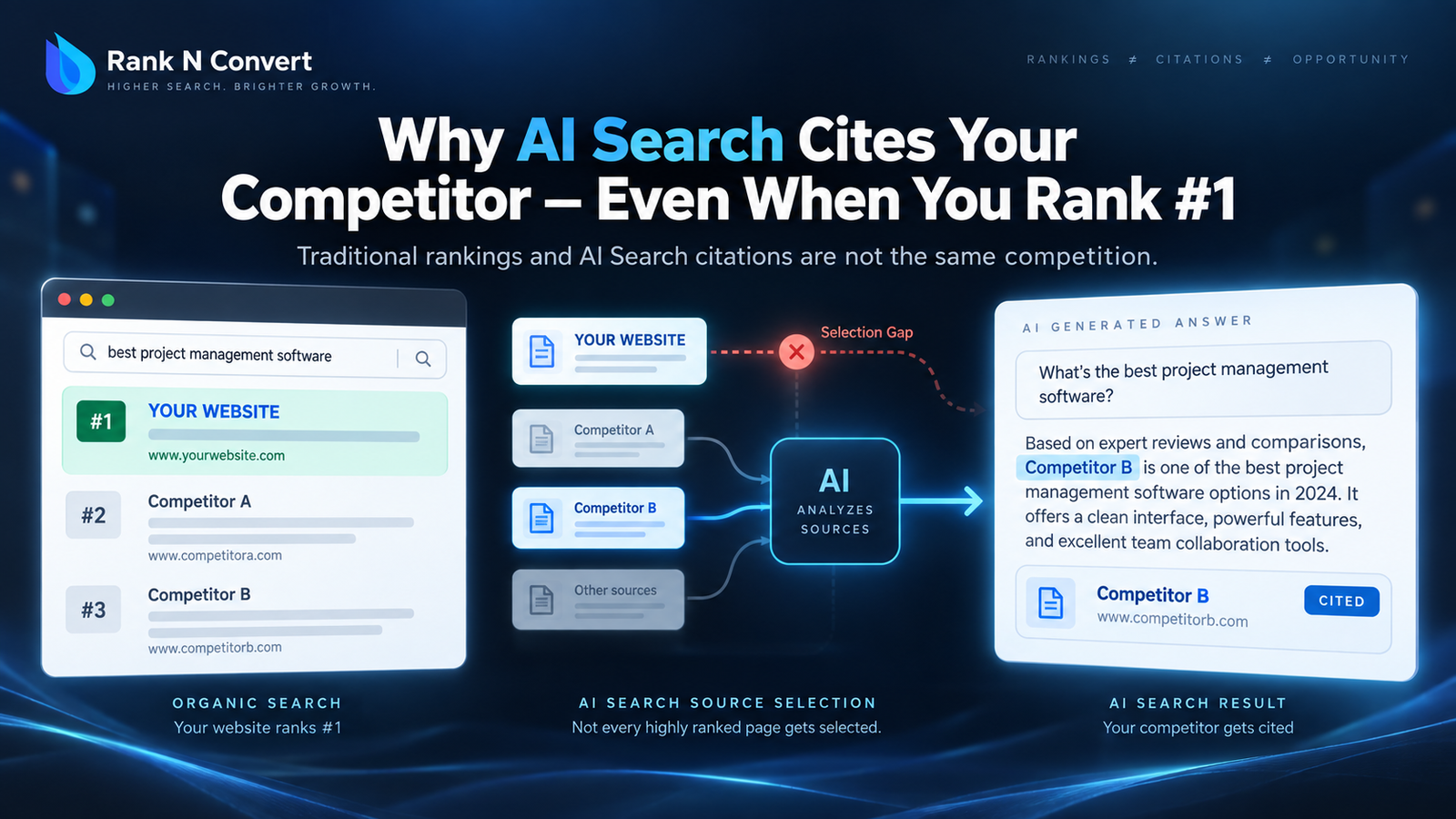
You can rank on page one and still disappear from the AI answer. In March 2026, Ahrefs found that only 37.9% of URLs cited in Google AI Overviews appeared within the first 10 SERP blocks. ChatGPT is even more selective: AirOps found that 85% of the 548,534 pages it retrieved across 15,000 prompts were never cited. That gap is the problem. AI search does not simply reward rankings; it retrieves, compares, and selects evidence-and your competitor may be winning there.
Quick Answer: Why Does AI Cite Your Competitor Instead of Your Website?
AI search can cite a competitor even when your page ranks higher, has more backlinks, or covers the topic in greater depth.
The reason is simple:
Ranking, retrieval, citation, and brand visibility are different outcomes.
A page may:
- rank well but never be retrieved for the information the AI needs;
- be retrieved but lose the citation to another source;
- be cited without the brand being named;
- appear as a source without materially shaping the answer.
This gap is larger than many SEO teams realize.
AirOps analyzed 548,534 pages retrieved by ChatGPT across 15,000 prompts and found that only about 15% of retrieved pages were ultimately cited.
That means roughly 85% of pages that made it into the retrieval pool still did not receive a citation.
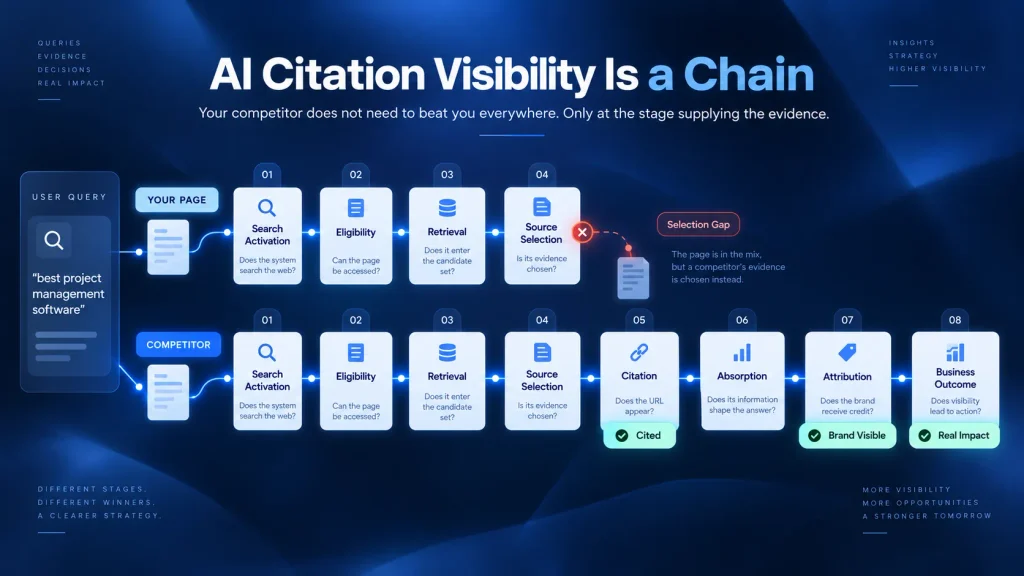
So, if you are trying to understand how to get cited by ChatGPT, improve AI citations, or increase AI search visibility, do not begin with:
“What AI SEO tactic should I add?”
Start with a more useful question:
“At which stage did my page lose?”
The Short Answer: Ranking, Retrieval, and Citation Are Different Decisions
A high Google ranking can improve discoverability. It does not guarantee that an AI system will use your page as evidence.
Think of the process as three separate decisions:
- Ranking: Where your page appears in a traditional search system.
- Retrieval: Whether your page enters the set of sources considered for a specific information need.
- Citation selection: Whether the system chooses your page to support a claim in the generated answer.
These stages influence one another, but they are not interchangeable.
Google makes this especially important through query fan-out. AI Overviews and AI Mode can run several related searches across subtopics before building an answer.
For example, someone may ask:
“What is the best CRM for a 20-person sales team?”
The AI may also need information about:
- pricing for 20 users;
- Salesforce integration;
- onboarding time;
- reporting features;
- cancellation terms;
- mobile access;
- customer support.
Your page might rank first for the broad CRM query.
A competitor may still become the cited source because its page answers one of those narrower information needs more precisely.
This is why:
You can win the visible keyword and still lose the citation.
The ranking-citation gap also appears in large AI Overview datasets.
Ahrefs analyzed 863,000 SERPs and 4 million AI Overview URLs in March 2026. Only 37.9% of cited URLs appeared within the first 10 search-result blocks for the same query.
The practical lesson is not that rankings no longer matter. It is that ranking alone does not explain AI citation selection.
Your Competitor Only Needs to Beat You at the Stage Supplying the Evidence
Your competitor does not need a better website overall.
They may only need a better answer to one specific question inside the larger query.
Imagine two software comparison pages are retrieved.
Your article contains:
- 3,000 words;
- dozens of headings;
- product descriptions;
- FAQs;
- screenshots;
- a broad feature overview.
The competitor states clearly:
“Plan X costs $49 per user per month when billed annually and includes 25 GB of storage.”
If the AI needs evidence for a sentence about price, that precise statement may be more useful than the rest of your longer article.
The important question becomes:
Which page gives the system the strongest evidence for the exact claim it is trying to support?
Controlled research strengthens this point.
The 2026 study What Gets Cited ran 252,000 pairwise trials across six language models. Researchers supplied two competing documents and changed individual variables.
The strongest factors for first-citation selection included:
- topical relevance;
- position within the supplied context.
Other factors such as these also helped under certain tested conditions:
- explicit pricing;
- recent timestamps;
- specific evidence relevant to the task.
By comparison, formatting-only changes showed much weaker and less consistent effects.
There is an important limitation. Both competing documents had already been placed inside the model’s context.
So the study helps explain:
Which already-retrieved source gets selected?
It does not prove:
Which page will be discovered or retrieved from the live web?
That difference matters because much of the advice around ChatGPT SEO, AI citation optimization, generative engine optimization, and AI search ranking factors mixes retrieval and citation selection together.
A better rule is:
Find the stage where your competitor beats you. Then fix that stage instead of optimizing everything.
What Should You Check First?
Before rewriting headings, adding FAQs, changing paragraph length, installing schema, or publishing more content, follow the citation path in order.
Can the AI system access and index your page?
Start with technical eligibility.
If the relevant search or retrieval system cannot access your content, improving the wording will not solve the problem.
For Google AI Overviews and AI Mode, Google says a page must be:
- indexed by Google;
- eligible to appear in normal Google Search;
- eligible to display a search snippet.
For ChatGPT Search, OpenAI advises publishers who want their pages included in search results, summaries, citations, and links to allow OAI-SearchBot.
Check:
- robots.txt;
- noindex directives;
- canonical tags;
- HTTP status codes;
- CDN or firewall restrictions;
- rendering problems;
- whether important information appears in accessible page text.
Decision rule:
If the page cannot be accessed or indexed, you have an eligibility problem. That needs to be fixed before content-level AI optimization matters.
Is your page retrieved for the information the answer actually needs?
Once technical access is confirmed, check whether your page is being considered for the right information need.
Do not look only at the main keyword.
AirOps found that 32.9% of ChatGPT-cited pages in its dataset appeared only in search results generated from fan-out queries rather than the original user query.
The same research reported that 95% of those fan-out searches showed zero traditional monthly search volume.
That creates an important blind spot in traditional keyword tracking.
You may rank well for:
“best project management software”
while a competitor is retrieved for:
- project management software for agencies;
- unlimited guest pricing;
- client approval workflows;
- time tracking limitations;
- enterprise data residency.
If the generated answer needs one of those details, the competitor may become the stronger citation candidate.
So ask two questions:
- Do we rank for the visible keyword?
- Do we answer the supporting information needs required to complete the query?
The second question matters much more for diagnosing an AI retrieval gap.
Does your page provide the strongest evidence for that specific claim?
Being retrieved still does not guarantee citation.
Now compare the exact evidence.
If the AI needs a price:
- Which source has the current first-party price?
- Is the billing period clear?
- Are conditions or limitations included?
If the AI needs a statistic:
- Which page cites the original study?
- Is the sample size stated?
- Is the date clear?
- Is the statistic represented accurately?
If the AI needs a comparison:
- Which page compares the exact criteria being discussed?
- Are the differences explicit?
- Are trade-offs shown?
If the AI needs a limitation:
- Which page states the restriction directly?
- Is it buried inside generic copy on your page?
This is where generic advice such as “write high-quality content” becomes too vague to help.
A more useful audit question is:
What exact claim is the AI trying to support, and which available source gives it the clearest, strongest evidence for that claim?
Compare:
- relevance to the exact claim;
- evidence quality;
- primary vs secondary sourcing;
- specificity;
- currentness when time matters;
- source type;
- unique information;
- limitations and conditions;
- whether the passage makes sense on its own.
Do not begin by comparing:
- word count;
- number of headings;
- number of FAQs;
- number of tables;
- schema quantity.
Those features may affect usability, but they do not tell you whether your evidence is the best fit for the claim.
Is your URL cited but your brand left out?
A citation does not automatically mean the brand received visibility.
Semrush analyzed 3,981 domain appearances across ChatGPT, Google AI Overviews, Gemini, and Google AI Mode and found 61.7% were “ghost citations.”
A ghost citation happens when:
- the URL appears as a source;
- information from the website may be used;
- but the brand itself is not named in the generated answer.
That creates a measurement problem.
A company may report:
“Our AI citations increased.”
But that does not necessarily mean users saw or remembered the brand.
Track these outcomes separately:
- URL citation: Did your webpage appear as a source?
- Brand mention: Was your company or product named?
- Recommendation: Did the system actively suggest your brand?
- Sentiment: Was the brand described positively, negatively, or neutrally?
For example:
An AI answer could:
- cite Nike while recommending Adidas;
- mention HubSpot while citing Gartner;
- cite Reddit to support a complaint about a company.
So citation ≠ mention ≠ recommendation.
Does the citation actually influence the generated answer?
There is one more layer. A page can appear in the source list without contributing much to the answer itself.
Researchers increasingly describe this distinction as:
- citation selection;
- citation absorption.
Citation selection means the system lists the page as a source.
Citation absorption asks whether information from that source actually influenced the:
- facts;
- wording;
- reasoning;
- structure;
- evidence used in the final response.
A 2026 study examined:
- 21,143 valid search-layer citations;
- 18,151 fetched pages;
- multiple systems including ChatGPT, Google/Gemini, and Perplexity.
The researchers found that citation breadth and source influence can differ. Some systems may cite a wider pool of sources, while others rely more heavily on fewer sources. That means appearing in the bibliography is not always the same as shaping the answer.
For practical AI visibility measurement, track at least four questions:
- Were we retrieved?
- Were we cited?
- Was our brand named?
- Did our evidence materially contribute to the answer?
Those four checks tell you much more than a screenshot showing that your website appeared once in ChatGPT. The next step is to turn those observations into a diagnosis: eligibility gap, retrieval gap, selection gap, attribution gap, or absorption gap.
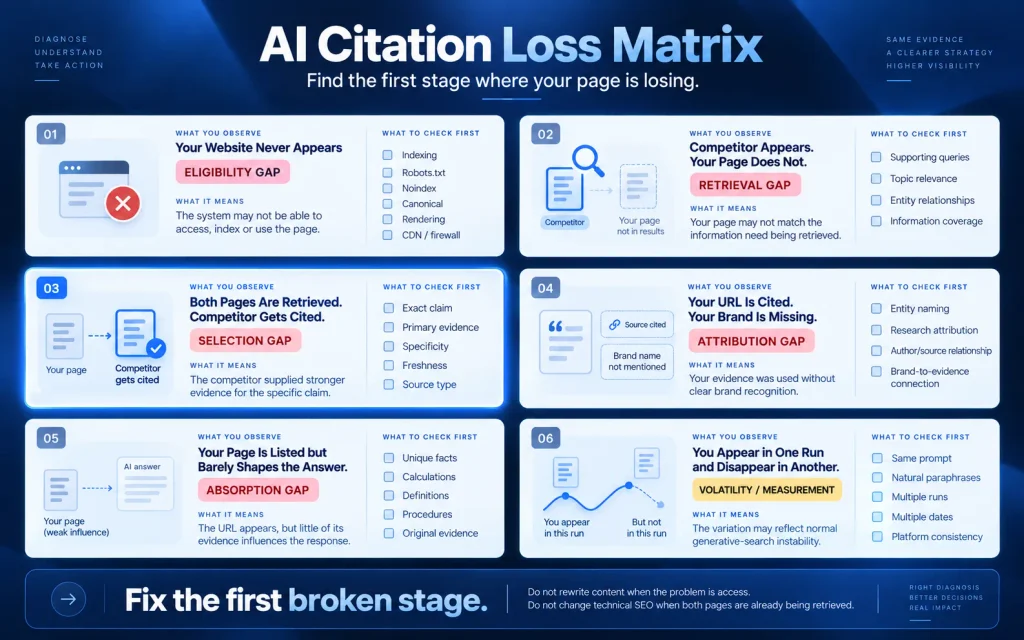
The AI Citation Loss Matrix: Find Exactly Where Your Page Is Losing
When a competitor appears in ChatGPT, Google AI Mode, or another AI answer and your page does not, do not treat every absence as the same problem. A page can fail before retrieval, during source selection, after citation, or simply because the answer changed on another run.
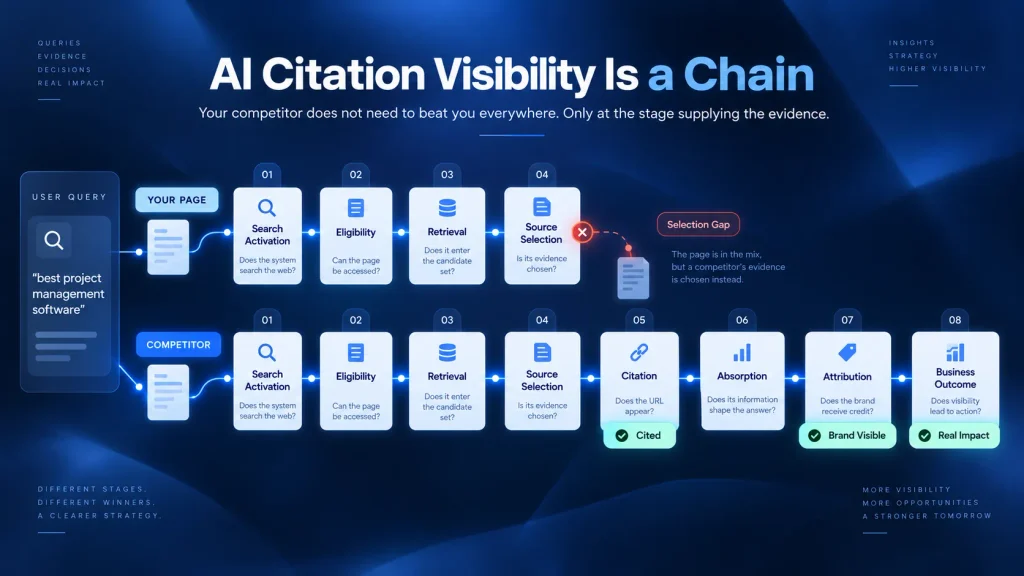
Use this matrix before touching the content:
| What you see | Most likely gap | Check first | Do not start with |
| Your site never appears | Eligibility / access | Indexing, crawler access, robots, server response | Rewriting headings |
| Competitor appears but your URL is never retrieved | Retrieval | Query fit, fan-out needs, relevant page | Adding schema |
| Both URLs are retrieved but competitor is cited | Selection | Exact evidence, relevance, source fit | Increasing word count |
| Your URL is cited but your company is not named | Attribution | Entity clarity and how the source supports the answer | Celebrating citation count alone |
| Your URL appears in sources but contributes little | Absorption | Evidence actually used in the response | Counting all citations equally |
| You appear in one test and disappear in another | Volatility | Repeated prompts, runs, platforms, time | Rewriting after one test |
The key is simple: >Fix the first stage that is broken.>Everything after that stage can wait.
Your Website Never Appears: Check Eligibility and Access First
If your website never appears at all, resist the urge to rewrite the article. First confirm that the relevant search system can actually crawl, index, and use the page. A brilliant answer that cannot be reached is still invisible.
Google indexing and snippet eligibility
For Google AI Overviews and AI Mode, the technical requirement is surprisingly ordinary.
Google says a page must be:
- indexed by Google;
- eligible to appear in Google Search;
- eligible to display a search snippet.
There are no separate technical requirements for appearing as a supporting link in AI Overviews or AI Mode. Google also says there is no special AI-specific schema or machine-readable file required.
Start with Google Search Console and check:
- Is the exact URL indexed?
- Did Google choose the canonical URL you expected?
- Can Googlebot crawl the page?
- Is the page allowed to appear with a snippet?
- Is important information available as readable text?
- Is the page internally linked strongly enough to be found?
- Does the URL return a successful HTTP response?
One detail matters here: eligibility is not a guarantee of selection. Google explicitly says meeting the technical requirements does not guarantee that a page will be crawled, indexed, or served.
So passing this check only tells you:
“Google can consider this page.”
It does not tell you:
“Google will cite this page.”
OAI-SearchBot access for ChatGPT Search
ChatGPT Search has its own access layer. OpenAI says public websites can appear in ChatGPT Search and advises publishers to allow OAI-SearchBot if they want site content to be discovered, included in summaries or snippets, and clearly cited and linked.
For an SEO or engineering team, that means checking more than whether the website works in Chrome.
Verify that:
- robots.txt does not block OAI-SearchBot;
- the relevant path is publicly accessible;
- the page does not require login or session authentication;
- the crawler receives the same useful content a normal visitor receives;
- bot-protection systems are not returning an error before the page loads.
Allowing OAI-SearchBot is an eligibility step, not a ChatGPT ranking tactic. It creates the possibility of discovery. It does not guarantee retrieval or citation.
Robots.txt, noindex, canonical and rendering problems
Several technical controls can create very different failures, so do not group them under “crawlability.”
robots.txtA robots rule can stop a crawler from accessing a path at all. Google specifically recommends ensuring crawling is allowed both in robots.txt and through hosting or CDN infrastructure.
noindexnoindex tells a search engine not to keep the page in its searchable index when the directive can be seen. For Google’s generative Search features, a page that is not indexed cannot qualify as a supporting link.
OpenAI also notes that noindex can be used when publishers do not want certain discovered URLs surfaced.
Canonical tagsA canonical tag does not simply “block AI.”
The more realistic problem is that your preferred page may not be the URL a search engine treats as canonical. If several near-duplicate URLs exist and the wrong version is canonicalized, the page you are monitoring may not become the search system’s preferred version.
Check the Google-selected canonical, not only the canonical tag written in your HTML.
RenderingA page may load beautifully for a user while the important evidence is difficult for a crawler to access.
Google specifically recommends making important content available in textual form.
Pay particular attention to:
- key facts injected only after complex JavaScript execution;
- data hidden behind interactions;
- information available only inside images;
- tables populated through failing API requests;
- content accessible only after login;
- client-side errors that leave crawlers with an incomplete page.
The diagnostic question is not:
“Does the page look fine to me?”
It is:
“What content did the crawler actually receive?”
CDN or firewall restrictions that block crawlers
This is easy to miss because the problem sits outside the CMS.
A CDN, Web Application Firewall, or bot-protection service can allow normal visitors while silently blocking automated crawlers. Google explicitly tells publishers to make sure crawling is permitted by CDN and hosting infrastructure, not just robots.txt.
OpenAI’s crawler troubleshooting guidance likewise warns that systems such as Cloudflare, Akamai, firewalls, bot mitigation, JavaScript challenges, and rate limits can return responses such as 403 Forbidden even when robots.txt allows the crawler.
Check server and edge logs for:
- 403 Forbidden;
- 429 Too Many Requests;
- CAPTCHA challenges;
- JavaScript bot challenges;
- geo restrictions;
- authentication redirects;
- crawler requests terminated by WAF rules.
Decision rule:
If the crawler cannot consistently access the page, stop there. Fix access before changing the copy.
Your Competitor Appears but Your Page Is Never Retrieved: You Have a Retrieval Gap
If the competitor enters the candidate pool and you do not, you are dealing with a retrieval problem, not yet a citation-selection problem. This usually means the system found another page that matched the information need more closely. The important phrase is information need, not just keyword.
Google confirms that AI Overviews and AI Mode can use query fan-out, issuing multiple related searches across subtopics and data sources before constructing an answer.
AirOps found a similar pattern while studying ChatGPT. In its March 2026 dataset of 548,534 retrieved pages across 15,000 prompts:
- 32.9% of cited pages appeared only for a fan-out query, rather than the original query;
- 95% of those fan-out queries showed zero traditional monthly search volume.
So imagine you rank well for:
“best payroll software for small businesses.”
The AI answer may also need:
- payroll software for 25 employees;
- UAE payroll compliance;
- contractor payments;
- payroll software with QuickBooks integration;
- end-of-service calculation support;
- monthly pricing.
If your competitor answers one of those supporting needs more directly, it may enter the retrieval pool while your broader article does not.
When you suspect a retrieval gap, check:
- Which exact claim or sub-question is the AI answering?
- Do you have a page that directly serves that information need?
- Does the page use the same entities, products, problems, conditions, and relationships involved in the query?
- Is the answer buried inside a broad article about a different primary topic?
- Does Bing Webmaster Tools expose a related grounding query for Microsoft AI experiences?
Microsoft’s AI Performance report is especially useful here because it exposes sampled grounding queries: the phrases used while retrieving pages that were ultimately cited. Microsoft explicitly notes that citation counts represent citation activity, not ranking, importance, or placement.
That distinction makes grounding queries far more useful for diagnosis than pretending there is a fixed “AI position.”
Fix first: improve the page's fit to the information need. Do not immediately add more words.
Both Pages Are Retrieved but Your Competitor Gets Cited: You Have a Selection Gap
This is where the comparison gets interesting.
If your page and the competitor’s page are both retrieved, technical eligibility is no longer the main explanation.
Now ask:
Why was their evidence selected instead of yours?
AirOps found that ChatGPT cited only 15% of the 548,534 pages it retrieved in its study. In that dataset, 85% made it through retrieval but still disappeared before the final citations.
Controlled research gives us a clearer view of what can happen next.
The 2026 What Gets Cited study ran 252,000 controlled trials across six language models. Two competing sources were placed into the model context, and one factor was changed at a time.
The strongest factors for receiving the first citation were:
- topical relevance;
- position in the supplied context.
Explicit price information and recent timestamps also helped consistently under the study conditions, while formatting-only changes had comparatively little effect.
The limitation matters: both documents were already retrieved and supplied to the model.
So this is evidence about selection, not proof that adding a price, date, table, or heading will make a live website get retrieved more often.
For a real competitor comparison, inspect the exact citation job.
If the generated sentence needs a price:
- Who gives the current price?
- Who states the billing basis?
- Who states the conditions?
If it needs research evidence:
- Who cites the primary study?
- Who reports the correct population and period?
- Who distinguishes the study finding from interpretation?
If it needs a comparison:
- Who compares the exact dimensions being discussed?
- Who states the important trade-off directly?
If it needs a limitation:
- Who states the restriction clearly?
- Who hides it three sections down?
A selection gap is often less about “better writing” and more about better evidence fit.
Fix first: improve the specific evidence unit the answer needs. Do not rewrite the entire page unless the entire page is the problem.
Your URL Is Cited but Your Brand Is Missing: You Have an Attribution Gap
A source citation and a brand mention are not the same thing.
Semrush’s 2026 study found that 61.7% of appearances in its dataset were “ghost citations”: the domain appeared as a cited source, but the brand name did not appear in the answer itself. Another 13.2% included both the citation and brand mention, while 25.1% were brand mentions without a citation.
That creates a reporting trap.
A dashboard may show:
+40% AI citations
while users still rarely see your company’s name.
Track these separately:
- Citation: Was your URL used as a source?
- Mention: Was your brand named?
- Recommendation: Was the brand actually proposed as an option?
- Sentiment: Was the brand discussed positively, negatively, or neutrally?
For example, an AI answer could cite your research while naming your competitor as the recommended product. That is a citation win. It is not automatically a brand win.
If you have an attribution gap, inspect whether the useful evidence is clearly connected to the entity that produced it.
Look for passages where:
- the brand or organization responsible for the data is never stated;
- a statistic appears without attribution;
- the author/source relationship is unclear;
- pronouns make the subject ambiguous;
- original research is presented without a clear methodology or publisher identity.
Fix first: make attribution factual and explicit where it helps readers understand who produced the evidence. Do not repeat the brand name unnaturally throughout the article.
Your Page Is Listed as a Source but Barely Shapes the Answer: You Have an Absorption Gap
Citation count still does not tell the whole story. A source may appear in the citation list while contributing very little to the generated response. Researchers describe this distinction as citation selection vs citation absorption.
A 2026 study analyzed:
- 602 prompts;
- 21,143 valid search-layer citations;
- 18,151 successfully fetched pages;
- 72 extracted features;
across ChatGPT, Google AI Overview/Gemini, and Perplexity.
The researchers found that citation breadth and citation depth can diverge.
In simple terms:
- One platform may list many sources but use each lightly.
- Another may cite fewer sources but rely heavily on the information inside them.
The same study found that high-influence pages tended to contain useful, extractable evidence such as:
- definitions;
- numerical facts;
- direct comparisons;
- procedures;
- clearly aligned supporting information.
That does not establish a universal content formula. It does show why counting citations alone can hide how much your content actually contributes.
When checking absorption, compare the generated answer with your page:
- Did the answer reproduce a fact unique to your source?
- Did it use your comparison logic?
- Did it follow your procedure?
- Did it rely on your original number or dataset?
- Did it merely list your URL beside several interchangeable sources?
A useful measurement model is therefore:
Retrieved → Cited → Absorbed → Attributed → Business Outcome
Each stage answers a different question.
Fix first: strengthen the evidence that only your page can supply, rather than chasing more source appearances.
You Appear in Some Runs but Disappear in Others: You May Be Measuring Volatility, Not Failure
One ChatGPT answer is not an AI ranking report.Generative search is probabilistic. The same prompt can produce different wording, different research paths, and different cited domains across runs.
A 2026 research paper on AI-search measurement argues that visibility should be treated as a distribution, not a fixed rank, because answers change across prompts, runs, and time.
A separate statistical analysis using repeated sampling across generative search platforms found substantial citation variability and warned that apparent differences between domains can fall inside the normal noise of the measurement process.
There is also a platform-mode problem.
In Semrush’s 2026 analysis of ChatGPT reasoning modes, only 25.6% of cited domains overlapped between minimal- and higher-reasoning responses to the same prompts.
So this sequence is weak evidence:
- Monday: competitor cited
- Tuesday: you rewrite the page
- Wednesday: your site appears
- Conclusion: rewrite worked
You do not know that.
Instead, test a cohort:
- run the same core query multiple times;
- include natural paraphrases;
- repeat the test over time;
- separate platforms;
- separate model or reasoning modes where observable;
- record citation, mention, recommendation, and URL separately.
Then look for patterns.
If your competitor appears in 18 of 20 comparable tests and you appear in 1, that deserves investigation.
If each domain appears in a handful of changing responses, the main story may be volatility rather than a structural content failure.
Decision rule:
Do not rebuild a page because it lost one AI answer. Diagnose recurring failure, not a single screenshot.
The point of the AI Citation Loss Matrix is not to give every missing citation a label. It is to stop you from applying the wrong fix.
- If the problem is access, fix access.
- If the problem is retrieval, improve information-need relevance.
- If the problem is selection, strengthen the exact evidence the answer needs.
- If the problem is attribution, separate citation from brand visibility.
- If the problem is absorption, make your contribution harder to substitute.
And if the result keeps changing from run to run, measure the pattern before changing the page.
You Can Rank #1 on Google and Still Lose the AI Citation
Ranking first on Google is still valuable. It means your page has already cleared a difficult test: for that search, location, device, time, and result set, Google’s systems considered it strong enough to place near the top.
But a #1 organic position does not give that URL first refusal on an AI citation.

Google says its generative Search features still rely on its core ranking and quality systems, so traditional SEO remains part of the foundation. At the same time, AI Overviews and AI Mode can run additional searches through query fan-out and surface supporting pages that a user may never have seen in the original results.
That creates a useful distinction:
| A high Google ranking tells you… | It does not tell you… |
| Your page performed strongly for the observed search | That it will be retrieved for every related sub-query |
| Google can crawl, index, and serve the page | That an AI answer will select it as evidence |
| The page is competitive in traditional Search | That your brand will be named |
| Your SEO foundation is working for that query | That the citation will become a recommendation or visit |
So when a team says, “We rank #1. Why is ChatGPT or Google AI Search citing someone else?”, the ranking itself is not the contradiction it first appears to be.
It simply means the two systems are making different decisions.
What Does a High Google Ranking Actually Prove?
A #1 ranking proves one observable thing:
For the search result you checked, Google’s traditional Search systems ranked that URL ahead of the other displayed organic results.
It does not reveal the exact combination of signals that caused the result, and it should not be translated into claims such as:
- “Google considers us the most authoritative website on the topic.”
- “We have the strongest E-E-A-T.”
- “Our page is the best source on the internet.”
- “AI systems should therefore cite us first.”
Those conclusions go beyond what a ranking can establish.
What a strong organic position does tell you is still useful:
- the URL is discoverable in Google;
- Google can index and serve it;
- the page has enough relevance and quality signals to compete for that query;
- your traditional SEO work is giving the page access to an important retrieval ecosystem.
That final point matters because Google’s own 2026 guidance says SEO best practices remain relevant to AI Overviews and AI Mode. Its generative features are built on Search’s core ranking and quality systems rather than on a completely separate “GEO index.”
Traditional SEO therefore remains the foundation. The mistake is assuming that the foundation also determines the final citation.
What Does a High Google Ranking Not Prove?
A traditional position tells you where your page appeared for one observable search. An AI-generated answer may need several pieces of evidence, may run related searches, may use a different source for each claim, and may mention a brand without citing its website at all.
That leaves four major gaps between “we rank #1” and “we won AI search.”
It does not guarantee retrieval for every supporting information need
Consider a page ranking #1 for:
“best accounting software for small businesses.”
An AI answer may need to establish:
- which tool supports UAE VAT;
- the price for five users;
- whether payroll costs extra;
- which platform integrates with Shopify;
- whether data can be exported;
- which product is easier for a first-time business owner.
Your page may be the strongest result for the broad query while another page is a stronger result for “accounting software UAE VAT support” or “Xero five-user pricing.”
Google officially confirms that AI Overviews and AI Mode can use query fan-out, issuing multiple searches across related subtopics and data sources while developing a response.
So a useful diagnostic rule is:
Do not ask only, “Where do we rank for the user’s query?” Ask, “Which supporting questions must the answer solve, and where do we appear for those?”
This is one reason ranking on Google but not ChatGPT or AI search is possible without anything being technically broken.
The page may simply be strong for the broad keyword and weak for the evidence need.
It does not guarantee citation selection
Retrieval gets a page into consideration. Citation selection decides whether it gets the credit. Those are separate gates.
Ahrefs’ April 2026 analysis of 1.4 million ChatGPT prompts found that ChatGPT cited only about half of all URLs appearing in the retrieval data studied. Ahrefs also cautioned that appearing in this retrieval layer does not necessarily mean every URL was opened and read in full.
That nuance is important.
The useful conclusion is not:
“50% of retrieved pages are rejected after being read.”
The dataset cannot prove that.
The safer conclusion is:
A URL can enter ChatGPT’s retrieval pipeline and still never appear among the final citations.
The same principle applies when thinking about Google AI citations.
You may rank highly enough to be discoverable, yet another source may better support the particular statement the generated answer needs.
If the answer needs:
- an exact price, a current pricing page may win;
- a regulation, a government source may win;
- customer sentiment, independent reviews may win;
- original research, the primary study may win;
- a product specification, the manufacturer may win.
A #1 ranking for the broad topic does not automatically make your page the strongest evidence for each of those claims.
It does not guarantee a brand mention
A source link can appear while the brand behind it remains invisible in the answer.
Semrush analyzed 3,981 domain appearances across ChatGPT, Google AI Overviews, Gemini, and Google AI Mode in 2026. It found that 61.7% were “ghost citations”: the domain was cited, but the brand name did not appear in the generated text.
That means SEO and content teams should stop treating these as the same KPI:
- Organic rank: Where did our URL rank?
- Citation: Was our URL used as a source?
- Brand mention: Was the company actually named?
- Recommendation: Was the brand proposed as an option?
A page can perform well on the first two and still fail on the third.
This matters especially for branded AI visibility.
If your research article supplies a statistic but the answer says:
“Research shows that…”
and links to your URL without saying who produced the research, you earned a citation but not full brand attribution.
It does not guarantee recommendation or traffic
Being used as evidence does not mean the AI prefers your product.
A system could cite:
- your pricing page while recommending a competitor;
- your study while naming another brand;
- your documentation while warning users about a limitation;
- your article as background evidence without sending a click.
Recent BrightEdge research also shows that source selection and brand selection can behave differently across AI engines. In its 2026 cross-engine analysis, overlap among heavily cited sources varied much more than overlap among the brands appearing in answers. In other words, AI systems can agree on which brands belong in an answer while relying on different websites as evidence.
Traffic is another separate outcome.
In a Pew Research Center analysis of 68,879 Google searches from U.S. adults in March 2025, users clicked a source directly inside an AI summary in only 1% of visits where an AI summary appeared. Traditional search-result clicks were also lower when an AI summary appeared: 8% versus 15% on pages without one. The study reflects a specific U.S. sample and time period, so it should not be treated as a universal 2026 click-through benchmark.
The important lesson survives the limitation:
Ranking, citation, brand visibility, recommendation, and traffic are separate outcomes. Measure them separately.
Why Organic Rankings and AI Citations Overlap but Do Not Match Perfectly
Traditional SEO still matters because AI systems need sources, and search rankings are one way relevant documents enter the source pool.
But generative answers have a different job from a classic ten-blue-links SERP.
A traditional SERP needs to answer:
“Which pages should we rank for this search?”
A generated response may instead need to solve several smaller evidence problems:
- Which source defines the concept?
- Which source has the latest number?
- Which source gives the price?
- Which source documents the exception?
- Which source provides independent judgment?
- Which source supports the next sentence?
That is why one AI response can cite several pages that would never occupy the same organic position.
The March 2026 Ahrefs study makes the disconnect easy to see.
Researchers examined 863,000 keyword SERPs and 4 million AI Overview URLs. When comparing standard blue-link rankings for the identical query:
- 37.1% of cited URLs ranked in Google’s organic top 10;
- 26.2% ranked between positions 11 and 100;
- 36.7% did not rank within the top 100 organic blue links for that same query.
That does not mean Google ignores its own rankings.
Google says its AI Search experiences use the same underlying Search foundations, and Ahrefs itself suggests fan-out searches are one plausible reason pages outside the original SERP can appear.
A cleaner interpretation is:
Organic ranking improves your chances of entering Google's search ecosystem, but the visible rank for the original query does not fully describe the retrieval paths used to construct an AI answer.
That is far more useful than saying either:
“Google rankings don’t matter anymore.”
or:
“You must rank in the top 10 to get cited.”
The evidence supports neither extreme.
Why There Is No Timeless “X% of AI Citations Come From Page One” Rule
This is where AI citation statistics are often misused.
In July 2025, Ahrefs reported that 76.1% of the AI Overview citations it studied ranked in Google’s top 10.
In March 2026, Ahrefs updated the study using a larger dataset and improved citation parsing. The top-10 figure fell to roughly 38%.
At first glance, those numbers look contradictory. They are not directly comparable.
The earlier study examined 1.9 million citations from 1 million AI Overviews and focused on the three most visible citations. The later analysis covered 863,000 SERPs and 4 million AI Overview URLs, used improved parsing, and Google had also changed the models powering AI Overviews.
A separate BrightEdge study demonstrates another problem with universal percentages.
Across nine industries from May 2024 to September 2025, BrightEdge reported 54.5% overall overlap between AI Overview citations and organically ranking pages. Yet the result varied sharply by sector:
- Healthcare: 75.3%
- Education: 72.6%
- B2B technology: 71.0%
- Finance: 32.2%
- E-commerce: 22.9%
- Restaurants: 19.2%
Its methodology and definition of “organic overlap” also differed from Ahrefs’.
So when you encounter a headline such as:
“76% of AI citations come from page one.”
or:
“Only 38% of AI citations rank in the top 10.”
do not turn that percentage into an optimization rule.
Ask:
- When was the data collected?
- Which AI product was tested?
- Which model/version was active?
- Did the study count all citations or only prominent ones?
- Did “top 10” mean blue links or SERP blocks?
- Was the comparison against the original query or fan-out searches?
- Which industries and query types were included?
- Did the provider change its parsing methodology?
The percentage will change.
The more durable finding is this:
Strong organic rankings and AI citations are connected, but they are not interchangeable. Ranking gives a page a stronger foundation for discovery; it does not guarantee that the same URL will be the evidence selected for every AI-generated answer.
That is the useful way to approach AI citation optimization. Do not abandon traditional SEO because an AI cited a lower-ranking page. And do not assume a #1 ranking means there is nothing left to diagnose.
Rank for the topic. Then investigate whether your page also supplies the evidence the AI answer actually needs.
The Search You See Is Not Necessarily the Search the AI Uses
A user types one question. The AI system may need answers to several smaller questions before it can respond. That difference changes how you diagnose AI search visibility.
A page may rank well for the exact phrase the user entered and still miss the citation because another source is retrieved for a supporting need such as price, compatibility, eligibility, implementation time, or a product limitation.
Google officially calls one version of this process query fan-out. AI Overviews and AI Mode can generate concurrent related searches across subtopics and data sources, retrieve additional pages, and use those sources to build a broader response.
So the practical SEO question is no longer only:
“Do we rank for the keyword?”
It is also:
“Do we have useful evidence for the questions that sit underneath that keyword?”
Query Fan-Out: How One User Prompt Can Create Multiple Supporting Searches
Query fan-out means an AI search system expands a user’s question into related searches that help it collect the information needed for the final answer.
Google gives a straightforward example. A search such as “how to fix a lawn that’s full of weeds” might lead to related searches about herbicides, removing weeds without chemicals, and preventing weeds from returning.
The important point is not the number of searches generated. There is no universal rule saying every prompt creates three, five, or ten fan-out queries.
The important point is that:
The retrieval problem can be larger than the visible query.
A July 2026 critical review of 45 GEO studies describes generative visibility as a multi-stage process involving search activation, retrieval, context allocation, citation, and later outcomes rather than one simple ranking event. The review also warns that techniques shown to affect already-retrieved content should not automatically be treated as techniques that improve open-web discovery.
That distinction matters for ChatGPT SEO, AI search optimization, and generative engine optimization.
If you only study the keyword visible in the search box, you may be studying just one part of the retrieval journey.
AirOps saw this effect in its March 2026 observational study of ChatGPT. It analyzed 15,000 original prompts, 43,233 original-plus-fan-out queries, and 548,534 retrieved pages. Among cited pages that appeared in the studied search results, 32.9% appeared only through a fan-out query rather than the original starting query. AirOps also reported that 95% of those fan-out queries showed zero monthly volume in conventional keyword tools.
Treat those percentages as findings from that dataset, not universal ChatGPT rules.
But they expose a real SEO blind spot:
valuable retrieval paths may exist even when a keyword tool reports no meaningful search volume for the exact phrase. You Can Win the Visible Keyword and Lose the Hidden Information Need
Suppose you rank first for:
“best CRM for a 20-person sales team.”
That looks like a single commercial query. But producing a genuinely useful answer may require several separate facts.
A useful way to map the query is:
| Information need | What the answer may need | Likely useful source |
| Overall CRM choice | Evaluation criteria and trade-offs | Independent comparison |
| Price for 20 users | Current plan price × required seats | Official pricing page |
| Onboarding | Setup requirements and implementation time | Official documentation or credible implementation evidence |
| Integrations | Specific supported tools and limitations | Official integration documentation |
| Reporting | Exact reporting capabilities | Product documentation |
| Contract terms | Billing commitment, cancellation, limits | Official terms/pricing documentation |
Your “best CRM” article may rank #1 because it answers the broad comparison well.
But that does not automatically make it the strongest source for every row in this table.
The AI may use one source to establish pricing, another for integrations, another for customer sentiment, and another for the final comparison.
That leads to one of the most useful rules in this article:
You can win the visible keyword and lose the information need that supplies the citation.
Broad query: “best CRM for a 20-person sales team”
The broad query asks for a recommendation.
To answer it responsibly, the system may first need to establish criteria such as:
- total cost for 20 seats;
- required integrations;
- time to deploy;
- reporting needs;
- support requirements;
- contract flexibility.
Your page therefore needs more than a paragraph declaring which CRM is “best.” It needs enough evidence for the decision.
Supporting need: price for 20 users
A vague line such as:
“CRM X has affordable plans for growing teams.”
is weak evidence.
A stronger source would establish:
- price per seat;
- billing period;
- minimum seat requirement;
- features locked behind a higher tier;
- applicable date;
- any usage limits relevant to the comparison.
The information need is not “CRM pricing.”
It is closer to:
“What would this CRM actually cost this particular 20-person team under the relevant plan?”
That level of specificity is what keyword-only analysis often misses.
Supporting need: onboarding time
If the answer discusses fast deployment, the supporting evidence needs to justify that statement.
Useful information might include:
- whether implementation is self-service;
- whether data migration is required;
- administrator setup steps;
- mandatory training;
- enterprise implementation requirements.
Do not invent an onboarding timeframe simply because a competitor article gives one. If the vendor does not publish a timeframe and no credible implementation research supports one, say that the timeframe is not verified.
Supporting need: integrations
“Integrates with popular tools” is not enough if the user specifically depends on Salesforce, Slack, QuickBooks, Shopify, or another named platform.
The retrieval need may be entity-specific:
CRM X + Salesforce integration
rather than:
best CRM.
For content teams, this is a reminder that semantic coverage should reflect real user dependencies, not a list of loosely related keywords.
Supporting need: reporting features
A buyer asking for a CRM recommendation may also need to know:
- whether custom reports are available;
- which plans include them;
- whether dashboards can be shared;
- whether data can be exported;
- whether attribution or forecasting is supported.
A competitor with a precise comparison of those features can become more useful for that part of the answer even if your broad CRM guide ranks higher.
Supporting need: contract limitations
This is exactly the kind of information many “best software” articles skip. Yet it may change the recommendation.
Examples include:
- annual commitment requirements;
- cancellation conditions;
- minimum seats;
- feature caps;
- contact limits;
- add-on costs;
- regional restrictions.
The broader lesson is simple:
A supporting query often exists because the answer needs a decision-changing fact.
Those facts deserve more attention than adding another generic paragraph to make the article “more comprehensive.”
Grounding Queries: The Search Phrases AI Used Before Citing a Page
Microsoft now gives publishers a rare look into this process.
In February 2026, Bing Webmaster Tools introduced AI Performance, covering citations across Microsoft Copilot, AI-generated Bing summaries, and select partner integrations.
One of its reports is Grounding queries.
Microsoft defines these as the key phrases its AI systems used when retrieving content that was later referenced in an AI-generated answer. Microsoft also makes two important limitations clear:
- the displayed grounding queries are a sample of overall citation activity;
- citation counts do not represent ranking, authority, importance, or placement within an answer.
That makes grounding-query data valuable for diagnosis.
Suppose your page about project-management software is repeatedly cited for grounding queries such as:
- “project management software guest access”;
- “project management software approval workflow”;
- “project management software client portal.”
You have learned something more useful than “this article gets AI citations.” You have learned which information jobs the retrieval system associates with the page.
For SEO teams using Bing Webmaster Tools, review:
- Which URLs are cited?
- Which grounding queries are associated with them?
- Which topics appear repeatedly?
- Which commercially important information needs are absent?
- Do you already have a relevant page for those missing needs?
Do not read a grounding query as a new keyword you must immediately create a page for. Read it as evidence about the retrieval path.
What Query Fan-Out Changes About SEO Keyword Research
Query fan-out does not make traditional keyword research useless. It changes what keyword research is for. Search volume, ranking difficulty, current SERPs, and primary keywords still help you understand demand and competition.
But they are not a complete map of the information needed to answer a complex query.
For a page targeting “best CRM for a 20-person sales team,” a better content-research workflow looks like this:
1. Start with the primary user task
What decision is the person actually trying to make?
Here:
Choose a CRM suitable for a 20-person sales team.
2. Map decision-changing information needs
Ask what facts could change the choice:
- total cost;
- seat limits;
- onboarding;
- required integrations;
- reporting;
- contract terms;
- support;
- data migration.
3. Separate facts from judgments
For example:
- Price: factual.
- Salesforce integration: factual.
- “Easiest CRM”: evaluative.
- “Best for a 20-person team”: comparative judgment.
Different claims may require different evidence.
4. Identify the strongest source for each need
Use official sources for:
- prices;
- specifications;
- integrations;
- policies;
- contract terms.
Use independent evidence where appropriate for:
- usability;
- customer sentiment;
- comparisons;
- real-world limitations.
5. Check whether one page can solve the information job naturally
Do not force every supporting need onto one page.
Include a subtopic when it helps the same reader make the same decision.
Create a separate resource when the subtopic has:
- a substantially different intent;
- enough depth to require its own treatment;
- a different audience;
- a different decision or task.
This is a better way to interpret AI query fan-out than trying to “optimize for every hidden query.”
Why You Should Not Create a Separate Page for Every Possible Fan-Out Query
This is where a useful AI SEO insight can turn into bad publishing strategy.
If an AI system might search:
- “CRM pricing for 20 users”;
- “CRM onboarding time”;
- “CRM Salesforce integration”;
- “CRM reporting features”;
- “CRM cancellation terms”;
the answer is not automatically five new SEO pages.
Google’s 2026 generative-search guidance explicitly warns against creating separate content for every possible query variation or fan-out query primarily to manipulate Search or generative AI visibility. Google says that approach can violate its scaled content abuse policy and is not a useful long-term strategy.
Google also notes that its systems can understand page relevance without requiring an exact-match page for every query variation.
Use this decision rule instead:
| Situation | Better action |
| Supporting question helps the same reader make the same decision | Add it naturally to the existing page |
| Existing section is vague but important | Strengthen the section with better evidence |
| Supporting topic has a different search intent | Consider a separate page |
| Topic requires substantial technical depth | Create a focused resource and link it logically |
| Variation only changes wording | Do not create another page |
| Keyword tool shows zero volume but the need affects the decision | Cover it if useful; do not reject it solely because volume is zero |
| Fan-out phrase exists only as an observed retrieval query | Treat it as research evidence, not an automatic content brief |
The goal is not to predict every invisible search an AI system might make. That is neither realistic nor necessary. The better approach is to understand the information architecture behind the user’s decision.
For every important query, ask:
What would a reliable answer need to know before it could answer this well?
Then make sure your content provides those answers-or points clearly to the right supporting resource.
That is the real SEO lesson from query fan-out:
Stop treating the keyword as the entire question. Treat it as the entrance to an information problem.
Were You Even Retrieved? Solve Discovery Before Rewriting Your Content
Before changing a headline, adding statistics, or rewriting half the article, answer one question:
Did the system ever have a realistic chance to use your page?
If the answer is no, content optimization is solving the wrong problem.
A useful retrieval audit separates three different states:
| What you observe | What it suggests | What to investigate first |
| URL cannot be crawled or indexed | Eligibility problem | robots, noindex, server response, rendering |
| URL is eligible but never surfaces for relevant needs | Retrieval problem | topic fit, supporting queries, internal discovery |
| URL is retrieved but competitor receives citation | Selection problem | evidence, relevance, source type, specificity |
The order matters.
Access → discovery → retrieval → selection.
Do not jump to the last step before confirming the first three.
Google AI Search: A Page Must First Be Eligible for Search
For Google AI Overviews and AI Mode, there is no separate “AI index” you need to unlock.
Google says its generative Search features use its core Search ranking and quality systems. To qualify as a supporting link, a page must be:
- indexed by Google;
- eligible to appear in Google Search;
- eligible to appear with a search snippet.
Google explicitly states that there are no additional technical requirements for AI Overviews or AI Mode. That gives SEO teams a much cleaner starting point than most GEO checklists.
Check the exact URL in Google Search Console and ask:
- Is the URL indexed?
- Which canonical URL did Google select?
- Can Googlebot fetch the page successfully?
- Is the page blocked by robots.txt?
- Does it contain a noindex directive?
- Can Google show a snippet from the page?
- Is the important information present as crawlable text?
- Can Google find the page through internal links?
- Is a CDN, firewall, or hosting rule interfering with Googlebot?
Google also says site owners do not need a special AI file, new machine-readable format, or AI-specific schema to appear in these experiences. Existing Search fundamentals still apply.
That makes the first decision rule straightforward:
If Google cannot index and serve the page normally, do not diagnose an AI citation problem yet. You have a Search eligibility problem.
There is also an important limit.
Passing every technical check does not mean Google will retrieve or cite the page. Google explicitly notes that meeting its requirements does not guarantee crawling, indexing, or serving.
So “indexed” means:→ eligible for consideration.
It does not mean:→ selected as evidence.
ChatGPT Search: OAI-SearchBot Access Is an Eligibility Requirement, Not a Citation Guarantee
ChatGPT Search has its own crawler controls.
OpenAI says any public website can potentially appear in ChatGPT Search. For site content to be discoverable and included in ChatGPT summaries, snippets, citations, and links, publishers should make sure they are not blocking OAI-SearchBot.
That makes robots.txt worth checking directly.
A simplified example might look like:
User-agent: OAI-SearchBot
Allow: /But do not stop there.
A crawler can be allowed in robots.txt and still fail to reach the content.
Check whether:
- OAI-SearchBot receives a successful response;
- the page is publicly accessible without login;
- your CDN allows the crawler;
- your WAF is not challenging or blocking automated traffic;
- the page does not redirect the bot somewhere irrelevant;
- rate limits are not repeatedly returning errors;
- the useful content is actually present in the response.
OpenAI also makes an important distinction around noindex.
If OpenAI discovers a URL from another source but the page itself is disallowed to OAI-SearchBot, ChatGPT may still be able to surface limited URL information in some contexts. OpenAI notes that a noindex directive can be used to prevent this, but the crawler must first be allowed to access the page to see that directive.
For an SEO team, the bigger lesson is simpler:
OAI-SearchBot access controls eligibility. It does not create citation preference.
Allowing the crawler does not mean ChatGPT will:
- retrieve your page for every relevant question;
- rank it above a competitor;
- cite it;
- mention your brand;
- recommend your product.
Think of crawler access as opening the door. You still need a reason for the system to walk through it.
A practical ChatGPT discovery audit should therefore separate:
Technical access
- Is OAI-SearchBot allowed?
- Does the server return the page?
- Is the content public?
- Are security layers blocking the bot?
from:
Retrieval relevance
- Does this page answer the information need?
- Is the topic clearly identifiable?
- Is there a more precise page on the site?
- Is a competitor a stronger fit for the supporting query?
Do not confuse the two.
Bing and Copilot: Use Citation and Grounding-Query Data Where Available
Microsoft currently gives site owners something unusually useful: first-party data about AI citations and the searches behind them. Bing Webmaster Tools introduced its AI Performance report in February 2026 for visibility across Microsoft Copilot, Bing AI-generated answers, and select partner integrations.
The report includes:
- total citations;
- cited pages;
- citation trends;
- grounding queries;
- page-level citation activity.
The grounding-query data is particularly useful.
Microsoft defines grounding queries as the phrases its AI systems used while retrieving content that was later referenced in an AI answer.
That lets you move beyond:
“This URL gets cited.”toward:
“This URL gets retrieved and cited for these types of information needs.”Suppose a B2B software page is cited for grounding queries around:
- “CRM client portal”;
- “CRM Salesforce integration”;
- “CRM sales forecasting.”
That tells you far more about the page’s retrieval role than its primary keyword alone.
Microsoft expanded the report again in June 2026 with four additional preview features:
- Intents
- Topics
- Citation Share
- Compare
These additions make the data more useful for diagnosis.
- Intents groups grounding queries into broader purposes such as informational, commercial, navigational, local, research, learn-and-solve, and creation.
- Topics clusters related grounding queries into broader themes rather than forcing you to analyze every phrase separately.
- Citation Share shows your site’s share of citations for a grounding query across the citation set.
- Compare lets you compare citation activity across time periods.
Microsoft is careful about what these metrics mean.
Citation Share is an observational visibility metric, not a ranking score, quality score, traffic-share metric, or competitor leaderboard. Microsoft also notes that AI citation patterns can shift as models, freshness, demand, and the wider web change.
That is exactly how SEO teams should use it.
Do not interpret:
Citation Share: 18%
as:
“We rank #2 in Copilot.”
Instead, treat it as evidence that:
“Our content is receiving a measurable share of citations around this grounding context.”
A useful Bing/Copilot workflow is:
- Open AI Performance.
- Find the pages receiving citations.
- Review their grounding queries.
- Group those queries by intent and topic.
- Look for commercially important topics where your site has little or no citation activity.
- Check whether a suitable page already exists before creating something new.
- Compare citation trends over time after meaningful content or technical changes.
This is much more useful than manually asking Copilot the same question once and taking a screenshot.
Crawlability Explains Exclusion, Not Why One Eligible Competitor Beats Another
This is the line technical SEO teams need to keep clear:
Crawlability can explain why you never entered the race. It usually cannot explain why you entered the race and still lost.
Consider two pages:
Page A
- indexed;
- crawlable;
- accessible;
- relevant.
Page B
- indexed;
- crawlable;
- accessible;
- relevant.
The AI retrieves both. Page B receives the citation. At that point, changing robots.txt on Page A is not the answer. The problem has moved downstream.
AirOps’ March 2026 analysis illustrates how large that downstream drop can be. Across 548,534 pages retrieved by ChatGPT, only around 15% appeared in the final citations. That is vendor research rather than a universal platform rule, but it demonstrates the scale of the distinction: entering retrieval does not mean surviving source selection.
So use this diagnostic sequence:
1. Can the crawler reach the page?
If no → fix access.
2. Can the search system index or otherwise discover it?
If no → fix eligibility/discovery.
3. Does the page appear for the relevant information need?
If no → investigate retrieval relevance.
4. Is the page retrieved but not cited?
If yes → investigate source selection.
5. Is it cited but the brand is invisible?
Then you have moved into attribution, not crawling.
This prevents one of the most common wastes of time in AI SEO: repeatedly changing page copy when the crawler is blocked, or repeatedly changing technical settings when the page is already being retrieved.
A simple rule can save hours:
| Failure | First place to look |
| Page inaccessible | Technical SEO |
| Page not indexed/discoverable | Indexing and site architecture |
| Page indexed but not retrieved | Information-need relevance |
| Page retrieved but not cited | Evidence and source selection |
| Page cited but brand absent | Attribution |
| Page cited inconsistently | Measurement and volatility |
The first two rows are primarily discovery problems.
The later rows are competitive selection problems.
That distinction tells you when technical SEO stops being the bottleneck.
Once you have confirmed that your page is accessible, indexed, and entering the relevant retrieval environment, stop asking whether the AI can find you.
The more useful question becomes:
Why did it find both pages and choose the competitor's evidence instead?
If Both Pages Were Retrieved, Why Did Your Competitor Win the Citation?
Once your page and your competitor’s page have both been retrieved, the problem changes.
You are no longer asking:
“Can the AI find my page?”
You are asking:
“Why was their page more useful for this answer?”
That distinction matters because retrieval is only the entry ticket. AirOps found that 85% of the 548,534 pages ChatGPT retrieved in its March 2026 dataset never appeared in the final citations. A page can be relevant enough to enter the candidate set and still lose when the system chooses which sources will support the response.
The strongest controlled evidence we currently have points away from many popular “AI formatting hacks.” A 2026 study ran 252,000 paired trials across six LLMs, placing two competing documents into the same context and changing one factor at a time. Topical relevance and context position were the strongest predictors of which document received the first citation. Explicit prices and recent timestamps also helped under the study conditions, while formatting-only changes had comparatively little effect.
That gives us a much better way to compare a cited competitor with an ignored page.
| Ask this | Not this |
| Which page answers the exact claim? | Which article is longer? |
| Which source has the right evidence? | Which page has more H2s? |
| Is the information current when it needs to be? | Which page was updated most recently? |
| Is the source appropriate for this claim? | Which domain has the prettier design? |
| Can the evidence be understood clearly? | How many FAQ blocks are on the page? |
Exact Topical Relevance Can Matter More Than Superficial Formatting
Once two pages are being considered for the same answer, relevance to the exact information need becomes critical.
That does not simply mean using the same keyword.
Suppose the user asks:
“Which CRM is better for a 20-person sales team?”
Your article may cover:
- CRM features;
- benefits;
- sales automation;
- dashboards;
- mobile apps;
- integrations;
- customer support.
But the generated answer may currently be trying to establish one narrower point:
Which CRM supports Salesforce integration on the plan suitable for 20 users?
A competitor page that answers that exact question can be more useful than your more comprehensive guide.
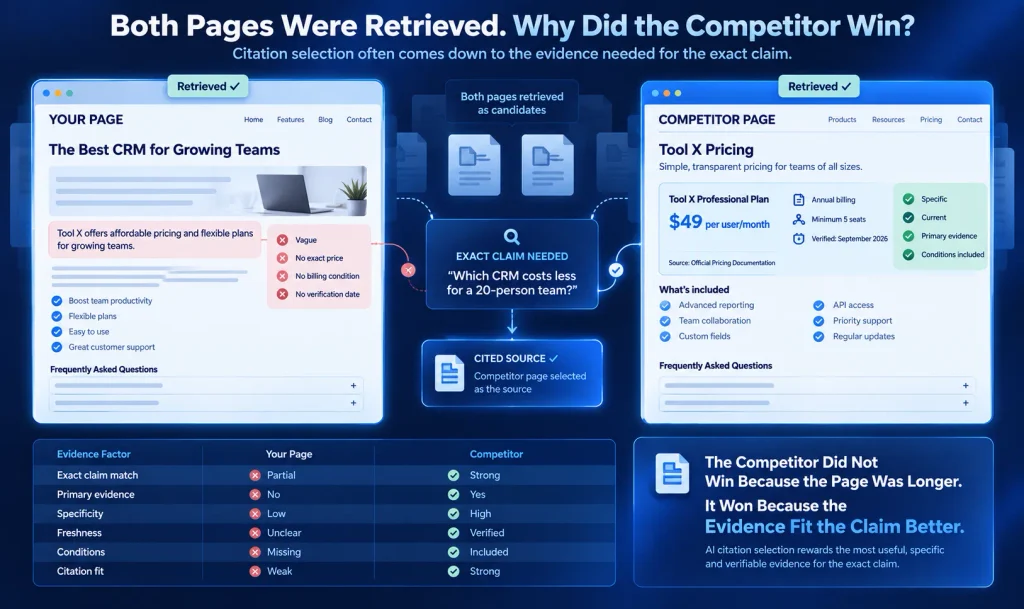
This is consistent with the controlled citation study: when two documents were already supplied to the model, topical relevance was one of the strongest citation-selection factors.
The practical lesson for AI citation optimization is simple:
Do not compare pages only at the topic level. Compare them at the claim level.
When investigating why a competitor received the citation, identify:
- the exact sentence in the AI answer;
- the fact that sentence needed;
- the source cited beside it;
- whether your page answers the same fact directly;
- whether your evidence is as specific and verifiable.
That will usually tell you more than comparing keyword density or article length.
The Winning Page May Answer the Exact Claim the AI Needs
Generative answers are built from claims.
A single response might need evidence for:
- a definition;
- a price;
- a date;
- a product feature;
- a limitation;
- a comparison;
- a process;
- a statistic.
One page does not have to be “the best article” on the whole subject to become useful.
It may simply be the best source for one sentence.
For example:
Your page says:
“Platform X is a flexible option for growing businesses.”
The competitor says:
“Platform X’s Professional plan supports up to 25 users and includes Salesforce integration.”
If the AI answer needs evidence about user capacity and Salesforce compatibility, the competitor has supplied a much cleaner evidence unit.
This is why generic language such as:
- powerful;
- flexible;
- easy to use;
- affordable;
- feature-rich;
- ideal for businesses
often contributes very little unless the page also explains what those words actually mean.
Replace broad claims with the underlying fact whenever the evidence is available.
A Specific Piece of Evidence Can Beat a More Comprehensive but Generic Page
More content does not automatically create more citation value.
Google’s current guidance says there is no ideal page length and no need to split content into artificial chunks for generative AI. Google instead recommends useful, original, non-commodity content that adds something beyond what could easily be reproduced elsewhere.
This creates a useful contrast.
Page A: 4,000 words
Covers everything at a high level but mostly summarizes existing information.
Page B: 1,300 words
Contains:
- the current price;
- a clearly defined comparison;
- an original calculation;
- a documented limitation;
- a primary source;
- one useful piece of evidence that other pages do not provide.
For the claim that requires that evidence, Page B may be far more useful.
AirOps’ separate analysis of 16,851 queries and 353,799 pages also found that focused pages sometimes outperformed pages attempting to cover every fan-out need. That is observational vendor research rather than a universal rule, but it reinforces the broader point: comprehensiveness and citation usefulness are not the same thing.
So do not ask:
“How can we make this article longer?”
Ask:
“What evidence does this page contribute that the answer cannot get just as easily elsewhere?”
Current Pricing Helps When the Answer Needs a Current Price
Price is a good example of why citation selection is conditional.
The 252,000-trial controlled study found that including explicit price information consistently improved first-citation selection under its experimental setup.
That does not mean every article should contain prices.
It means price becomes useful when price is part of the information job.
If someone asks:
“Which project-management tool is cheaper for a team of 15?”
a page saying:
“Tool A offers competitive pricing.”
does not answer the question.
A useful source needs details such as:
- price per user;
- monthly vs annual billing;
- required plan;
- minimum seats;
- relevant add-ons;
- date checked.
And if the price is volatile, the page should make its verification date clear.
The rule is not:
“Add pricing because AI likes numbers.”
It is:
If the answer depends on price, give the system accurate, current pricing evidence.
Freshness Helps When Newer Information Changes the Correct Answer
Freshness works the same way.
The controlled citation study found recent timestamps helped under its experimental conditions, but that should not be turned into:
“Update every article every month.”
Google has long used freshness systems when a query deserves freshness. Its ranking documentation gives examples where recent information materially changes what users need, while stable subjects do not automatically benefit from newer dates.
Freshness is highly relevant for:
- prices;
- software versions;
- regulations;
- product availability;
- statistics;
- schedules;
- current recommendations;
- breaking news.
It matters far less for:
“What is canonicalization?”
or:
“What does HTTP 301 mean?”
if the underlying answer has not changed.
Use this decision test:
Would newer information materially change the correct answer?
If yes, freshness matters.
If no, changing the publication date without adding new information creates little value and may reduce trust.
Formatting Can Improve Extraction, but It Cannot Make Irrelevant Evidence Relevant
Headings, lists, tables, and concise paragraphs are useful. But they should be treated as information-design tools, not automatic AI citation factors.
Google explicitly says publishers do not need to break content into tiny “AI-friendly” chunks. It also says there is no ideal page length and that its systems can understand nuance and related topics without exact wording for every search variation.
The controlled 252,000-trial study reaches a compatible conclusion from a different direction: formatting-only changes had relatively little impact compared with topical relevance and context position.
That does not mean formatting is useless.
Use a:
- table when readers need to compare dimensions;
- list when information is naturally a set of steps or criteria;
- short answer block when the question has a direct answer;
- heading when it helps readers locate a distinct information need.
But do not expect a perfectly formatted paragraph to rescue a page that answers the wrong question.
A clean table about “CRM benefits” still loses if the answer needs CRM pricing for 20 users.
Formatting can make relevant evidence easier to use. It cannot turn weak evidence into strong evidence or irrelevant information into relevant information.
What Controlled Citation Research Can Prove – and What It Cannot Prove
This limitation is important because many ChatGPT SEO and GEO articles turn laboratory findings into live-web ranking rules.
The What Gets Cited experiment is valuable precisely because its setup was controlled:
- two competing documents;
- one changed factor at a time;
- six LLMs;
- 252,000 trials;
- brand anonymization;
- counterbalanced document order.
That lets researchers say something meaningful about:
Which of two already-supplied sources is more likely to receive the first citation under those conditions?
It cannot directly prove:
Which page will be crawled, indexed, retrieved from the open web, cited repeatedly over time, clicked, or converted into revenue.
The July 2026 review of 45 GEO studies makes this boundary explicit. It concluded that there is credible evidence that changes to already-retrieved content can alter citation behavior, but it found no reviewed technique with a stable, longitudinal, cross-platform causal effect across organic discovery and downstream outcomes.
That gives us a better evidence hierarchy:
Strong conclusion:
When candidate documents are already present, exact relevance can materially affect citation selection.
Useful but conditional:
Current pricing and recent timestamps can help when those details are relevant to the information need.
Reasonable editorial practice:
Clear headings, tables, lists, and self-contained explanations can improve usability and extraction.
Not established:
Adding a table, updating a date, shortening paragraphs, or inserting more statistics will automatically make a page more discoverable or more cited across AI systems.
That is the distinction worth carrying into the rest of the article.
Once both pages have been retrieved, stop asking:
“Which page looks more AI optimized?”
Ask:
“Which page gives the answer stronger evidence for the exact claim it is trying to make?”
That is where citation selection becomes a content problem rather than a crawlability problem.
AI Search Does Not Simply Need “Good Content” – It Needs Evidence for a Citation Job
“Write good content” is not wrong. It is just too vague to explain why one page becomes a source and another does not.
An AI-generated answer is made of smaller claims. One sentence may define a term. Another may state a price. Another compares two products. Another summarizes customer complaints. Each claim creates a different evidence need.
For this article, we will call that a Citation Job:
A Citation Job is the specific claim a source is being used to support inside an AI-generated answer.
This is an editorial framework, not an official Google or OpenAI ranking term. The distinction matters because the best source for a definition may be useless for customer sentiment. The best source for a product price may be poor evidence for whether that product is actually easy to use.
Recent citation research points in the same direction. A 2026 study of 21,143 valid search-layer citations found that highly influential cited pages often contained extractable evidence such as definitions, numerical facts, comparisons, and procedural information. A separate 252,000-trial controlled experiment found topical relevance to be one of the strongest citation-selection factors once sources were already in the model context.
The useful lesson is not “add more facts.”
It is:
Match the evidence to the job the citation needs to perform.
| Citation job | What a useful source should contain | Strong source type |
| Define X | Exact meaning, scope, qualification | Official documentation, recognized reference |
| State a price | Amount, currency, billing basis, conditions, date | First-party pricing page |
| Compare X vs Y | Same criteria applied to both | Primary data or credible independent comparison |
| Support a statistic | Number, population, period, methodology | Original study or dataset |
| Explain a procedure | Prerequisites, ordered steps, verification | Official documentation or demonstrated method |
| Describe sentiment | Representative user evidence and method | Reviews, forums, survey data |
| Recommend an option | Clear criteria, trade-offs, evidence | Independent testing or transparent expert analysis |
What Is a Citation Job?
A citation job begins with the sentence the AI is trying to justify.
Suppose an answer says:
“Tool A is cheaper for a 20-person sales team.”
That claim creates several evidence requirements. A useful source needs enough information to establish:
- which plan applies;
- price per user or team;
- billing period;
- minimum seats;
- mandatory add-ons;
- relevant currency;
- when the price was checked.
A page that merely says Tool A is “affordable” cannot perform that citation job well.
Now change the sentence:
“Users frequently complain about Tool A's customer support.”
The official pricing page is no longer the logical evidence source. The claim concerns customer sentiment, so authentic reviews, a credible survey, or a transparent analysis of user feedback would make more sense.
This is why there is no single page format that is best for every AI citation.
The evidence changes with the claim.
If the AI Needs a Definition, Give It a Precise Definition
A useful definition should tell the reader what the thing is and where the definition stops.
Weak:
“Query fan-out is an AI search technique.”
Stronger:
“Query fan-out is a retrieval approach in which an AI search system generates related searches from a user’s original query to collect information across multiple subtopics before forming an answer.”
The second version establishes:
- the entity;
- the mechanism;
- the purpose;
- the relationship to the original query.
When an official definition exists, use the primary source instead of paraphrasing another SEO article. Google, for example, describes query fan-out as issuing multiple related searches across subtopics and data sources to develop a response. A precise definition becomes easier for both a human reader and an AI system to reuse without losing the intended meaning.
If the AI Needs a Price, Give It the Current Price, Date and Conditions
Price claims age quickly.
Writing:
“Tool X starts at $20.”
may be technically true and still be useless.
The reader may need to know:
- $20 per user or per account?
- Monthly or annual billing?
- Which plan?
- Minimum number of seats?
- Taxes included?
- New customers only?
- Was the price checked this month or two years ago?
The 252,000-trial citation experiment found explicit pricing helped citation selection under its controlled conditions. That does not mean “prices are an AI ranking factor.” Both documents were already supplied to the models.
The practical rule is narrower:
When price changes the answer, provide enough current pricing detail to make the claim verifiable.
For volatile information, include the verification date where it materially helps.
If the AI Needs a Comparison, Give It Explicit Comparison Dimensions
“X is better than Y” is not a comparison until better has a defined meaning.
A useful comparison might evaluate both options using the same dimensions:
| Decision criterion | Tool A | Tool B |
| Price for 20 users | Verified figure | Verified figure |
| Required contract | Monthly/annual | Monthly/annual |
| Salesforce integration | Included/limited | Included/limited |
| Reporting | Defined capability | Defined capability |
| Support | Defined channel/hours | Defined channel/hours |
The purpose of the table is not “AI optimization.” It prevents the comparison from quietly changing criteria halfway through. If Tool A wins on price while Tool B wins on integrations, say exactly that. Do not manufacture a universal winner from mixed evidence. A comparison becomes more useful when the reader can see why the conclusion changes under different conditions.
If the AI Needs a Statistic, Give It the Number, Source, Period and Methodology
A statistic without context can create false confidence.
Consider:
“61% of companies use AI search.”
Before publishing that figure, the reader should be able to answer:
- 61% of which companies?
- In which country?
- Surveyed when?
- How many respondents?
- What counted as “AI search”?
- Who conducted the study?
The minimum useful statistical unit is closer to:
Number + population + period + source + methodology limitation.
This also prevents a common citation problem: a secondary article repeats a number, another article copies it, and eventually nobody can identify the original dataset.
When the primary research is available, cite the primary research.
And when a study only demonstrates an association, preserve that limitation. Do not turn:
“Pages with X were cited more often”
into:
“Adding X increases citations.”
If the AI Needs a Procedure, Give It an Ordered and Verifiable Process
A procedure should let the reader reach an observable result.
“Improve crawlability” is advice.
A procedure is:
Check robots access → inspect the URL → verify the server response → review crawler logs → confirm the important content is present → retest.
A strong procedural block should establish:
- starting condition;
- required access or tools;
- sequence;
- decision point;
- expected result;
- what to do if the result differs.
For software and technical tasks, official documentation should normally be the first source. The goal is not to create the longest how-to. It is to make each important step checkable.
If the AI Needs Customer Sentiment, First-Party Marketing Copy Is Usually Not Enough
A company is the strongest source for many facts about itself. It is not an independent source for how customers feel about it. A product page can reliably tell you:
- plan features;
- product specifications;
- published pricing;
- official policies.
It cannot independently establish:
- “customers love our support”;
- “users find us easier than competitors”;
- “we are the most trusted provider.”
For sentiment claims, look for evidence such as:
- verified customer reviews;
- community discussions;
- structured review datasets;
- independent surveys;
- credible third-party research.
But do not cherry-pick three angry Reddit comments and call that “customer sentiment.”
The sample matters.
This is especially important because research comparing web-search assistants has found meaningful differences in source credibility and groundedness across platforms. AI citation itself should never be treated as proof that the underlying source is reliable.
If the AI Needs a Recommendation, Show the Criteria Behind the Judgment
Recommendations are where weak content most often hides behind adjectives.
Statements such as:
“Tool A is the best CRM for small businesses.”
need a methodology.
Best for whom?
A five-person startup and a 200-person sales team may need completely different products.
Define the decision criteria first:
- team size;
- total cost;
- required integrations;
- implementation resources;
- reporting needs;
- contract flexibility;
- support requirements.
Then show how each option performs against those criteria.
A useful recommendation sounds like:
“Tool A fits smaller teams that prioritize low setup complexity, while Tool B is stronger when advanced reporting and Salesforce integration matter more than entry price.”
That is more defensible than:
“Tool B is the winner.”
And it gives an AI system something more useful than an unsupported opinion: a judgment tied to explicit conditions.
The larger principle is simple:
Do not optimize a page to look citation-worthy. Give each important claim the evidence it actually requires.
A definition needs precision. A price needs current terms. A statistic needs provenance. A comparison needs common criteria. A procedure needs verification. Sentiment needs independent observation. A recommendation needs a transparent decision rule.
That is what turns “good content” into usable evidence.
The Best Source Depends on the Claim the AI Is Trying to Support
There is no universally “best” website type for AI citations.
The better question is:
Which source is best positioned to prove this particular claim?
If an AI answer needs the official price of HubSpot, HubSpot’s pricing page is usually more appropriate than a Reddit comment. If it needs to explain what customers dislike about HubSpot, the company’s own marketing page is unlikely to be enough.
This is source-to-claim fit.A 2026 study covering 167,551 URL-grounded citations across 128 brands, 12 markets, and 13 languages found that 85.7% of citations used for brand-related answers came from third-party websites, compared with 14.3% from brand-owned domains.
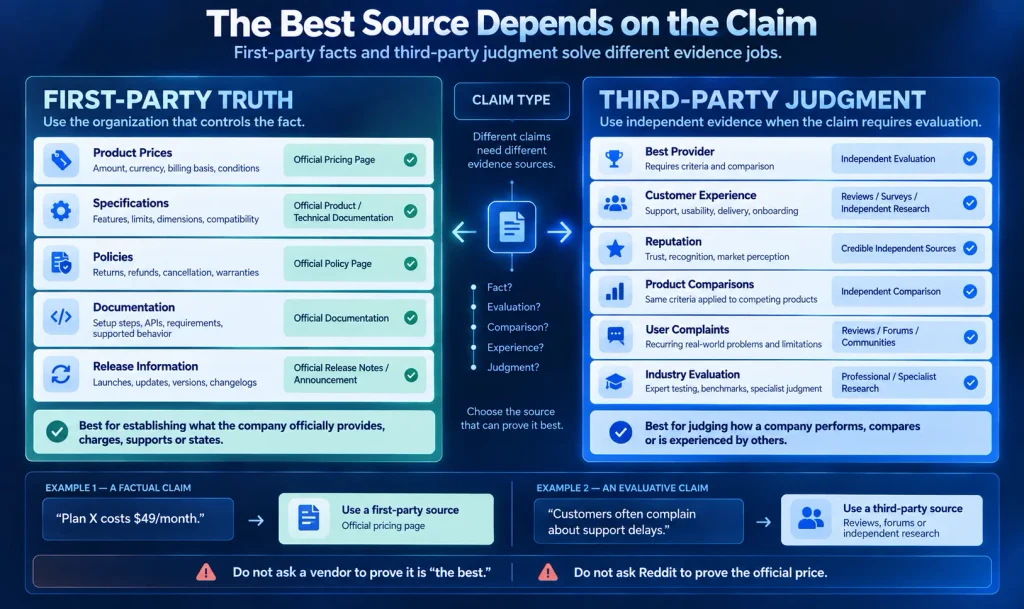
But the source mix also varied by language and market. That does not prove that AI systems universally “prefer third parties.” It shows that brand questions often require information a company’s own website cannot independently establish.
Use this rule instead:
| Claim the answer needs to support | Usually strongest starting source |
| “This product costs AED 299” | Official pricing/product page |
| “This feature supports 50 users” | Official documentation/specifications |
| “Returns are allowed within 30 days” | Official policy |
| “Version 4.2 launched on September 1” | Official release notes/announcement |
| “Customers frequently complain about support” | Reviews, communities, survey evidence |
| “Product A is better for beginners” | Transparent independent comparison |
| “This company has a strong reputation” | Credible independent evidence |
| “Users report this recurring problem” | User communities/reviews plus corroboration |
The source should follow the evidence need, not an AI SEO checklist.
First-Party Truth: When Your Own Website Should Be the Strongest Source
A company’s own website is often the logical primary source for facts the company itself controls. Call these first-party truths.
They include information where the organization is the authoritative publisher because it sets, maintains, or documents the fact.
Product prices
If the question is:
“How much does Product X cost?”
the official pricing page should normally be the starting point.
A third-party article may be useful for price comparisons, but it introduces additional failure points:
- the price may be outdated;
- the billing period may be missing;
- regional pricing may differ;
- a promotion may have expired;
- required add-ons may be excluded.
For time-sensitive pricing, make the evidence complete enough to verify: amount, currency, billing basis, plan, conditions, and date when relevant. The job of the official page is to establish the price. The job of an independent source may be to judge whether that price represents good value.
Those are different claims.
Specifications
Manufacturers and service providers are normally the strongest source for their published specifications.
Examples include:
battery capacity, dimensions, supported integrations, storage limits, seat limits, API capabilities, compatibility, or included features.
If a product’s official documentation says an integration is supported, an AI answer does not need a forum comment to establish the basic fact.
But first-party documentation has a boundary.
It can establish:
“This integration exists.”
It cannot automatically establish:
“This integration works better than every competitor’s.”
The second claim requires comparison or independent evidence.
Policies
For claims about a company’s current: returns, cancellation, shipping, privacy, warranties, eligibility, refunds, or subscription terms, the official policy should generally be the primary evidence.
This becomes particularly important when conditions change. A review saying, “I returned mine within 30 days,” does not prove that the current official return window is 30 days.
One customer’s experience and the company’s published policy answer different questions.
Documentation
For questions such as:
“How do I configure this feature?”
or:
“Does the API support this parameter?”
official technical documentation is usually the strongest starting point.
Community posts can still be useful for:
- undocumented edge cases;
- implementation problems;
- workarounds;
- real-world troubleshooting.
But a Stack Overflow or Reddit answer should not replace current official documentation for the documented behavior of a product when that documentation exists.
Release information
Companies are also the primary source for what they released, changed, discontinued, or announced.
Official sources may include:
- release notes;
- changelogs;
- company announcements;
- developer documentation;
- product update pages.
Independent reporting can then answer different questions:
How important was the release? Did it work as promised? How did customers respond? How does it compare with a rival’s release?
First-party truth establishes what happened.
Third-party analysis can help establish what it means.
Third-Party Judgment: When Independent Sources Can Be More Useful
Your website becomes a weaker source when the claim requires an independent judgment about your own company.
A hotel can publish its room types.
It cannot independently prove that it has the best service in Dubai.
A SaaS company can publish its features.
It cannot independently prove that users find its interface easier than every competitor’s.
This is where third-party evidence becomes important.
Best provider
“Best” is not a product specification.
It is a conclusion produced by criteria.
A useful independent comparison should explain:
- who the recommendation is for;
- what was compared;
- which criteria were used;
- where each option performs differently;
- what could change the recommendation.
The stronger statement is rarely:
“Brand A is best.”
It is:
“Brand A fits teams prioritizing X, while Brand B is stronger when Y matters more.”
Customer experience
Customers are the main factor:
- Companies can describe the customer experience they intend to provide.
- Customers provide evidence about the experience they actually received.
For claims involving:
support responsiveness, ease of use, delivery experience, onboarding friction, returns, reliability, or recurring frustrations, independent reviews and community discussions can provide evidence first-party copy cannot.
That evidence still needs careful handling. One five-star review or one angry post is not representative customer sentiment.
Reputation
Reputation exists outside the company’s own website.
Evidence may come from:
- recognized industry publications;
- independent review platforms;
- professional organizations;
- reputable news coverage;
- awards with transparent criteria;
- sufficiently broad customer-feedback datasets.
A company describing itself as “trusted” is marketing copy, not independent evidence that it has a strong reputation.
Product comparisons
The manufacturer of Product A may accurately document Product A.
That does not make it the neutral source for deciding whether Product A beats Product B.
Direct comparisons become stronger when the same criteria are applied to both sides:
price vs price, specification vs specification, policy vs policy, test result vs test result.
The reader should be able to see where the evidence ends and the evaluator’s judgment begins.
User complaints
Complaints are one place where forums and review platforms can be especially useful.
They can expose issues official pages are unlikely to document prominently:
billing frustrations, support delays, reliability problems, unexpected limitations, difficult cancellation processes, or usability issues.
But treat complaint evidence as experience evidence, not automatically as proof of prevalence.
Five Reddit posts can establish:
“Some users report this problem.”
They cannot by themselves establish:
“Most customers experience this problem.”
Industry evaluation
Some claims require specialist knowledge rather than either marketing copy or anonymous comments.
Examples include:
- cybersecurity evaluations;
- technical benchmark testing;
- financial-product comparisons;
- medical evidence;
- enterprise software analysis.
For these claims, credible specialist publications, professional bodies, researchers, or independent testing organizations may offer stronger evidence than either the vendor or a general discussion forum.
Why “Get Mentioned on Reddit” Is Too Simplistic
Reddit clearly matters in AI search. But “get mentioned on Reddit” is not a citation strategy.
The latest datasets make the danger of that advice obvious.
Ahrefs’ September 2026 U.S. snapshot currently shows Reddit as the largest individual citation source in its tracked ChatGPT dataset, with 16.8% mention share among the top sources. Reddit also ranks highly in Ahrefs’ current Google AI Mode and Gemini datasets.
Yet another dataset tells a very different story.
Ahrefs’ study of 1.4 million ChatGPT prompts found that a dedicated Reddit retrieval channel supplied a huge volume of candidate URLs, but only 1.93% of those Reddit-channel URLs were cited. Reddit represented 67.8% of the non-cited URLs in that retrieval dataset. The researchers caution that Reddit pages reaching ChatGPT through ordinary web search are categorized differently, so this is not a domain-wide Reddit citation rate.
And citation share can change quickly. Promptwatch data reported by Semrush showed Reddit’s observed ChatGPT citation share dropping from about 3.8% to 0.5% during part of August 2026. Promptwatch itself called the finding provisional and could not rule out a data-collection issue.
Those studies use different methodologies, so their percentages should not be compared as if they measured the same thing. That is precisely the point.
There is no stable rule that says:
“AI loves Reddit, therefore your brand needs Reddit mentions.”
Reddit is particularly useful when the information need involves personal experience, opinions, troubleshooting, complaints, recommendations, or community consensus. Research on Google AI Overviews and Reddit also found effects concentrated in experience-based discussions rather than purely factual information.
But if the answer needs an official warranty period, API limit, legal requirement, or current product price, Reddit is usually the wrong evidentiary starting point.
Do not manufacture Reddit marketing tactical mentions.
Create products and information worth discussing, monitor genuine conversations, and use community evidence for the claims it can actually support.
Match the Source Type to the Evidence Need, Not to a Universal AI Preference
The strongest source is not always:
your website, Reddit, Wikipedia, a high-DR publication, or the newest page.
It depends on the claim.
Google’s current generative-search guidance says its AI systems look across a variety of sources and recommends creating original, useful, non-commodity content rather than recycling information already available elsewhere.
OpenAI gives similarly cautious advice to users: search citations can be incomplete, outdated, or incorrect, and people should inspect the source and use authoritative evidence when accuracy matters.
For a content team, that creates a practical source-selection test:
If this sentence were challenged, which source would you want open in front of you to prove it?
- For a current price, that may be the vendor.
- For a law, the regulator or legislation.
- For original research, the study itself.
- For customer frustration, reviews or community evidence.
- For a product recommendation, a transparent comparison using defined criteria.
- For a company’s launch, the company announcement may establish the event while independent reporting explains its significance.
This is why AI citation optimization should not begin with “Which websites does ChatGPT like?”
Begin with:
“What claim needs proving, and who is genuinely in the best position to prove it?”
That question produces stronger content for readers and a much more defensible source strategy for AI search.
Source Substitutability: Why Generic Content Gives AI No Reason to Cite You
Here is one of the hardest questions to ask about your own content:
If this page disappeared tomorrow, what useful information would disappear with it?
If the answer is “almost nothing”, you have a source-substitutability problem.
For this article, Source Substitutability means how easily another available source could replace the useful evidence on your page without materially weakening the answer.
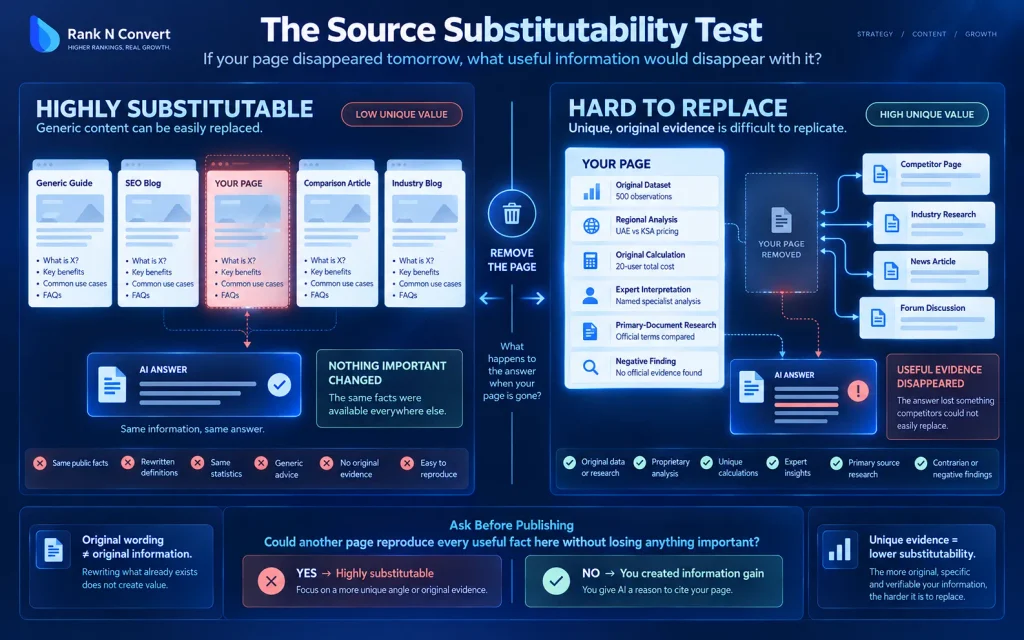
It is a diagnostic framework, not a documented Google or OpenAI ranking factor.
But the underlying problem is real.
Google’s 2026 guidance for generative AI Search explicitly recommends valuable, non-commodity content and contrasts first-hand, experience-based information with pages that simply summarize what already exists elsewhere. Google specifically advises publishers not to recycle information that is already widely available or could easily be reproduced by a generative model.
That gives content teams a more useful target than “make the article sound original.”
Make the information harder to replace.
The Source Substitutability Test: Could AI Replace Every Useful Fact on Your Page?
Run this test on any page you want to improve for AI citations, ChatGPT visibility, or Google AI Search.
Temporarily imagine your URL has vanished.
Now ask:
- Could another website provide the same definition?
- Could another article repeat the same statistic?
- Could the AI obtain the same price from the official website?
- Could five competitors reproduce your comparison from the same public information?
- Could a language model generate almost the same advice without consulting your page?
- Is there any calculation, test, dataset, regional evidence, expert interpretation, or documented finding that exists because your page created it?
The more often the answer is yes, another source could replace us, the more interchangeable your page becomes.
Consider two articles about CRM software.
Page A contains:
- what CRM means;
- common CRM benefits;
- five popular tools;
- vendor descriptions;
- pricing copied from product websites;
- a generic FAQ.
Page B contains:
- current prices checked on a stated date;
- cost calculated for teams of 5, 20, and 50;
- integration limitations verified from documentation;
- a consistent comparison method;
- regional availability differences;
- documented cases where a cheaper plan becomes more expensive after required add-ons.
Page B does not necessarily have more words.
It has more information that another page cannot casually replace.
This matters because citation visibility is not just about supplying true information. It is about supplying evidence that is useful enough to justify selecting your source from several plausible alternatives.
A useful audit table is:
| Ask | If the answer is “yes” | What to improve |
| Can the same facts be found on dozens of pages? | High substitutability | Add original evidence or interpretation |
| Are you only paraphrasing official documentation? | High substitutability | Add analysis, calculation, testing, or decision value |
| Does your page contain a fact generated by your own research? | Lower substitutability | Explain method and limitations clearly |
| Would removing your page remove a useful dataset or framework? | Lower substitutability | Make that contribution easy to find and verify |
| Are your conclusions obvious from the sources you cite? | Medium/high substitutability | Add interpretation that changes a decision |
The goal is not to make information artificially exclusive.
The goal is to contribute something useful.
Original Wording Is Not the Same as Original Information
This distinction is easy to miss.
Suppose ten websites read the same report.
The report says:
42% of respondents selected Option A.
One website writes:
“Option A was selected by 42% of participants.”
Another writes:
“Nearly four in ten respondents preferred Option A.”
A third asks an AI writing tool to rewrite the sentence into more conversational language.
You now have different wording.
You do not have different information.
Google’s people-first content guidance makes a similar distinction. It asks whether a page provides original information, reporting, research, or analysis, and whether pages drawing on other sources add substantial value instead of merely copying or rewriting them.
This is why “make it unique” should not mean:
- change the introduction;
- use different adjectives;
- rearrange the headings;
- paraphrase competitor articles;
- rewrite the same facts with AI.
Those changes may avoid literal duplication, but they do not create information gain.
A better question is:
What does this page allow the reader to know, calculate, verify, compare, or decide that the source material alone did not?
That is a much higher editorial standard.
Why Summarizing the Same Study as Everyone Else Creates Little Citation Value
Secondary synthesis can still be useful.
A skilled writer may make a difficult study understandable, explain its limitations, or apply it to a practical decision.
But simply repeating the headline statistic creates little unique evidence value.
Suppose 50 SEO articles all cite the same research showing a relationship between a content characteristic and AI citations.
If your page only repeats:
- the study title;
- the headline percentage;
- the researcher’s conclusion;
then almost every useful factual statement on your page remains replaceable.
An AI system could potentially cite:
- the primary study;
- another summary;
- a better-known publication covering the study;
- a page providing more context.
The stronger version does more.
For example:
- explain the experimental setup;
- identify whether retrieval was controlled;
- separate correlation from causation;
- compare the result with conflicting research;
- identify where the finding does not apply;
- calculate what the finding means in a realistic scenario.
This is particularly important in GEO research.
A July 2026 review of 45 studies found that many reported optimization effects are conditional on experimental settings. It warns specifically against turning effects observed on already-retrieved documents into claims about open-web discoverability.
Repeating the headline result is commodity content.
Explaining where the result stops being valid adds genuine value.
What Makes a Source Harder to Replace?
The strongest content usually contains at least one evidence asset that would be difficult to recreate simply by reading the same search results.
That does not mean every page needs an expensive study.
There are several ways to create useful information gain.
Original data
Original data gives the page evidence that did not exist before the research was conducted.
Examples include:
- analyzing 1,000 search results;
- tracking prices across 50 retailers;
- measuring delivery estimates across multiple locations;
- reviewing citation behavior across a defined prompt set;
- publishing survey results with a documented sample.
The methodology matters as much as the number.
State:
- sample size;
- collection period;
- inclusion criteria;
- exclusions;
- calculation method;
- limitations.
Do not publish an unexplained percentage and label it “research.”
First-hand testing
Actual testing can answer questions official documentation cannot.
For example:
- How long did setup take under defined conditions?
- Which advertised integrations required an additional paid plan?
- How accurately did a tool export data?
- What happened when a documented procedure was followed?
Google explicitly uses first-hand reviews as an example of the unique experience that distinguishes non-commodity content from summaries of existing information.
Testing should be reproducible where practical.
Document:
what was tested, when, under which conditions, and what was not tested.
Current price or market analysis
Copying today’s product price adds little by itself because the vendor already owns that fact.
The value appears when you transform prices into a useful decision.
For example:
Cost for 20 users = seat price × 20 + mandatory add-ons + applicable platform fees
Then compare:
- monthly vs annual cost;
- break-even points;
- required plan upgrades;
- regional pricing;
- renewal conditions.
Now the page contains an analysis rather than a copied price list.
Regional evidence
Global content often ignores differences that materially change a decision.
Regional evidence might include:
- UAE versus Saudi pricing;
- Qatar delivery availability;
- GCC warranty conditions;
- country-specific payment methods;
- local regulations;
- product availability;
- language support.
A page answering “Does this work in Qatar?” can be more useful than a global 5,000-word guide that never answers Qatar-specific conditions.
Named expert interpretation
Expertise becomes useful when it produces an interpretation, not merely a byline.
A named specialist can explain:
- why an observed result matters;
- where a rule has exceptions;
- which trade-off inexperienced buyers miss;
- what evidence would change the conclusion.
The expert’s role and relevant credentials should be clear when they materially affect trust.
Do not invent expert review merely to decorate the page.
Primary-document research
Sometimes the valuable work is not generating new data.
It is finding and correctly interpreting difficult primary evidence.
Examples include:
- regulations;
- court decisions;
- technical documentation;
- financial filings;
- product changelogs;
- government datasets;
- terms and conditions.
The value comes from connecting several primary documents into an answer readers would otherwise have to assemble themselves.
Original calculations
A calculation can turn public inputs into genuinely useful output.
For example:
A SaaS provider publishes:
- AED 80 per user monthly;
- AED 60 per user on annual billing;
- minimum 10 seats.
Instead of repeating those figures, calculate:
20 users monthly: AED 1,600/month
20 users annual billing: AED 1,200/month equivalent
Annual difference: AED 4,800
The inputs are public.
The decision-support output is yours.
Show the formula so the calculation can be checked.
Decision frameworks
A framework becomes useful when it reduces a complicated choice into explicit criteria.
For example:
Choose Option A when:
- the team has fewer than 20 users;
- upfront price matters most;
- advanced reporting is unnecessary.
Choose Option B when:
- Salesforce integration is mandatory;
- reporting depth matters;
- annual commitment is acceptable.
That gives the reader a decision rule instead of another list of features.
Useful negative findings
One of the most underused forms of original utility is discovering that something does not work, does not exist, or could not be verified.
Examples:
- no official delivery guarantee was found;
- the cheaper plan does not include the required integration;
- no statistically significant effect was detected;
- an advertised capability was not available in the tested region;
- no primary evidence supports a commonly repeated claim.
Negative findings are valuable because weak content often quietly omits them.
Do not force a positive conclusion because it sounds more interesting.
“We could not verify this claim” can be more useful than repeating it.
Why a Highly Specific Page Can Sometimes Be More Useful Than an “Ultimate Guide”
Comprehensiveness and usefulness are not the same thing.
An “ultimate guide” may cover:
- history;
- definitions;
- benefits;
- types;
- tools;
- FAQs;
- trends;
- tips.
But if the user’s immediate question is:
“Which CRM costs less for a 20-person team that needs Salesforce integration?”
a focused comparison containing:
- verified plan prices;
- 20-seat cost calculations;
- Salesforce availability;
- plan restrictions;
- verification dates;
may provide far more useful evidence.
Recent citation research supports the importance of this distinction. Controlled experiments found topical relevance to be one of the strongest factors affecting first-citation selection when two candidate sources were already in context. Cross-platform observational research also found that highly influential pages tend to be semantically aligned with the answer and rich in recognizable evidence such as numerical facts, comparisons, definitions, and procedures.
Neither finding proves that “short pages beat long pages.”
They support a narrower conclusion:
A page that solves one information job precisely can be more useful for that claim than a broad page that discusses the topic without supplying the required evidence.
So before publishing another “complete guide,” run the Source Substitutability Test:
If this page disappeared tomorrow, what would the web actually lose?
If the answer is only your wording, the page remains easy to replace.
If the answer is your dataset, calculation, test, regional evidence, primary-document synthesis, expert interpretation, decision framework, or carefully documented negative finding, you have created something much more valuable.
Not because an AI system owes original content a citation.
But because you have finally given readers-and potentially the systems answering their questions-a reason to need your source specifically.
How to Make Content Citation-Ready Without Writing for Robots
Citation-ready content should still sound like it was written for a person.
You do not need to break every paragraph into three sentences, force a table into every section, repeat entities unnaturally, or create tiny “AI chunks.”
Google’s current generative-search guidance explicitly says publishers do not need to divide content into small chunks for AI systems, and there is no ideal page length. It recommends organizing information in ways that help human readers and focusing on useful, non-commodity content instead.
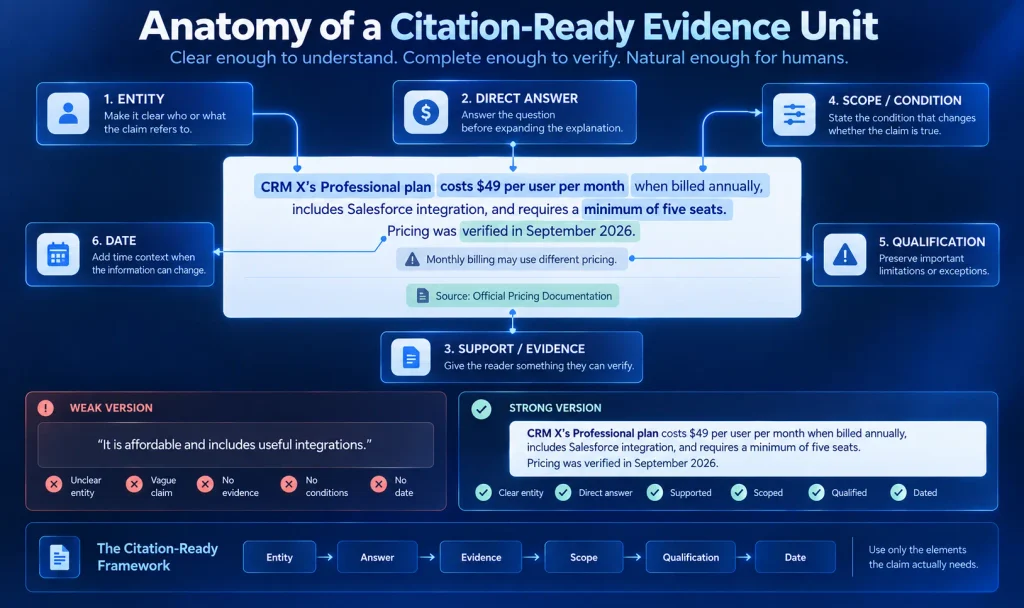
The better goal is:
Make every important claim clear enough to understand, verify, and reuse without stripping away the context that makes it true.
That is what “citation-ready” should mean.
Answer the Important Question Before Expanding the Explanation
When a heading asks a clear question, answer it before surrounding the reader with background.
If the heading is:
“Does schema increase AI citations?”
do not begin with three paragraphs about the history of structured data.
Start with the answer:
There is currently no reliable evidence that adding schema by itself increases AI citation selection. Schema can still help search engines understand structured information and support existing Search features.
Then explain:
- what evidence exists;
- what the evidence does not prove;
- where schema is still useful;
- what to prioritize instead.
This structure works because the reader gets the decision first.
A useful pattern is:
- Direct answer
- Evidence
- Explanation
- Condition or exception
- Action
This is not an AI formatting trick.
It is simply strong information design.
It also reduces the chance that an important conclusion becomes buried beneath an introduction that never answers the heading.
Build Evidence Units, Not Artificial “AI Chunks”
An evidence unit is a passage that contains enough information to support one meaningful claim without forcing the reader to reconstruct the point from five disconnected sections.
It does not have a fixed word count.
It might be:
- one sentence;
- a paragraph;
- a table row;
- a short list;
- several connected paragraphs.
The unit should be as long as the evidence requires.
Google specifically advises against chopping pages into artificial pieces simply because someone believes AI systems prefer small chunks. Its systems can understand multiple topics and nuance on the same page.
A strong evidence unit usually contains six things when they are relevant:
Entity → answer → support → scope → qualification → date
Not every claim needs all six.
But this checklist catches many of the reasons a passage becomes vague when separated from the rest of the page.
State the entity clearly
Readers should know what the sentence is about.
Weak:
“It also offers unlimited exports.”
Clearer:
“HubSpot’s Enterprise plan offers unlimited report exports.”
The second sentence remains understandable even if it appears without the paragraph above it.
This idea has support beyond SEO research. Work on sentence decontextualization has shown that extracted sentences can become difficult to interpret when key subjects or references exist only in the surrounding context. Research in this area specifically identifies unresolved pronouns and missing contextual information as common reasons extracted statements stop making sense.
That does not mean repeating a company name in every sentence. Use the entity again when the reference would otherwise become ambiguous.
Give the direct answer
Do not make the reader decode the conclusion.
Weak:
“There are several things businesses should consider when choosing between monthly and annual plans.”
Better:
“The annual plan costs less over 12 months, but it requires a longer commitment.”
The second sentence gives the answer before expanding the trade-off.
Direct answers are especially valuable when the question concerns:
- price;
- eligibility;
- compatibility;
- dates;
- limitations;
- definitions;
- yes/no conditions.
Support the claim
A clear sentence is still weak if nothing supports it.
If you write:
“Platform A is easier to use.”
ask:
According to what evidence?
Useful support might include:
- an official specification;
- an original test;
- a survey;
- a documented calculation;
- a credible study;
- a comparison using defined criteria.
Citation-ready writing is not simply concise writing.
It is concise writing with traceable evidence.
Define the scope or condition
Many claims become wrong because the condition was removed.
Compare:
“The discount is 20%.”
with:
“New customers receive 20% off their first annual subscription.”
Or:
“The integration is available.”
with:
“The Salesforce integration is available on the Professional and Enterprise plans.”
Conditions may include:
- country;
- plan;
- device;
- customer type;
- minimum purchase;
- user count;
- product version;
- eligibility requirement;
- time period.
If the condition changes whether the statement is true, include it.
Add the necessary qualification
Qualification is not weakness. It is accuracy.
Examples:
- “The study found an association, not causation.”
- “The result applies only to the six models tested.”
- “The company does not publish a guaranteed delivery time.”
- “The evidence comes from U.S. users, so it may not represent GCC customers.”
This becomes especially important when summarizing AI-search research.
A controlled citation experiment may show what happens when two pages are already supplied to a model. It does not automatically prove that the same change improves live-web retrieval. Good citation-ready content preserves that boundary.
Include the date when freshness matters
Dates are useful when the truth can change. Add a verification date for information such as:
- prices;
- policies;
- regulations;
- product availability;
- software features;
- rankings;
- promotions;
- market statistics.
Do not add dates mechanically to evergreen facts.
The useful question is:
Would knowing when this was verified change whether the reader trusts or acts on it?
If yes, include the date.
Reduce Ambiguous Pronouns When They Make a Passage Unclear Out of Context
Pronouns are normal human language.
Do not turn every sentence into:
“HubSpot offers... HubSpot supports... HubSpot provides...”
That sounds terrible.
But avoid passages where it, they, this, that, or these could refer to multiple entities.
Example:
“Salesforce and HubSpot both support integrations. It also includes advanced reporting.”
What does it mean?
Salesforce?
HubSpot?
The integration?
The sentence works poorly even for a human.
Write:
“HubSpot's Enterprise plan also includes advanced reporting.”
Research on decontextualization supports the broader principle that extracted sentences often lose meaning when pronouns or incomplete references depend on surrounding text.
But there is no credible evidence for a universal “pronoun penalty” in AI search.
The rule is much simpler:
Remove ambiguity when ambiguity harms understanding.
Use Tables When the Information Job Is Comparison
A table is useful when the reader needs to compare the same dimensions across multiple options.
Good table:
| Criterion | Tool A | Tool B |
| Price for 20 users | Verified total | Verified total |
| Annual commitment | Required | Optional |
| Salesforce integration | Professional plan | Included |
| Reporting | Standard | Advanced |
| Best fit | Cost-sensitive teams | Reporting-heavy teams |
This structure works because each row answers the same question for both products.
A table is less useful when:
- the information is mostly explanatory;
- every cell requires a paragraph;
- comparison criteria differ across options;
- the table duplicates the prose without adding clarity.
Do not add tables because somebody claimed “AI prefers tables.”
Current controlled citation research found formatting-only changes had much smaller effects than topical relevance once documents were already in context.
Use a table because comparison becomes easier for the reader.
Use Lists When the Information Is Naturally Procedural or Criteria-Based
Lists work well when sequence or membership matters.
Use numbered steps for a process:
- Check whether the URL is indexed.
- Verify crawler access.
- Identify the information need.
- Compare the cited competitor’s evidence.
- Make the smallest relevant improvement.
- Retest across multiple runs.
Use bullets for criteria:
- current pricing;
- integration requirements;
- user limits;
- contract terms;
- support coverage.
Do not convert ordinary explanation into bullets merely to make the page look “AI optimized.”
A paragraph is often better when the idea depends on cause, nuance, or interpretation.
Choose the format that matches the information job.
Use Statistics to Support Important Claims, Not Because “AI Likes Numbers”
Statistics can strengthen a page because they add measurable evidence.
They can also make weak content look falsely authoritative.
Do not chase rules such as:
“Add one statistic every 100 words.”
There is no defensible universal citation rule like that.
Instead, use a statistic when the number changes the reader’s understanding.
A useful statistical statement includes enough context to answer:
- What is the number?
- What population was measured?
- When?
- By whom?
- Using what method?
- What important limitation applies?
For example:
Weak:
“85% of pages are ignored by ChatGPT.”
Better:
“In AirOps’ March 2026 observational dataset of 548,534 pages retrieved across 15,000 ChatGPT prompts, roughly 85% of retrieved pages did not appear in the final citations.”
The second version tells the reader what the figure actually represents. Statistics should support the reasoning. They should not replace it.
Complete the Information Job Instead of Chasing an Arbitrary Word Count
There is no ideal word count for AI search optimization. Google now states this directly: page length should depend on the audience and topic, not a belief that generative AI prefers short or long pages.
- A 900-word page can be incomplete.
- A 4,000-word page can also be incomplete.
The better question is:
Has the page completed the user's information job?
For a query such as:
“Does Tool A integrate with Salesforce?”
the job may require only:
- yes or no;
- supported plan;
- setup requirement;
- important limitation;
- official source.
For:
“Which CRM should a 20-person sales team choose?”
the job may require:
- price;
- seat limits;
- integrations;
- onboarding;
- reporting;
- contract terms;
- comparison criteria;
- recommendation conditions.
That naturally requires more depth.
Use this final citation-readiness check:
| Question | Pass when… |
| Is the entity clear? | The reader knows exactly who or what the claim refers to |
| Is the answer direct? | The conclusion appears before unnecessary explanation |
| Is the claim supported? | Evidence can be traced to a credible source or method |
| Is the scope clear? | Conditions, market, plan, population, or limits are stated |
| Is the qualification preserved? | The claim does not overstate what the evidence proves |
| Is freshness clear? | Time-sensitive information has an appropriate date |
| Is the format appropriate? | Tables, lists, or prose match the information job |
| Is the page complete? | The user can make the intended decision without obvious evidence gaps |
The goal is not to make every paragraph independently machine-readable. It is to make important evidence clear enough that it does not collapse when separated from surrounding fluff. Write naturally. Use pronouns when they are clear. Use paragraphs when explanation needs paragraphs. Use tables when comparison needs a table. Use numbers when the evidence needs numbers.
And when an important claim matters, make sure a reader can answer six questions without guessing:
Who or what? What is true? What supports it? Under what conditions? What is the limitation? When was it true?
That is citation-ready writing without turning the page into something written for robots.
Does Schema Help AI Citations?
Schema markup is useful SEO infrastructure. It is not currently a proven shortcut to more AI citations.
Structured data gives machines explicit information about entities and page content. Google says it uses structured data to understand pages and to make eligible content available for certain rich-result experiences. But Google’s 2026 generative AI guidance is equally clear: structured data is not required for AI Overviews or AI Mode, and there is no special schema markup publishers need to add for generative AI Search.
That means two claims should be kept separate:
- Schema can help communicate structured facts to search systems.
- Schema has not been shown to independently increase AI citation selection.
Schema Can Help Machines Understand Structured Information, but It Is Not a Proven Citation Multiplier
Schema is most useful when it accurately describes information that already exists visibly on the page.
Examples include:
- an article’s author and publication date;
- a product’s structured attributes;
- breadcrumbs;
- organization information;
- recipe data;
- job-posting information;
- other supported structured-data types.
Google describes structured data as a standardized way to provide explicit clues about a page’s meaning. It can also make pages eligible for supported rich-result experiences.
But that does not mean an AI system sees JSON-LD and awards the page extra citation weight.
The strongest large-scale evidence currently available points in the opposite direction.
In May 2026, Ahrefs studied 1,885 pages that added JSON-LD between August 2025 and March 2026, matching them against roughly 4,000 control pages with similar pre-treatment citation behavior.
After controlling for broader platform changes, the measured citation effects were:
| AI surface | Measured change after schema | Interpretation |
| Google AI Overviews | −4.6% | Small statistically significant decline, but causation was unclear |
| Google AI Mode | +2.4% | Statistically indistinguishable from zero |
| ChatGPT | +2.2% | Statistically indistinguishable from zero |
Ahrefs therefore found no clear positive citation uplift from adding schema to pages that were already receiving substantial AI citations.
That does not prove schema can never matter in any context. The study had important boundaries:
- it focused on pages already receiving AI citations;
- it pooled multiple schema types;
- it studied JSON-LD;
- the main post-treatment window was 30 days;
- observational web conditions still make perfect causal isolation difficult.
The safe conclusion is narrower:
Do not add schema because you expect a direct AI citation boost. Add schema when it accurately represents the page and supports legitimate Search features.
Why Schema Correlation Should Not Be Confused With Citation Causation
This is a good example of how AI SEO statistics can mislead.
Before running its matched analysis, Ahrefs looked across roughly 6 million URLs and found that AI-cited pages were almost three times more likely to contain JSON-LD than non-cited pages.
At first glance, that sounds like evidence that schema causes citations.
But consider what else tends to be true of websites that invest in structured data:
- stronger technical SEO;
- better-maintained templates;
- more established publishing workflows;
- stronger internal linking;
- better organic visibility;
- larger SEO teams;
- more frequently updated content.
Schema can therefore act as a marker of a well-maintained website without being the reason the page was cited.
This is the difference between:
Correlation: cited pages often have schema.and:
Causation: adding schema makes a page more likely to be cited.The first has been observed.
The second has not been reliably established.
This distinction should guide your own testing too. If you add schema while simultaneously updating copy, adding links, improving internal linking, changing titles, and republishing the page, you cannot attribute any later citation increase to schema alone.
When Schema Still Makes Sense for Normal Search and Structured Results
None of this means removing structured data.
Schema still has clear uses in conventional search.
Google says structured data can:
- help it understand page information more explicitly;
- make qualifying pages eligible for supported rich-result features;
- improve how certain information such as article titles, images, authors, and dates is understood;
- support specific Search experiences where Google documents the markup.
Use schema when:
- Google documents support for that structured-data type;
- the markup accurately represents visible page content;
- the data can be maintained when the content changes;
- there is a genuine Search or machine-understanding use case.
Do not use schema as a substitute for missing content.
If your page does not clearly state the product price, adding the price only inside JSON-LD is not a strong content strategy.
And do not add every schema type you can find on Schema.org just because it exists. Google notes that its own documentation, not the full Schema.org vocabulary, is the authoritative source for how structured data is used in Google Search.
Decision rule:
Use schema to describe real information better. Do not rely on it to make weak information citation-worthy.
Do You Need llms.txt to Get Cited by ChatGPT or AI Search?
No evidence currently shows that publishing llms.txt is necessary to get cited by ChatGPT, Google AI Search, or other major AI search systems.
llms.txt is a proposed Markdown-based convention designed to give agents a curated overview of a website and point them toward useful resources. Its specification was originally proposed in 2024 and continues to evolve. It is not the same thing as robots.txt: robots.txt controls crawler permissions, while llms.txt is intended as a content map for systems that choose to support it.
That distinction matters.
llms.txt Is Not Currently a Proven AI Visibility Lever
For Google, the answer is unusually definitive.
In June 2026, Google clarified that:
- Google Search does not use llms.txt;
- it is not required for Google Search or its generative AI features;
- publishing one will neither help nor hurt Google Search visibility or rankings.
So if your goal is specifically:
“How do I get cited in Google AI Overviews or AI Mode?”
creating llms.txt should not be near the top of the list.
Real-world server data also suggests adoption by AI systems is still limited.
Ahrefs analyzed server logs across 137,000 domains in May 2026. Among domains publishing llms.txt:
- 97% of the files received no requests at all during the study period;
- among the small number that were fetched, most requests were automated bots;
- named AI tools represented only part of that already-small request pool.
That does not prove llms.txt is useless forever.
Some development tools, documentation systems, agents, and coding assistants may support it. The proposal itself lists integrations across documentation platforms and CMS tools.
But there is a big difference between:
“Some agents can use this file.”
and:
“Publishing this file increases ChatGPT or Google AI citations.”
The second claim is not currently established.
What Matters More: Actual Crawler Access, Indexing and Useful Content
If you have limited technical resources, prioritize the mechanisms that the platforms actually document.
For Google:
- make the page crawlable;
- ensure it can be indexed;
- keep it eligible for a snippet;
- use normal SEO foundations;
- publish useful, non-commodity information.
For ChatGPT Search, OpenAI explicitly recommends making sure you do not block OAI-SearchBot if you want site content to be discoverable and usable in search summaries, snippets, citations, and links.
That gives you a practical priority order:
| Technical task | Priority for AI-search visibility |
| Publicly accessible useful content | High |
| Correct crawler permissions | High |
| Google indexing eligibility | High for Google AI Search |
| OAI-SearchBot access | High for ChatGPT Search discovery |
| Clear internal linking and discoverability | High |
| Useful, differentiated evidence | High |
| Accurate schema where relevant | Useful |
| llms.txt | Optional / platform-dependent |
If maintaining an llms.txt file is nearly effortless and you serve audiences using tools that support it, there is little reason you cannot provide one.
Just do not confuse cheap optional infrastructure with evidence of improved AI visibility.
If you have one engineering hour available, fixing an accidental crawler block is far more important than polishing an llms.txt file nobody may request.
Do Backlinks and Brand Mentions Matter for AI Citations?
Probably-but not in the simple way traditional link-building advice suggests.
Backlinks, web mentions, branded searches, reviews, YouTube discussions, PR coverage, and other off-site signals are often associated with brands that appear frequently in AI answers.
The difficult part is identifying why.
A well-known brand may have:
- thousands of backlinks;
- extensive media coverage;
- high search demand;
- Reddit discussions;
- YouTube reviews;
- Wikipedia coverage;
- strong organic rankings;
- years of accumulated training-data exposure.
If that brand appears frequently in ChatGPT, you cannot isolate one of those properties and confidently say:
“This caused the AI visibility.”
Backlinks Can Support Traditional Discovery and Authority Without Being a Proven Direct Citation Trigger
Backlinks still matter to traditional search.
Google says links help it:
- discover new pages;
- understand relevance;
- understand relationships between pages.
PageRank, Google’s link-analysis system, also remains part of its core ranking systems.
That matters for Google AI Search because Google says its generative Search experiences rely on its core Search ranking and quality systems to retrieve relevant pages.
The logical chain can therefore be:
Relevant backlinks → stronger discovery/ranking signals → stronger chance of entering Search retrieval → possible AI citation opportunity
But that is different from:
Backlink → direct AI citation boost
Current evidence does not support such a simple rule.
Ahrefs’ study of 75,000 brands found comparatively weak relationships between classic link metrics and AI brand visibility. For example, ChatGPT visibility showed a correlation of about 0.266 with Domain Rating, while branded web mentions showed substantially stronger correlations across the AI systems studied. Ahrefs explicitly warns that these relationships are correlations, not causal ranking factors.
Another Ahrefs analysis focusing on Google AI Overviews found correlations of:
- branded web mentions: 0.664
- referring domains: 0.295
- backlinks: 0.218
Again, those values describe associations within the dataset, not direct weighting inside Google’s AI systems.
So backlinks remain valuable SEO assets.
Just do not claim:
“Build X backlinks and ChatGPT will cite you.”
The evidence does not support that.
Brand Mentions Are Associated With AI Visibility but Should Not Be Called a Direct Ranking Factor
Brand mentions show a stronger relationship with AI visibility in several observational datasets.
Ahrefs’ 75,000-brand analysis found branded web mentions correlated roughly 0.66–0.71 with visibility across ChatGPT, AI Mode, and AI Overviews. YouTube mentions showed an even stronger correlation of around 0.737 in that dataset.
But the safest wording is:
Brands that are discussed more widely across the web also tend to appear more frequently in AI responses.
Not:
“Unlinked mentions are an AI ranking factor.”
Why?
Because heavily discussed brands also tend to be:
- larger;
- searched more often;
- covered by publishers;
- reviewed by customers;
- included in comparisons;
- linked more frequently;
- represented across many source types.
A mention may contribute useful context about the brand.
It may also simply indicate that the brand is already prominent.
Google’s own 2026 AI-search guidance warns specifically against chasing inauthentic mentions. Google says generative Search can draw on what is said about products and services across blogs, videos, and forums, but manufacturing mentions is not a useful shortcut because the same quality and spam systems still apply.
So the practical goal is not:
“Get our brand name onto 100 random domains.”
It is:
“Create enough real-world usefulness that credible people and sources have reasons to discuss the brand in relevant contexts.”
Brand Familiarity May Affect Consideration Before Page-Level Selection
There is another layer worth separating from citations.
An AI system may first need to decide which brands belong in the answer at all.
Only after that might it choose which pages to cite as evidence.
Emerging research supports treating these as different stages.
A September 2026 study evaluated open-ended brand recommendations across six LLMs and five product categories. It found that recommendation prominence was associated more strongly with broader marketplace-visibility signals such as search interest and online brand conversation than with conventional brand popularity alone.
It also found that adding specific user needs and constraints changed which brands were retrieved, and that some brands omitted from generic recommendations could still appear when distinctive cues were supplied.
That suggests a useful two-stage model:
Stage 1: Brand consideration
Does the system know enough about the brand and associate it strongly enough with this category or use case to consider it?
Stage 2: Evidence selection
Which webpage or external source supports the specific claims made about that brand?
This helps explain why your company website can be technically perfect and still struggle with AI visibility.
The system may never reach the point of choosing one of your pages if the brand itself rarely enters the consideration set.
But this is still emerging research. It should not be converted into:
“Brand search volume is an AI ranking factor.”
Why Correlation Is Not Enough to Tell You What to Fix
This is the most important part.
Suppose your competitor has:
- Domain Rating 85;
- 50,000 backlinks;
- thousands of brand mentions;
- heavy YouTube coverage;
- high branded search volume;
- frequent ChatGPT appearances.
You have:
- Domain Rating 48;
- fewer backlinks;
- fewer mentions;
- lower AI visibility.
That observation does not tell you which change would increase your citations.
You cannot safely conclude:
“We need another 20,000 backlinks.”
The competitor may actually be winning because:
- its product is better known;
- it ranks for more supporting searches;
- journalists cite its original research;
- customers discuss it organically;
- its documentation supplies the exact evidence AI answers need;
- its brand is already strongly associated with the category.
Use correlation studies to identify areas worth investigating, not to create causal checklists.
A better audit is:
| Observation | What to investigate |
| Few backlinks + weak indexing/rankings | Traditional SEO authority and discovery |
| Many backlinks + no AI retrieval | Query relevance and information coverage |
| Strong rankings + few brand mentions | Off-site brand footprint |
| Brand frequently mentioned but site rarely cited | Page-level evidence and citation jobs |
| Competitor dominates independent comparisons | Product/reputation evidence outside your site |
| Brand appears for category queries but not specific use cases | Positioning and semantic association |
That is the difference between studying a correlation and diagnosing a problem.
- Backlinks matter.
- Brand mentions matter.
- Search demand may matter.
- Third-party discussion may matter.
But none of them should be treated as a universal AI citation switch.
The more useful question remains the same one running through this entire article:
At which stage are you losing: discovery, retrieval, brand consideration, source selection, attribution, or recommendation?
Fix that stage first.
Does Fresh Content Get Cited More Often?
Sometimes. But freshness is useful when newer information makes the answer more correct, not simply because a page carries a recent date.
This distinction matters because the data can look contradictory if you ignore query intent.
A large Ahrefs study of 16.975 million cited URLs across ChatGPT, Perplexity, Gemini, Copilot, Google AI Overviews, and Google Search found that AI assistants, as a group, cited pages that were younger than pages appearing in traditional Google results. The average AI-cited URL was about 1,064 days old, compared with 1,432 days for organic Google results.
But that does not mean “newest page wins.”
A newer 2026 Ahrefs analysis of 1.4 million ChatGPT prompts found something more nuanced: cited pages in the retrieval pool had a median age of roughly 500 days, and the very newest retrieved pages were often not the ones selected. For news queries, however, newer pages had a much clearer advantage when relevance was similar.
That leads to the more useful rule:
Freshness matters most when time can change the truth.
Freshness Matters When a Newer Answer Would Be More Correct
Google has used query-deserves-freshness systems for years. Its ranking documentation explains that fresher results are favored when users would reasonably expect current information, such as a newly released movie or a recent earthquake.
The same reasoning is useful when auditing AI citations.
Ask:
Would information from six months ago produce a meaningfully worse answer today?
If yes, freshness deserves attention.
Prices
Prices are highly time-sensitive.
A page that says:
“Plan X costs $29 per user”
may become wrong after:
- a pricing change;
- a new plan structure;
- annual billing changes;
- regional pricing changes;
- mandatory add-ons;
- a promotion ending.
For price-sensitive content, include:
- current amount;
- currency;
- billing period;
- applicable plan;
- important conditions;
- verification date when useful.
The controlled 2026 What Gets Cited study also found that recent timestamps and explicit pricing consistently influenced first-citation selection when two candidate documents were already placed inside the model context.
That is useful evidence, but the limitation matters: the study tested post-retrieval source selection, not live-web discovery.
Software versions
Software advice can become wrong quickly.
A tutorial written for:
Version 4.1
may not apply to:
Version 6.0
after:
- navigation changes;
- renamed settings;
- removed features;
- API changes;
- new pricing tiers;
- altered integrations.
For technical pages, state the relevant:
- version;
- platform;
- operating system where relevant;
- verification date;
- deprecated behavior.
A newer date without checking whether the steps still work is not enough.
Regulations
Legal and regulatory information deserves an especially high freshness standard.
A rule may change because of:
- new legislation;
- regulator guidance;
- implementation dates;
- court decisions;
- amendments;
- thresholds changing.
For regulatory content, the important information is not merely:
“Updated September 2026.”
It is:
- what rule currently applies;
- effective date;
- jurisdiction;
- who it applies to;
- primary source;
- transitional exceptions where relevant.
If you have not rechecked the primary source, do not imply the page is current.
Statistics
Statistics can become stale even when the surrounding explanation remains valid.
A page saying:
“42% of consumers do X”
should make clear:
- survey period;
- publication date;
- population;
- methodology.
Do not replace a valid historical statistic simply because it is old.
Instead, distinguish:
“In the 2024 study…”
from:
“Currently…”
Freshness is about using the right time period, not deleting history.
News
News is one of the clearest cases where recency can function as a practical tie-breaker.
Ahrefs’ 2026 ChatGPT retrieval analysis found that for news queries, cited and non-cited pages had similar relevance scores, while cited sources skewed younger.
That makes sense.
For:
“What happened in today’s Apple event?”
a perfectly written article from last year is useless.
Here freshness is part of relevance itself.
Availability
Availability changes the answer when the user needs something they can act on now.
Examples include:
- products in stock;
- event tickets;
- flights;
- delivery windows;
- restaurant bookings;
- software features available by region;
- services operating in a particular market.
A guide can remain factually accurate at a broad level while becoming practically useless because the option it recommends is no longer available.
When availability affects the decision, verify it.
Current recommendations
Recommendations often decay faster than definitions.
For example:
“Best CRM for small teams”
may change because of:
- new pricing;
- feature launches;
- acquisitions;
- product discontinuation;
- new integrations;
- competitor improvements.
The criteria may remain stable.
The winner may not.
For recommendation pages, refresh the evidence behind the recommendation, not just the headline year.
Freshness Matters Less When the Fact Has Not Changed
Not every article needs constant updates.
Consider:
- “What is a canonical tag?”
- “What does HTTP 301 mean?”
- “How does compound interest work?”
- “What is retrieval-augmented generation?”
If the core definition or mechanism remains correct, publishing yesterday does not automatically make the explanation better than one published two years ago.
The Ahrefs freshness data illustrates this.
Even though AI assistants showed an overall preference for newer pages than traditional Google results, the average cited page was still measured in years, not days. And Google AI Overviews in that study showed much less freshness preference than ChatGPT.
The controlled citation study also should not be overread. A recent timestamp helped when two already-retrieved documents competed, but that does not prove that changing a publication date on an evergreen article improves live AI visibility.
Use this test:
| Ask | If yes |
| Has the underlying fact changed? | Update it |
| Has the product/version changed? | Reverify it |
| Has the market or price changed? | Refresh the evidence |
| Has a better primary source become available? | Upgrade the sourcing |
| Would an older answer still be fully correct? | Do not force an update |
| Are you changing only the displayed date? | Stop and add real value first |
Freshness should follow information decay.
Not the calendar.
Updating the Date Alone Does Not Create New Information Value
Changing:
Updated: March 2025
to:
Updated: September 2026
without changing the substance does not make the page more current in any meaningful sense.
A genuine refresh should answer:
What changed since the last version?
Possible improvements include:
- replacing outdated statistics;
- checking prices;
- updating screenshots;
- testing current software behavior;
- adding new primary research;
- correcting discontinued products;
- changing recommendations after market changes;
- documenting that nothing material changed after verification.
Google’s current generative-search guidance emphasizes unique, valuable, non-commodity content, not superficial freshness signals.
The practical rule is:
Do not refresh the timestamp. Refresh the evidence.
If the evidence has not changed, leave a correct evergreen section alone.
Does Longer Content Perform Better in AI Search?
There is no reliable rule that says longer content earns more AI citations.
Google now states this directly: there is no ideal page length for generative AI Search. Shorter or longer pages can both work depending on the audience and the subject. Google also says pages do not need to be broken into artificial “AI chunks” because its systems can understand multiple topics and retrieve relevant parts of a page.
So the useful question is not:
“How many words should this article be?”
It is:
“How much evidence does this information job require?”
AI Citation Systems Can Use Individual Evidence Passages From Long or Short Pages
An AI answer does not necessarily need your entire article.
It may need:
- one price;
- one definition;
- one table row;
- one limitation;
- one calculation;
- one procedural step.
That piece of evidence can live inside a 700-word page or a 7,000-word report.
Google explicitly says its systems can understand the nuance of multiple topics on one page and surface the relevant information without requiring publishers to split everything into tiny pages.
This is why both extremes can work:
Short page
A 600-word technical note may be the best source if it answers one narrow question precisely.
Long page
A 6,000-word research report may be useful if the user needs methodology, results, limitations, comparisons, and supporting evidence.
Length is therefore an outcome of the information need.
Not the optimization target.
Length Is Not a Substitute for Relevance, Evidence or Information Gain
One of the more interesting 2026 datasets comes from AirOps.
Its Fan-Out Effect study analyzed:
- 16,851 unique queries;
- 50,553 ChatGPT responses;
- 353,799 pages.
When researchers controlled for strong primary-query relevance, pages covering a moderate share of fan-out subtopics had a 38.2% citation rate, while pages covering every measured subtopic had a 34.0% citation rate.
The study is observational and has methodological limits. Its relevance measurement relied heavily on H1-H4 heading embeddings rather than full-body semantic analysis, and it tested one ChatGPT environment.
So do not convert the result into:
“Cover exactly 26–50% of subtopics.”
That would be the wrong lesson.
The useful conclusion is narrower:
Exhaustive topical breadth did not automatically produce better citation performance once primary relevance was strong.
The same dataset contains another useful counterexample.
Among government pages, pages that were always cited averaged about 4,091 words, while never-cited pages averaged roughly 6,292 words. Longer pages were not automatically stronger.
At the other extreme, Wikipedia performed unusually well with very dense, long pages.
That tells us exactly why word count is a poor optimization variable.
Different page types succeed for different reasons.
A page can be long because it contains:
- original research;
- comprehensive documentation;
- multiple decision cases.
Or it can be long because it repeats itself.
Those are not equivalent.
A better content audit asks:
- Does each section serve the same user task?
- Is evidence repeated?
- Are irrelevant subtopics included only for SEO coverage?
- Does the page contain original utility?
- Could a shorter section answer the claim more precisely?
- Is essential context missing?
Write Enough to Complete the Information Job – Then Stop
The correct length of a page is the amount of content required to answer the user’s question completely, accurately, and usefully.
For:
“Does CRM X integrate with Salesforce?”
the complete information job may require:
- whether the integration exists;
- required plan;
- setup method;
- known limitation;
- official documentation.
That might take 400–800 words.
For:
“Which CRM should a 20-person sales team choose?”
the job may require:
- seat pricing;
- total-cost calculation;
- integrations;
- onboarding;
- reporting;
- contract limits;
- support;
- comparison criteria;
- recommendation conditions.
That could reasonably require several thousand words.
Use this decision rule:
| If the next paragraph… | Then… |
| answers a question needed for the decision | Keep it |
| provides evidence for an important claim | Keep it |
| explains a meaningful condition or exception | Keep it |
| adds an original calculation, test, or insight | Keep it |
| repeats a point already established | Cut it |
| exists only to insert another keyword | Cut it |
| covers a different user intent entirely | Consider another page |
| adds “completeness” without changing understanding | Cut it |
Google’s current advice is unusually clear: make pages for the audience, not for a presumed AI word-count preference.
So the content-length rule for AI search optimization is simple:
Do not write 3,000 words because the competitor wrote 2,500. Write until the information job is complete. Then stop.
Freshness follows how quickly the truth changes.
Length follows how much evidence the question requires.
Neither should be optimized as a number by itself.
How AI Citation Behavior Can Differ Across Search Platforms
“AI search” is a useful umbrella term. It is a poor measurement unit.
Google AI Mode, ChatGPT Search, Microsoft Copilot, and Perplexity can all retrieve web information and show sources, but they do not necessarily:
- search the same index;
- generate the same supporting queries;
- retrieve the same URLs;
- cite the same number of sources;
- use cited sources with the same depth;
- mention the same brands;
- expose the same publisher data.
A page can therefore be highly visible in one system and almost absent in another without either result being unusual.
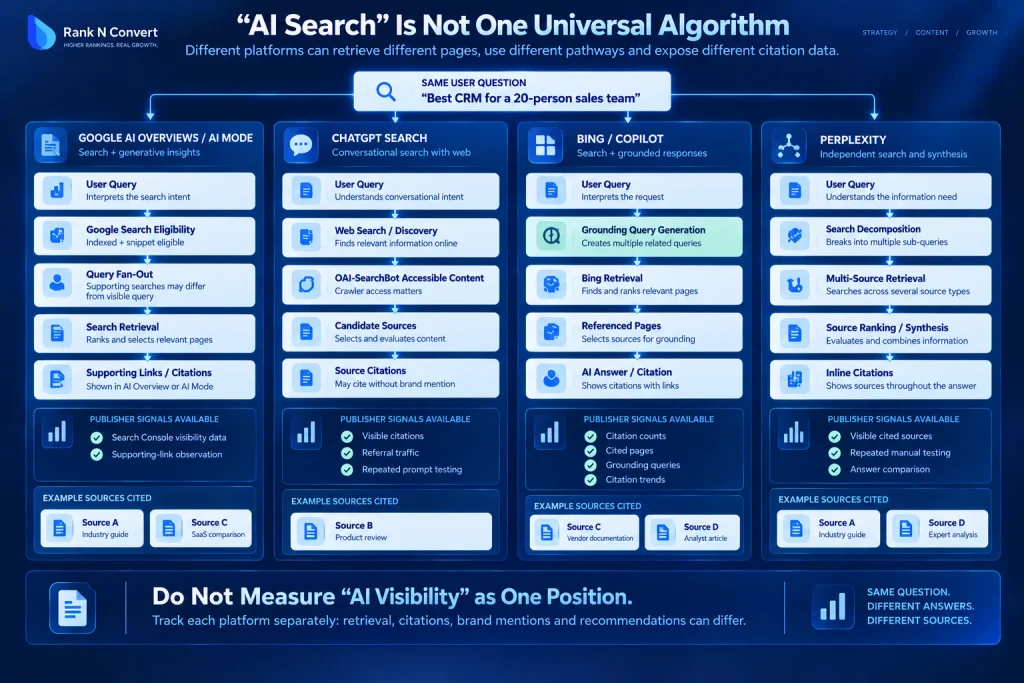
A better approach is to treat each platform as a separate retrieval and citation environment.
| Platform | What happens before citation | What publishers can observe | Important limitation |
| Google AI Overviews / AI Mode | Google Search retrieval + possible query fan-out | Search Console generative-AI visibility data | Traditional rank does not fully reveal fan-out retrieval |
| ChatGPT Search | Web discovery/search + OAI-SearchBot-accessible content | Visible citations and referral traffic | Crawler access does not guarantee retrieval or citation |
| Bing / Copilot | Search-grounded retrieval | Citation counts, cited pages, grounding queries, trends | Citation counts are not rankings |
| Perplexity | Its search infrastructure runs multiple searches and synthesizes sources | Visible citations in answers | Retrieval and source behavior should be tested independently |
Google AI Overviews and AI Mode: Search Eligibility, Query Fan-Out and Supporting Links
Google’s AI search features remain closely connected to Google Search.
Google says its generative Search experiences use its core Search ranking and quality systems to retrieve relevant pages from the Search index. A page must therefore be:
- indexed;
- eligible for normal Google Search;
- eligible to appear with a snippet.
There is no separate technical admission process for AI Overviews or AI Mode.
But the retrieval process can go beyond the search query you see.
Google confirms that both AI Overviews and AI Mode may use query fan-out: the model generates several related searches across subtopics and data sources, retrieves additional information, and builds the response from those results.
For example, a user might search:
“best CRM for a 20-person sales team.”
Google could need supporting information about:
- price for 20 seats;
- Salesforce integration;
- reporting;
- onboarding;
- contract terms.
That means your organic position for the broad CRM query does not tell you whether your page was competitive for every supporting search.
Google also warns that AI Overviews and AI Mode can use different models and techniques, so their responses and supporting links can differ even within Google’s own ecosystem.
Measurement has improved in 2026.
Google introduced dedicated generative AI performance reporting in Search Console, and by August 31, 2026 said those insights had rolled out worldwide. The reports provide dedicated visibility into impressions from generative Search features such as AI Overviews and AI Mode.
That is useful, but do not turn impression data into a fictional “AI rank.”
Use Google data to answer:
- Are we appearing in generative Search?
- Which pages are earning visibility?
- Is visibility rising or falling?
- Does the change align with organic Search changes?
Then audit the actual answers separately when you need to understand which evidence received the supporting link and why.
ChatGPT Search: Web Discovery, OAI-SearchBot and Source Citations
ChatGPT Search has a different discovery path.
OpenAI says any public website can potentially appear in ChatGPT Search. To help content be discovered, included in summaries and snippets, and clearly cited and linked, publishers should make sure they are not blocking OAI-SearchBot.
That makes crawler access an important eligibility check.
But it is not a ranking instruction.
Allowing OAI-SearchBot does not mean ChatGPT will:
- retrieve your URL for every relevant prompt;
- prefer it over a competitor;
- cite it;
- name your brand;
- recommend your product.
OpenAI’s own publisher guidance makes an interesting technical distinction. Even when a page is disallowed to OAI-SearchBot, OpenAI may sometimes obtain the URL through another search provider or by crawling other pages and surface limited information such as a link and title in certain experiences.
That is another reminder that URL discovery, page retrieval, content use, and citation are not identical events.
For ChatGPT Search, monitor separately:
- whether OAI-SearchBot can access the site;
- whether your URLs appear as sources;
- which prompts trigger those citations;
- whether your brand is actually named;
- whether the cited evidence contributes to the answer;
- referral traffic from ChatGPT where measurable.
Do not call any one of those metrics a “ChatGPT ranking.”
Bing and Copilot: Grounding Queries and Page-Level Citation Reporting
Microsoft currently exposes one of the clearest publisher views into the retrieval-to-citation process.
In February 2026, Bing Webmaster Tools launched AI Performance, covering content cited across:
- Microsoft Copilot;
- AI-generated answers in Bing;
- select partner integrations.
Its reporting includes:
- Total Citations
- Average Cited Pages
- Grounding Queries
- Page-Level Citation Activity
- Visibility Trends
The most diagnostically useful field is Grounding Queries.
Microsoft defines these as key phrases used by the AI while retrieving content that was ultimately referenced in a generated answer.
Imagine your page receives citations for:
- “CRM Salesforce integration”;
- “CRM reporting dashboard”;
- “CRM guest user limits.”
That tells you something traditional rank tracking may never reveal:
which retrieval jobs Microsoft associates with the page.
Microsoft also explicitly warns against misreading its data.
Citation counts do not indicate:
- ranking;
- authority;
- importance;
- placement within a particular response.
And grounding queries represent a sample of overall citation activity.
So use Bing’s reporting as diagnostic evidence.
Do not turn:
“Our URL has 200 citations.”
into:
“We rank first in Copilot.”
Those statements mean different things.
Perplexity: Evaluate Its Retrieval and Citation Behavior Separately
Perplexity should not be treated as “ChatGPT with more citations.”
Its own documentation describes a search-centric workflow.
Perplexity Pro Search can:
- break a complex question into searches;
- search across web pages, academic material, forums, videos, and other sources;
- synthesize information from multiple sources;
- provide direct source links alongside the answer.
Perplexity also describes operating its own large-scale search infrastructure. In its 2026 explanation of its search architecture, the company said its index tracks more than 200 billion unique URLs and uses a combination of lexical and semantic retrieval and ranking. It also identifies PerplexityBot as its search crawler.
That matters because a URL’s visibility in Google or ChatGPT does not prove anything about its position inside Perplexity’s retrieval environment.
The platform may differ in:
- crawler discovery;
- index coverage;
- refresh timing;
- query decomposition;
- retrieval ranking;
- source count;
- source-type mix;
- model used to synthesize the answer.
Even different Perplexity modes can change the retrieval environment. Its Pro Search documentation allows users to select different models and search focuses such as Web, Academic, Finance, or Files.
So test Perplexity separately.
Do not assume:
“We fixed ChatGPT citations, therefore Perplexity should improve too.”
Why You Should Never Treat “AI Search” as One Universal Algorithm
The strongest reason is empirical: the platforms behave differently.
A 2026 study covering 602 controlled prompts, 21,143 valid search-layer citations, and 18,151 successfully fetched pages compared ChatGPT, Google AI Overview/Gemini, and Perplexity.
The researchers found that citation breadth and citation depth diverged:
- Perplexity and Google tended to cite more sources;
- ChatGPT tended to cite fewer sources;
- the sources ChatGPT did cite showed higher average influence on the final answer in that dataset.
That does not establish a permanent ranking rule for any platform. Models, retrieval systems, interfaces, and source-selection methods continue to change.
But it demonstrates why combining all platforms into one “AI visibility score” can hide useful information.
Track at least:
| Metric | ChatGPT | Bing/Copilot | Perplexity | |
| Prompt tested | ✓ | ✓ | ✓ | ✓ |
| URL citation | ✓ | ✓ | ✓ | ✓ |
| Brand mention | ✓ | ✓ | ✓ | ✓ |
| Recommendation | ✓ | ✓ | ✓ | ✓ |
| Grounding/retrieval query | Limited/platform data | Not generally exposed like Bing | ✓ where reported | Not equivalent to Bing reporting |
| Repeated runs | ✓ | ✓ | ✓ | ✓ |
A competitor can beat you in ChatGPT and lose to you in Google AI Mode.
That is not contradictory.
It means different retrieval and citation systems made different choices.
A Citation Does Not Necessarily Mean Your Brand Won
Seeing your URL in an AI answer feels like success.
Sometimes it is.
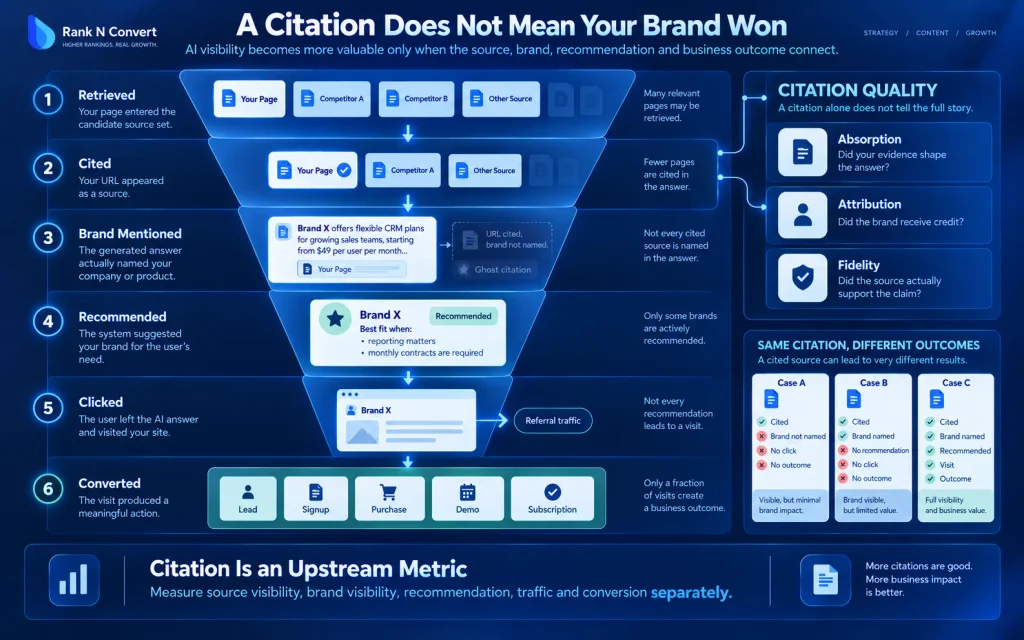
But a citation can represent several very different outcomes:
- Your URL was used.
- Your brand was named.
- Your product was recommended.
- Your evidence actually shaped the answer.
Those are not interchangeable.
For practical measurement, separate six outcomes:
| Outcome | What actually happened |
| Citation | Your URL appeared as a source |
| Brand mention | Your company/product name appeared in the answer |
| Recommendation | The system suggested your brand as an option |
| Citation absorption | Information from your source materially shaped the response |
| Full attribution | Your evidence was used and your brand received visible credit |
| Citation fidelity | The cited page genuinely supports the claim attached to it |
Citation: Your URL Appears as a Source
A citation answers one narrow question:
Was this URL displayed as supporting material?
That matters.
It means your content entered far enough into the system’s process to appear as a source.
But citation alone does not tell you:
- how much information the system used;
- whether the company was named;
- whether the citation supported a positive or negative statement;
- whether users were encouraged to choose the brand;
- whether the source correctly supported the attached claim.
Treat citation count as a source-visibility metric, not an all-purpose business outcome.
Brand Mention: Your Company Is Named in the Answer
Citation and mention can separate dramatically.
Semrush’s June 2026 study examined 3,981 domain appearances across 115 prompts, 14 countries, and four AI experiences: ChatGPT, Gemini, Google AI Overviews, and Google AI Mode.
It found:
- 61.7% were citations where the brand was not named;
- 13.2% contained both a citation and brand mention;
- 25.1% were brand mentions without a citation.
The study called the first group ghost citations.
Within its dataset, platform behavior also differed sharply. ChatGPT cited the domain in 87% of appearances but named the brand in only 20.7%. Gemini showed almost the opposite pattern: brand mention occurred in 83.7% of appearances while citation occurred in 21.4%.
Those percentages belong to that specific study and prompt set. They are not permanent platform rates.
But the distinction is important:
A source can supply the information while another brand receives the user’s attention.
Recommendation: The AI Actively Suggests Your Brand or Product
Being mentioned still does not mean being recommended.
Consider three responses:
Citation only:
“Annual CRM contracts commonly provide lower monthly pricing.[Your URL]”
Mention:
“HubSpot and Salesforce are widely used CRM platforms.”
Recommendation:
“For a 20-person team prioritizing simple onboarding, HubSpot may fit these requirements better because…”
The third outcome has much stronger commercial meaning.
Recommendations should therefore be tracked separately from citations.
Record:
- Was the brand recommended?
- For which user or use case?
- Was it first among several options?
- What reason was given?
- Was the reason supported by evidence?
- Was the recommendation positive, conditional, or negative?
A citation dashboard that does not distinguish these outcomes can make performance look stronger than it really is.
Citation Absorption: Your Information Actually Shapes the Answer
A source can appear in the bibliography without contributing much to the generated response.
This is where citation absorption becomes useful.
The 2026 cross-platform study defined citation absorption as the extent to which a cited page contributes:
- language;
- evidence;
- facts;
- structure;
- supporting information
to the generated answer.
Across its 21,143 valid citations, the study found that citation quantity and citation influence were not the same thing. Systems that cited more pages did not necessarily rely equally on every cited page.
For your own audit, ask:
- Did the answer use a number unique to our research?
- Did it reproduce our comparison?
- Did it use our definition?
- Did it follow our procedure?
- Did it rely on our original calculation?
- Or did our URL simply appear beside several interchangeable sources?
That difference matters.
Ten shallow citations may create less information influence than one source that supplies the central evidence used throughout the response.
Full Attribution: Your Evidence and Your Brand Both Receive Credit
The strongest source outcome is not merely:
“Our URL appeared.”
It is:
“Our information influenced the answer, and the user could identify us as the source.”
For this article, call that full attribution.
It requires two things:
- the source’s evidence materially contributes to the response;
- the answer visibly connects that evidence with the organization, researcher, publication, or brand responsible for it.
For example:
Weak attribution:
“Research found that 85% of retrieved pages were not cited.”
Stronger attribution:
“AirOps found that roughly 85% of the 548,534 pages retrieved in its March 2026 ChatGPT study did not appear in the final citations.”
Now the evidence and its origin travel together.
This is particularly important for:
- original research;
- proprietary datasets;
- surveys;
- named frameworks;
- expert analysis;
- original calculations.
Semrush’s ghost-citation data shows why this matters: only 13.2% of appearances in its sample contained both the source citation and a brand mention.
So if your goal is brand recognition, do not report citation count alone.
Citation Fidelity: Does Your Page Actually Support the Claim Attached to It?
There is one final test.
- Open the citation.
- Read the claim.
Then ask:
Does this source actually prove what the AI answer says it proves?
That is citation fidelity.
A citation can fail in several ways:
- the source discusses the topic but not the specific claim;
- the source supports only part of the sentence;
- the number is correct but refers to a different population;
- the evidence is outdated;
- the source says “may,” while the AI answer says “does”;
- a correlation is rewritten as causation;
- an exception or limitation disappears.
This is not a theoretical problem.
A 2026 longitudinal study of Google AI Overviews issued 55,393 queries and decomposed responses into 98,020 atomic claims. Researchers found that 11.0% of claims were unsupported by the cited pages, with omitted support being the dominant failure type.
So a citation is not proof of citation accuracy.
Use a simple fidelity audit:
- Copy the exact claim made by the AI.
- Open the cited page.
- Locate the evidence supporting that claim.
- Check whether the number, entity, period, market, and conditions match.
- Check whether the AI strengthened the original wording.
- Classify the citation as:
- fully supported;
- partially supported;
- unsupported;
- outdated.
That gives you a much more meaningful AI visibility dashboard.
Instead of reporting:
“We earned 420 AI citations this month.”
report:
- citation frequency;
- brand-mention frequency;
- recommendation frequency;
- absorption/influence;
- full attribution;
- citation fidelity.
That tells you whether the AI merely found your page, whether it used your evidence, and whether the user ever learned that the evidence came from you.
The difference matters. A citation is a source event. Brand visibility is an outcome.
How to Compare Your Page With the Competitor That AI Cited
When AI cites a competitor instead of you, the worst response is to open both pages and ask:
“Whose content looks better?”
That question is too broad. Instead, compare the two pages at the exact point where the AI needed evidence.
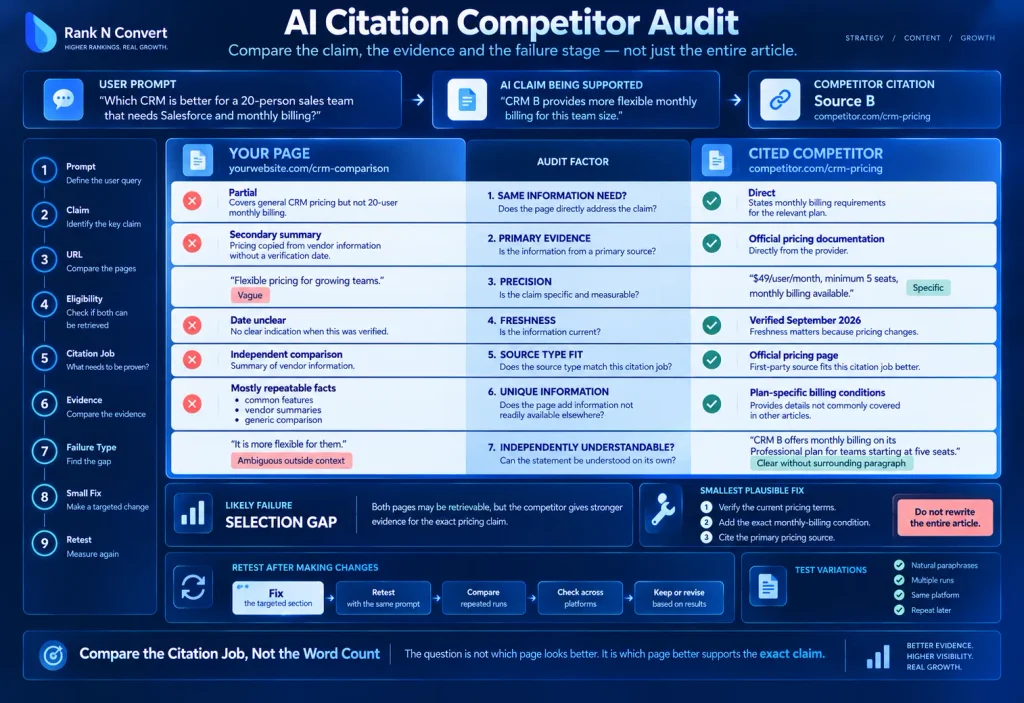
Use this nine-step audit:
| Step | Question |
| 1 | What exactly did the user ask? |
| 2 | Which claim did the competitor citation support? |
| 3 | What URL and source type supplied that evidence? |
| 4 | Could your page actually be discovered and used? |
| 5 | What citation job was being performed? |
| 6 | Which page supplied the stronger evidence for that job? |
| 7 | Where in the citation pipeline did you lose? |
| 8 | What is the smallest plausible fix? |
| 9 | Does repeated testing show that the change helped? |
This workflow matters because retrieval and citation are separate decisions. AirOps analyzed 548,534 pages retrieved across 15,000 ChatGPT prompts and found that only about 15% of retrieved pages were ultimately cited. Simply appearing in the candidate pool does not explain why one page survives into the final answer.
Step 1 – Capture the Exact User Prompt
Start with the prompt exactly as it appeared.
Do not reduce:
“What is the best CRM for a 20-person B2B sales team that uses Salesforce and wants monthly billing?”
to:
“best CRM.”
Those are different information problems.
Record:
- exact wording;
- platform;
- date;
- country or market if relevant;
- model or mode if visible;
- whether web search was active;
- whether the prompt was a fresh conversation or follow-up.
Why?
Because small changes can alter:
- user intent;
- fan-out queries;
- source retrieval;
- recommendation criteria;
- cited URLs.
Google confirms that its AI features can create multiple related searches through query fan-out, meaning the system may retrieve evidence for supporting questions rather than only the original visible query.
So preserve the actual prompt before diagnosing anything.
Step 2 – Identify the Exact Claim the Competitor Citation Supports
Do not compare the entire AI answer.
Find the specific sentence, clause, or factual statement attached to the competitor citation.
For example:
AI claim:
“CRM X is cheaper for teams under 25 users.”
Now ask:
What evidence is required to support that sentence?
Possibilities include:
- price per user;
- minimum seats;
- plan requirements;
- billing period;
- mandatory add-ons.
This immediately narrows the audit.
Your competitor may not have won the whole answer.
They may have won one citation job.
Copy the claim into your audit sheet exactly as shown.
Then separate:
Claim: CRM X is cheaper for teams under 25 users.
Evidence needed: comparable current price for the same number of seats under equivalent billing conditions.
That distinction prevents you from comparing unrelated parts of the two pages.
Step 3 – Record the Cited URL and Source Type
Next, identify what kind of source the AI selected.
Classify it as:
- official product page;
- pricing page;
- documentation;
- research paper;
- government source;
- independent comparison;
- publisher/article;
- review site;
- community/forum;
- news source;
- other.
Source type matters because different claims require different authority.
If the answer is citing:
an exact subscription price
and your competitor is the official vendor pricing page, your generic comparison article may not be the strongest source for that job.
If the claim concerns:
customer complaints
an independent review dataset or community discussion may fit better than the vendor’s website.
Record both:
Cited URL: competitor.com/pricing
Source type: first-party pricing page
This creates context before you judge the content itself.
Step 4 – Check Whether Your Page Was Eligible and Discoverable
Before comparing writing quality, confirm your page could realistically enter the candidate set.
For Google AI Overviews and AI Mode, Google says a page must be indexed and eligible to appear in Search with a snippet. There are no separate AI-specific technical requirements.
For ChatGPT Search, OpenAI says publishers should allow OAI-SearchBot if they want their content to be discoverable and usable in summaries, snippets, citations, and links.
Check:
- Google index status;
- canonical selection;
- robots.txt;
- noindex;
- HTTP response;
- OAI-SearchBot access;
- firewall/CDN blocks;
- public accessibility;
- whether the important information appears in readable page content.
If your page fails here, stop.
You have an eligibility or discovery problem.
Do not rewrite the introduction.
Step 5 – Identify the Citation Job
Now name the evidence job explicitly.
Examples:
- Definition job: define a concept.
- Price job: establish current cost.
- Comparison job: compare two options.
- Statistic job: substantiate a number.
- Procedure job: explain how something is done.
- Limitation job: document a restriction.
- Sentiment job: represent user experience.
- Recommendation job: justify which option fits a use case.
This step forces you to judge the competitor against the right standard.
- A pricing page should not be evaluated on storytelling.
- A customer-review source should not be evaluated on product documentation.
- A government regulation should not be judged by how engaging the prose is.
Ask:
What work is this citation doing inside the answer?
That is more useful than asking which article has “higher quality.”
Step 6 – Compare Evidence Instead of Comparing Overall “Content Quality”
This is the core of the audit.
Put your page and the cited competitor side by side and compare only the evidence relevant to the claim.
Does each page answer the same information need?
First confirm that the two pages are actually competing.
Your page may discuss:
CRM pricing
while the citation needs:
CRM price for 20 users on monthly billing.
Those are related, but not identical.
Mark each page:
- Direct match
- Partial match
- Adjacent topic
- Does not answer
If your competitor gives a direct answer and you provide only adjacent information, the likely problem is relevance.
Which page uses the stronger primary evidence?
Trace the source chain.
For a price:
- official pricing page beats an uncited secondary summary.
For a regulation:
- regulator documentation usually beats a marketing article.
For a study:
- original paper is stronger than a third-hand seo blog summary.
Ask:
- Does the page cite the primary source?
- Does it interpret it correctly?
- Is the source still current?
- Are limitations preserved?
Do not award your page points simply for having more external links.
Evidence quality matters more than link count.
Which page gives the more precise answer?
Compare what each page actually says.
Your page:
“Tool X is affordable for small businesses.”
Competitor:
“Tool X costs $29 per user per month on annual billing, with a five-seat minimum.”
The competitor has given:
- amount;
- unit;
- billing condition;
- minimum requirement.
That is a more usable evidence unit. Replace vague adjectives with verifiable facts where evidence allows.
Which page has more current evidence where freshness matters?
Check dates only when the claim can decay.
Compare:
- prices;
- policies;
- versions;
- regulations;
- statistics;
- availability;
- recommendations.
If your competitor’s pricing was checked in September 2026 and yours still reflects 2024 pricing, that difference matters. If both pages define an unchanged technical concept correctly, freshness may not explain anything.
The test is:
Would newer evidence materially change the correct answer?
If not, freshness is probably not your main problem.
Which source type better fits the claim?
This often explains the citation faster than any content analysis.
Ask:
Who is naturally best placed to prove this?
Examples:
| Claim | Stronger source type |
| Current price | Official vendor |
| Product specification | Manufacturer/documentation |
| Regulation | Government/regulator |
| Customer complaints | Review/community evidence |
| Industry benchmark | Original research |
| Best option | Transparent independent comparison |
Do not try to make your own domain the best source for every possible claim.
Sometimes the correct conclusion is:
“Our page should not win this citation.”
That is useful diagnosis too.
Which page contributes unique information?
Run the Source Substitutability Test.
Ask:
If this page disappeared, what useful evidence would disappear with it?
Look for:
- original data;
- calculations;
- first-hand testing;
- regional evidence;
- expert interpretation;
- primary-document synthesis;
- specific limitations;
- decision frameworks.
Google’s 2026 guidance encourages valuable, unique, non-commodity content rather than information that simply repeats what is already widely available.
Unique wording is not enough. Look for unique utility.
Which answer is independently understandable?
Finally, extract the key passage from each page. Can someone understand it without reading five previous paragraphs?
Check whether the passage clearly states:
- the entity;
- the direct answer;
- supporting evidence;
- conditions;
- important qualification;
- date where needed.
Avoid artificial “AI chunks.” But also avoid writing where:
“it,” “they,” “this plan,” or “that option”
becomes impossible to resolve when the passage is separated from surrounding context. The goal is not robotic repetition. It is unambiguous evidence.
Step 7 – Classify the Failure Using the Citation Loss Matrix
After the comparison, assign one primary failure type.
| Observation | Classification |
| Page cannot be crawled/indexed | Eligibility gap |
| Page is accessible but does not enter relevant retrieval | Retrieval gap |
| Both pages are candidates but competitor gets citation | Selection gap |
| URL is cited but brand is absent | Attribution gap |
| URL appears as source but contributes little | Absorption gap |
| Results change repeatedly | Volatility / measurement issue |
Do not assign five labels because five things could theoretically improve. Choose the earliest stage where the evidence shows a meaningful failure. That keeps the repair focused.
Step 8 – Fix the Smallest Plausible Cause
This is where most AI optimization goes wrong. Teams often diagnose one weak citation and then:
- rewrite the whole article;
- change every heading;
- add FAQ schema;
- insert ten statistics;
- expand the word count;
- update the publication date;
- change internal links.
Now even if performance changes, you do not know why.
A better approach is:
one diagnosis → one targeted intervention → retest
Examples:
| Diagnosed problem | Smallest plausible fix |
| Price is vague | Add verified price, billing condition and date |
| Evidence is outdated | Replace the specific outdated evidence |
| Claim lacks primary support | Add the primary source |
| Integration limitation missing | Add the verified limitation |
| Passage is ambiguous | Rewrite only that evidence unit |
| Retrieval need is absent | Add the missing relevant subtopic |
| Technical access is blocked | Fix access; do not rewrite content |
This approach is supported by emerging research.
The 2026 AgentGEO paper introduced a diagnostic system that identified citation failure modes and applied targeted repairs rather than generic optimization. In its benchmark, AgentGEO reported more than 40% relative improvement in citation rates while modifying about 5% of content, versus 25% improvement for baseline approaches. The researchers also found that generic optimization could hurt some long-tail content.
- That does not mean “change exactly 5% of every page.”
- The study used its own benchmark and experimental setup.
The useful principle is:
Targeted repairs preserve what already works and make cause-and-effect easier to evaluate.
Step 9 – Retest Instead of Assuming the Rewrite Worked
Never use this sequence as proof:
Competitor cited → you edit page → your page cited once → edit worked.
Generative-search results are variable.
Citation sets can change across:
- repeated runs;
- paraphrased prompts;
- days;
- platforms;
- reasoning modes;
- updated indexes or models.
Research on generative-search measurement has found substantial citation variability across repeated samples, with apparent domain differences often falling within normal measurement noise.
So retest systematically.
At minimum, record:
- original prompt;
- 2–4 natural paraphrases;
- multiple runs;
- same platform;
- dates tested;
- whether your URL was retrieved;
- whether it was cited;
- whether the brand was named;
- competitor cited;
- claim supported.
A simple audit sheet might look like this:
| Prompt | Run | Our URL cited? | Competitor cited? | Brand named? | Citation job | Notes |
| Original | 1 | No | Yes | No | Price | Competitor uses current pricing |
| Original | 2 | Yes | Yes | Yes | Price | Both cited |
| Paraphrase A | 1 | Yes | No | Yes | Comparison | Our revised table used |
| Paraphrase B | 1 | No | Yes | No | Contract terms | Missing evidence remains |
Look for persistent patterns, not perfect consistency. If your page moves from almost never appearing to appearing repeatedly across comparable tests after a targeted change, you have stronger evidence that the intervention may have helped.
If nothing changes, return to Step 7 and reconsider the diagnosis. Do not automatically make the page longer.
The entire competitor audit can therefore be reduced to one sequence:
Capture the prompt → isolate the claim → identify the citation job → compare the evidence → classify the failure → make the smallest plausible repair → repeat the test.
That is a much stronger method than asking whether your competitor has more words, more headings, more schema, or a higher Domain Rating. You are not trying to make your page look more “AI optimized.”
You are trying to understand why this particular source was more useful for this particular claim under these particular conditions.
How to Get Cited by ChatGPT and AI Search: Fix the Stage You Are Losing At
There is no single fix for “we are not getting cited by AI.”
A blocked page, a retrieval miss, weak evidence, generic information, poor attribution, and normal citation volatility are different problems. Applying the same optimization checklist to all six wastes time and makes testing almost impossible.

The more useful rule is:
Fix the earliest broken stage in the citation chain.
Use this diagnosis-to-action map:
| What is failing? | What you should change first | What you should not start with |
| Eligibility | Crawling, indexing, server access | Content rewriting |
| Retrieval | Information-need relevance | Adding random statistics |
| Selection | Evidence for the exact claim | Increasing word count |
| Source substitution | Unique information or analysis | Rephrasing existing facts |
| Attribution | Clear entity-to-evidence relationship | More backlinks |
| Volatility | Measurement quality | Rewriting after one failed prompt |
This targeted approach has emerging research support.
The 2026 AgentGEO study built a system that diagnosed specific citation failure modes and applied targeted repairs instead of giving every page the same generic rewrite. In its benchmark, the approach produced more than 40% relative improvement in citation rates while changing roughly 5% of content, compared with 25% improvement for baseline methods. The study also found that generic optimization could hurt some long-tail content.
That does not mean editing exactly 5% of a live page will produce the same result.
The practical lesson is stronger:
Diagnosis should determine the intervention.
If You Have an Eligibility Problem, Fix Access and Indexing
If the page cannot enter the system, content improvements are premature. For Google AI Overviews and AI Mode, Google says a page must be:
- indexed;
- eligible for Google Search;
- eligible to appear with a snippet.
There are no extra technical requirements specifically for Google’s generative AI features. For ChatGPT Search, OpenAI recommends allowing OAI-SearchBot if you want content to be discovered and included in summaries, snippets, citations, and links.
Check:
- robots.txt;
- noindex;
- canonical selection;
- server status;
- CDN/WAF blocks;
- rendering;
- internal discovery;
- crawler access.
Decision rule:
If the page fails technical eligibility, fix that before touching the article copy.
If You Have a Retrieval Problem, Improve Information-Need Relevance
An indexed page can still fail to enter the right candidate set.
The common mistake is optimizing only for the visible keyword.
Suppose the prompt is:
“Best CRM for a 20-person sales team.”
The retrieval system may need evidence for:
- price for 20 users;
- Salesforce integration;
- reporting;
- onboarding;
- monthly contracts.
Google confirms that AI Overviews and AI Mode can use query fan-out, issuing related searches across subtopics and data sources.
If competitors appear for those supporting needs and your page does not, strengthen the missing information where it naturally belongs.
Do not automatically create five new pages.
Ask:
- Does the existing page genuinely answer this need?
- Is the answer direct enough to identify?
- Does another page on our site fit better?
- Is the missing subtopic important to the same user’s decision?
- Are we trying to rank one broad page for a question it barely answers?
Fix: improve semantic and factual coverage of the missing information need.
If You Have a Selection Problem, Improve the Evidence for the Exact Claim
If your page is already being retrieved, discovery is no longer the main problem. Now compare the claim the competitor was cited for.
For example:
AI claim:
“Tool A is cheaper for a 20-person team.”
Your page says:
“Tool A offers competitive pricing.”
The competitor provides:
- exact seat price;
- billing period;
- minimum seats;
- required plan;
- verification date.
That is a source-selection problem.
Controlled 2026 research using 252,000 pairwise trials across six LLMs found that topical relevance was one of the strongest citation-selection factors once candidate documents were already supplied to the model.
Improve the evidence required by the citation job:
- price → current price and conditions;
- statistic → original number, sample, period, source;
- comparison → explicit common criteria;
- procedure → ordered, verifiable steps;
- limitation → clear restriction;
- recommendation → transparent decision criteria.
Fix the evidence unit, not automatically the entire page.
If You Have a Source-Substitution Problem, Add Information Competitors Cannot Replace
Sometimes your page is accurate and relevant but contributes nothing distinctive.
Ask:
If this page disappeared, could another source reproduce every useful fact?
If yes, rewriting the sentences will not solve the real weakness.
Add genuine information gain where the topic allows it:
- original data;
- first-hand testing;
- regional evidence;
- current market analysis;
- primary-document research;
- original calculations;
- named expert interpretation;
- decision frameworks;
- documented negative findings.
Google’s 2026 generative-search guidance specifically encourages valuable, unique, non-commodity content rather than information that merely reproduces what already exists.
Do not interpret that as an “original research ranking bonus.” The value is more practical: Unique evidence makes your page harder to replace.
If You Have an Attribution Problem, Make the Entity and Evidence Relationship Explicit
A page can supply useful evidence without the brand receiving visible credit.
If you publish original research, avoid passages such as:
“The study found that 48% of users…”
when the reader cannot tell whose study it was. Where natural, connect:
entity + evidence + finding
For example:
Rank N Convert analysis of 500 GCC e-commerce offers found…”
is clearer than:
“Our analysis found…”
provided that the research genuinely exists and the methodology is disclosed.
Do the same for:
- named datasets;
- proprietary frameworks;
- expert commentary;
- original calculations;
- testing.
The goal is not repetitive brand insertion. It is to ensure the source of important evidence is unambiguous.
If You Only Have a Volatility Problem, Improve the Measurement Before Rewriting the Page
One of the easiest ways to create unnecessary SEO work is to treat every change in an AI answer as evidence that your content quality has changed.
| Test | What you observe | What it actually tells you |
|---|---|---|
| Monday | Competitor is cited | One observed AI response |
| Wednesday | Your domain is cited | A different observed response |
| Friday | Neither domain is cited | Another variation in source selection |
These three results do not automatically mean your competitor’s content was stronger on Monday, your content improved by Wednesday, and both websites became weaker by Friday.
Generative search is probabilistic. The same prompt can produce different retrieval paths, source selections, citations, and answer structures across comparable runs. A single appearance or disappearance therefore provides weak evidence of a genuine change in AI visibility.
Instead of reacting to individual tests, measure performance across a larger cohort of comparable runs and look for persistent patterns in citation frequency, brand-mention frequency, and source selection before deciding whether a page needs to be changed.
A 2026 study comparing repeated samples across Perplexity Search, OpenAI search, and Google Gemini found substantial variation in cited domains across repeated runs. The authors concluded that AI visibility should be treated as an estimate of an underlying distribution, not a fixed position. Apparent differences between domains often fell inside the normal statistical noise of the measurement process.
Another 2026 paper reaches the same practical conclusion: answers vary across runs, prompt wording, and time, making one-off observations unreliable.
So before rewriting anything, establish whether the loss is persistent.
Do not optimize against one screenshot. Optimize against a repeated pattern.
How Should You Measure AI Visibility Without Inventing a “ChatGPT Ranking”?
Traditional ranking tools condition us to expect:
Keyword → position → URL.
Generative search does not behave that cleanly.
The same prompt can:
- retrieve different pages;
- cite different sources;
- name different brands;
- recommend different products;
- produce different wording on another run.
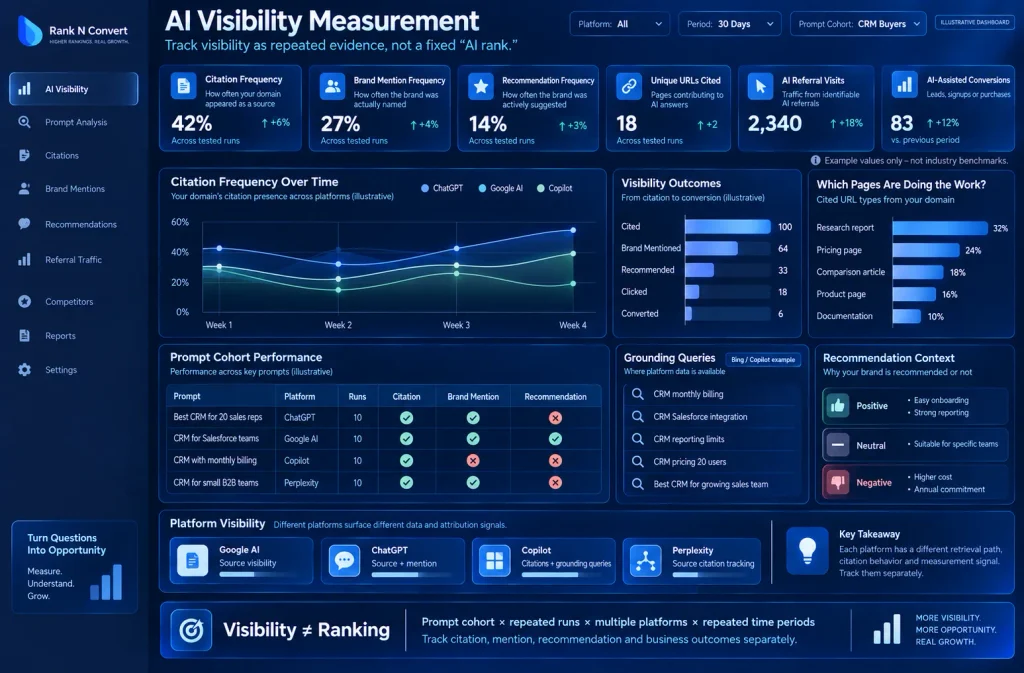
That means “we rank #3 in ChatGPT” is usually a misleading description unless a particular platform explicitly exposes a ranking metric with that meaning.
A better AI visibility dashboard measures several separate outcomes.
| Metric | What it tells you |
| Citation frequency | How often your domain/page appears as a source |
| Brand-mention frequency | How often your brand appears in the generated text |
| Recommendation frequency | How often the system actively suggests your brand |
| Cited URLs | Which pages are supplying evidence |
| Grounding queries | Which retrieval phrases led to citations where exposed |
| Sentiment | How the brand is characterized |
| Referral traffic | Whether users actually visit |
| Conversions | Whether visibility produces business value |
Do Not Test One Prompt Once
One answer is an observation. It is not a measurement system. Research on generative-search uncertainty found that repeated identical queries can return different citation sets and that domain rankings derived from those citations can move substantially between samples.
Variation can occur even within one product.
For example, Semrush’s June 2026 study found only 25.6% overlap in cited domains between minimal- and high-reasoning ChatGPT responses for the prompts it tested. That is one vendor dataset rather than a permanent ChatGPT rule, but it illustrates why configuration matters.
Therefore record the testing environment alongside the result.
Use a Repeatable Prompt Cohort
Instead of tracking one keyword, create a prompt cohort: a fixed group of prompts representing the same underlying information need from different realistic angles.
An illustrative cohort for:
“best CRM for a 20-person sales team”
could include:
- “What is the best CRM for a 20-person sales team?”
- “Which CRM would you choose for 20 sales reps using Salesforce?”
- “Compare CRM options for a 20-person B2B sales team.”
- “Which CRM is best for a small sales team that needs reporting and monthly billing?”
The wording changes. The underlying decision remains comparable.
Same core prompt
Keep the original prompt in every measurement cycle. This gives you a stable reference point.
Record:
- exact wording;
- market;
- platform;
- date;
- mode/model where visible;
- whether search was enabled.
Never quietly change the prompt and compare the output as if the test remained identical.
Natural paraphrases
Real users rarely ask the same question in exactly the same way. Paraphrases also help reveal whether your visibility depends on one fortunate wording. Keep the intent and constraints constant while changing natural phrasing.
Do not create paraphrases that secretly change the problem.
“Best CRM for 20 users”
and:
“Cheapest CRM for 20 users”
are not paraphrases. The second adds a price-priority condition.
Multiple runs
Repeat prompts.
There is no defensible universal rule such as:
“Five runs is always enough.”
The amount of sampling needed depends on:
- how volatile the query is;
- how important the decision is;
- how narrow the confidence range needs to be.
The statistical literature recommends treating citation visibility as a sampled distribution and reporting uncertainty rather than assuming a single output represents the system.
For routine monitoring, choose a repeat count you can sustain consistently.
For important experiments, increase repetitions rather than drawing conclusions from a tiny sample.
Multiple platforms
Do not merge Google AI Mode, ChatGPT, Copilot, and Perplexity into one result. Record each separately.
The 2026 critical review of 45 GEO studies found substantial platform differences and concluded that there is currently no demonstrated optimization technique with a stable, longitudinal, cross-platform causal effect on organic discoverability and downstream outcomes.
So your measurement might show:
- ChatGPT: strong
- Google AI Mode: moderate
- Copilot: weak
- Perplexity: strong
That is more useful than converting all four into an unexplained:
AI Visibility Score: 74/100
Repeated time periods
Run the cohort again on a fixed schedule.
For example:
Week 1 → Week 2 → Week 3 → Week 4
This helps distinguish:
- one-off variability;
- persistent improvement;
- platform changes;
- competitor movement;
- deterioration.
Keep major page changes recorded alongside your measurement dates.
Otherwise you will not know what changed between observations.
Track Citation Frequency Separately From Brand Mentions
For each prompt cohort, calculate citation visibility and brand visibility separately.
Start with citation frequency, which measures how often your URL or domain appears as a cited source across comparable runs. Divide the number of runs in which your domain was cited by the total number of comparable runs.
For example, if your domain appears as a source in 18 out of 30 runs, your citation frequency is 60%.
Next, calculate brand-mention frequency separately. This measures how often the generated answer explicitly names your brand, regardless of whether your URL is cited. If your brand appears in 9 out of the same 30 runs, your brand-mention frequency is 30%.
In this example, your website has 60% citation visibility but only 30% explicit brand visibility.
That gap matters because being used as a source does not necessarily mean the user sees or remembers your brand. Track citation frequency and brand-mention frequency as separate metrics rather than combining them into a single AI visibility score.
Track Cited URLs and Grounding Queries Where Platforms Expose Them
Domain-level visibility can hide the actual content doing the work. Track which URLs repeatedly appear. You may discover that:
- one research report earns most citations;
- product pages dominate commercial prompts;
- an old blog post is being cited instead of the preferred page;
- competitor documentation wins technical prompts.
Microsoft provides especially useful publisher-side telemetry. Bing Webmaster Tools’ AI Performance report currently exposes:
- total citations;
- cited pages;
- citation trends;
- page-level citation activity;
- sampled grounding queries used during retrieval.
Microsoft explicitly warns that citation counts do not represent ranking, authority, importance, or answer position. That is exactly how the metric should be treated.
Google also expanded its own measurement in 2026. Its dedicated Generative AI performance reports in Search Console rolled out worldwide by August 31, 2026 and currently show:
- impressions;
- pages;
- countries;
- devices for Search;
- performance over time.
These reports cover visibility in generative features such as AI Overviews and AI Mode.
Notice what Google does not call this:
a fixed AI ranking report.
Use the platform data that genuinely exists instead of reverse-engineering precision that does not.
Track Recommendation and Sentiment Separately From Citation
A citation can support a negative statement.
For example:
“Brand X is expensive compared with these alternatives.”
Your pricing page may be the citation.
That is strong citation visibility.
It may not be the business outcome you wanted.
Track at least:
- recommended;
- mentioned but not recommended;
- not mentioned.
Then record the context separately:
- positive;
- neutral;
- negative;
- mixed.
For recommendations, also record why the brand was suggested.
Examples:
- lower price;
- easier setup;
- regional availability;
- integrations;
- customer support.
This gives product and marketing teams information they can actually act on.
Track Referral Traffic and Business Outcomes Separately From Visibility
Citation visibility is an upstream metric. Traffic and conversions are downstream outcomes.
Do not assume:
more citations → more clicks → more revenue
without measuring each step. For ChatGPT, OpenAI currently adds:
utm_source=chatgpt.comto referral URLs, allowing publishers that permit OAI-SearchBot to identify inbound ChatGPT traffic in analytics tools such as Google SEO Analytics.
For Google, Search Console’s generative-AI reports provide dedicated visibility data, while Google recommends using analytics tools to track conversions and on-site engagement after the click.
A useful measurement chain is:
Prompt visibility → citation → brand mention → recommendation → click → engaged visit → conversion
Do not collapse those stages into one KPI.
A practical monthly dashboard might therefore report:
| Metric | This month | Previous month | Why it matters |
| Citation frequency | 42% | 34% | Source visibility |
| Brand-mention frequency | 27% | 26% | Brand recognition |
| Recommendation frequency | 14% | 9% | Commercial consideration |
| Unique URLs cited | 18 | 13 | Content footprint |
| Positive recommendation share | 71% | 67% | Recommendation context |
| AI referral visits | 2,340 | 1,890 | Traffic |
| AI referral conversions | 83 | 61 | Business outcome |
The numbers above are illustrative, not benchmarks. The important point is the structure.
A good AI visibility system should tell you:
- Are we being found?
- Are we being cited?
- Are we being named?
- Are we being recommended?
- Are users coming to the site?
- Are those visits producing value?
And because generative search is variable, each of those metrics should be evaluated across a repeatable sample of prompts, runs, platforms, and time periods.
That is a much more defensible measurement system than claiming:
“We rank #2 in ChatGPT.”
In generative search, visibility is better treated as a pattern with uncertainty, not a permanent position.
What AI Citation Research Still Cannot Reliably Prove
AI citation research is advancing quickly, but the evidence is still narrower than many “ChatGPT ranking factor” articles suggest.
The most useful 2026 review so far examined 45 GEO studies published between 2023 and July 2026. Its conclusion was not that optimization is useless. It was that generative visibility is a multi-stage, partly observable process involving search activation, crawling, retrieval, reranking, context allocation, citation, absorption, attribution and later user behavior. No reviewed technique showed a stable, longitudinal, cross-platform causal effect across that entire chain.
That distinction protects you from turning one interesting experiment into a universal SEO rule.
| Research finding | What it can support | What it cannot automatically prove |
| A content change increases citation in a fixed-context experiment | The change affected post-retrieval selection under those conditions | The page will be discovered more often on the open web |
| Cited pages frequently contain Feature X | Feature X is associated with citation in that dataset | Adding Feature X will cause more citations |
| A tactic works in ChatGPT | The tactic affected the tested ChatGPT setup | It will work in Google AI Mode, Copilot or Perplexity |
| One prompt cites your competitor | Your competitor won that observation | Your competitor has a stable “AI ranking” |
| A targeted rewrite improves a benchmark | Diagnosis-led editing can be promising | The same percentage lift will occur on every live website |
There Is No Stable Universal List of “AI Ranking Factors”
Traditional SEO already suffers when complex systems are reduced to numbered lists of “ranking factors.” AI search makes that simplification even riskier.
A generated answer can involve several distinct decisions:
- whether search is triggered;
- whether a page can be crawled;
- whether it enters retrieval;
- where it is placed in the available context;
- whether it receives a citation;
- how much of its evidence is absorbed;
- whether the brand is named;
- whether the user eventually clicks.
A factor that matters strongly at one stage may matter little at another.
The 2026 critical review of 45 studies found topical relevance and context position among the more reproducible effects, while generic optimization heuristics transferred poorly across studies and environments. It also reported that competition between documents can weaken individual gains.
So claims such as:
- “Tables are an AI ranking factor.”
- “Freshness is an AI ranking factor.”
- “Schema increases ChatGPT rankings.”
are too broad. A more defensible statement is:
Certain characteristics can affect particular stages under particular experimental conditions.
That wording may sound less exciting, but it is much more useful when deciding what to change.
A Technique That Changes Citation Selection After Retrieval May Not Improve Open-Web Retrieval
This may be the most important methodological distinction in GEO research.
The What Gets Cited study ran 252,000 paired trials across six LLMs. Researchers inserted exactly two competing sources into the model context and varied one factor at a time. Topical relevance and source position showed the strongest effects on first-citation selection; explicit pricing and recent timestamps also helped consistently in that setup.
That is strong evidence for a specific question:
When both documents are already present, what can influence which one is cited first?
It does not directly answer:
What makes a search engine discover and retrieve the document from the open web?
Those are different experiments.
If both documents are manually injected into context, the researchers have already bypassed:
- crawling;
- indexing;
- search activation;
- query fan-out;
- organic retrieval;
- reranking before context inclusion.
The July 2026 review makes this boundary explicit: effects observed on already-retrieved content establish neither organic discoverability nor durable downstream traffic effects.
So if a controlled experiment finds that explicit pricing helps citation selection, the safe takeaway is:
Make pricing explicit when price is part of the citation job.
Not:
“Add prices and Google AI Mode will retrieve your page more often.”
The second claim has crossed an evidence boundary.
Correlation Between Cited Pages and a Feature Does Not Prove That Adding the Feature Causes Citations
Suppose a dataset shows that frequently cited pages tend to contain:
- more statistics;
- more schema;
- more backlinks;
- more brand mentions;
- more headings;
- newer timestamps.
That observation can identify a useful research direction. It cannot, by itself, tell you what will happen if you add that feature to your page. The reason is confounding.
Pages with more backlinks may also belong to:
- larger brands;
- older domains;
- stronger publishers;
- pages with better organic rankings;
- companies with more PR coverage.
Pages with schema may come from technically mature sites that also have:
- cleaner templates;
- stronger internal linking;
- better-maintained content;
- dedicated SEO teams.
A correlation therefore answers:
“Which characteristics occur alongside citation visibility?”
A causal experiment tries to answer:
“If we change this characteristic while holding important alternatives constant, does citation behavior change?”
Do not treat those questions as interchangeable.
For your own SEO decisions, ask:
- Was the variable actually manipulated?
- Were comparable pages used?
- Was retrieval controlled?
- Were both sources already supplied to the model?
- Was the outcome citation, retrieval, mention, recommendation or traffic?
- Were other page changes happening at the same time?
If those questions are unclear, treat the result as evidence to investigate, not an instruction to deploy site-wide.
Results From One AI Engine Should Not Automatically Be Applied to Another
Google AI Mode, ChatGPT Search and Perplexity are not three interfaces sitting on one universal ranking system. Cross-platform research consistently finds differences.
One 2026 analysis used 602 controlled prompts, 21,143 valid citations and 18,151 fetched pages across ChatGPT, Google AI Overview/Gemini and Perplexity. It found that Google and Perplexity tended to cite more sources, while ChatGPT cited fewer sources but showed higher average influence from the pages it did cite in that dataset.
A newer multilingual mental-health audit also found sharp platform differences in citation consistency and the types of organizations each system surfaced, despite using the same underlying questions.
These are not permanent descriptions of the platforms. They demonstrate why cross-platform generalization is dangerous.
A tactic tested on:
ChatGPT + one model + one date + one query class
should not automatically become:
“an AI search ranking factor.”
Before applying a finding elsewhere, check:
- platform;
- model;
- search mode;
- data-collection period;
- geography;
- query type;
- retrieval setup;
- measured outcome.
Treat each engine as its own experimental environment until evidence shows otherwise.
Results From One Prompt or One Run Should Not Be Treated as a Fixed Ranking
Generative search is not deterministic enough for one prompt result to behave like a traditional ranking position.
A March 2026 study repeatedly sampled Perplexity Search, OpenAI SearchGPT and Google Gemini. Identical queries produced different answers and different citation sets over time. The researchers found that many apparent differences between domains fell within the noise floor of the measurement process, and citation rankings were unstable across samples.
Another 2026 measurement paper reached the same practical conclusion: AI visibility should be treated as a distribution, because results can vary across runs, wording and time.
So avoid statements such as:
“We rank #2 in ChatGPT.”
unless the platform itself exposes a metric with that exact meaning.
Instead, measure:
- citation frequency;
- brand-mention frequency;
- recommendation frequency;
- repeated prompt outcomes;
- cited URLs;
- platform;
- period.
One output is a data point. A repeated pattern is evidence.
The Most Defensible Strategy Is Diagnosis, Targeted Improvement and Repeated Testing
The research becomes much more useful once you stop looking for a universal recipe.
The July 2026 review concludes that current evidence is strongest for stage-specific effects, while no reviewed tactic yet demonstrates stable, longitudinal, cross-platform causal improvement from discovery through downstream outcomes. It recommends repeated measurements, paraphrases, controls and human validation.
AgentGEO provides a practical example of that philosophy. Instead of applying the same rewrite rules to every document, it classified citation failure modes and selected targeted repairs. In its benchmark, the system reported more than 40% relative citation-rate improvement while modifying about 5% of content, versus 25% for baseline approaches. It also found that generic optimization could damage some long-tail content.
Again, those percentages belong to that benchmark. Do not turn “5%” into a live-site formula.
Take the method instead:
- Identify the stage that failed.
- Form a specific hypothesis.
- Make the smallest defensible change.
- Hold unrelated variables steady where practical.
- Retest the same prompt cohort.
- Repeat enough runs to distinguish pattern from noise.
- Compare before and after results across time.
The strongest AI search strategy currently available is therefore not a list of tricks.
It is a disciplined process for learning why your page lost, changing the most plausible cause, and checking whether the evidence supports keeping that change.
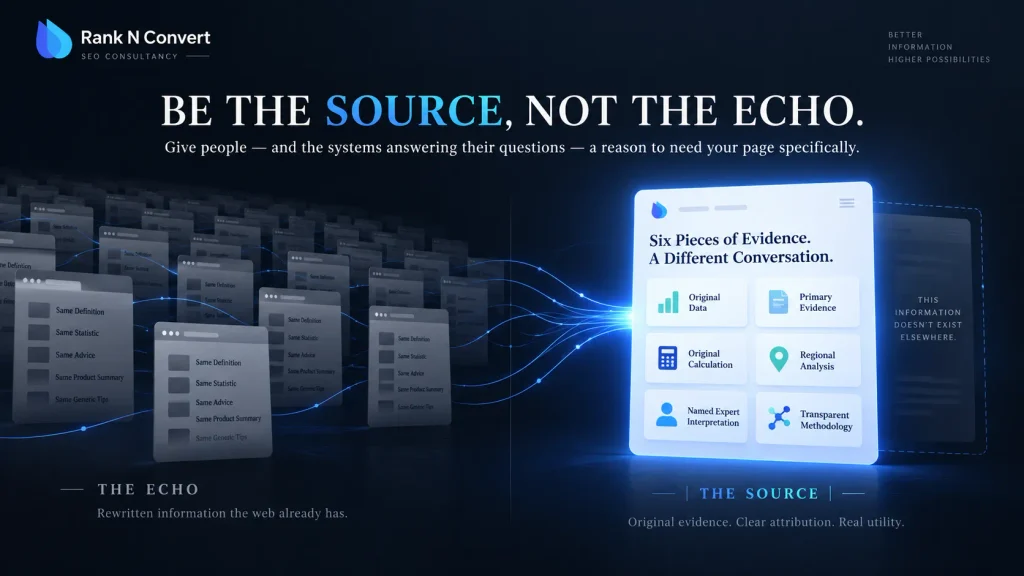
Final Decision: What Should You Fix First When AI Cites a Competitor?
First Fix Exclusion
If crawlers or indexes cannot reach the page, repair access before touching the copy.
Then Fix Retrieval Relevance
If the page is eligible but absent from retrieval, strengthen its fit to the information need.
Then Compare the Evidence Supporting the Exact Claim
When both pages appear, compare the exact claim and give stronger, better-sourced evidence.
Then Reduce Source Substitutability
If competitors can replace every useful fact, add original data, calculations, testing, regional evidence, or interpretation.
Then Improve Extraction and Attribution
Make evidence clearly attributable to the company, author, study, or product responsible for it.
Measure the Result Before Optimizing Anything Else
Retest across prompts, runs, platforms, and time before making another change.
The Goal Is Not to Look “AI-Optimized” – It Is to Become the Source the Answer Actually Needs
The goal is not cosmetic AI optimization. Become the source that best answers the evidence need.
Also Read: 15 Best Platforms for SEO Writers and Experts to Find Freelance Clients in 2026