

Getting found locally is not about stuffing your city name into every page. Google says local results are mainly shaped by relevance, distance, and prominence, which means small businesses need to be easy to understand, close enough to the searcher, and trusted enough to deserve attention.
In 2026, local SEO connects your Google Business Profile, website, reviews, and local authority into one system. This guide shows how to build that system without wasting time on outdated tactics or SEO myths.
Local SEO for Small Businesses in 2026: Quick Glance
| What you want to know | Quick answer |
|---|---|
| What actually helps a local business rank? | Google says local results are mainly based on relevance, distance and prominence. Focus on accurate business information, strong service relevance, reviews and genuine local authority. |
| What should I optimize first? | Start with your Google Business Profile: correct business name, primary category, services, address or service area, opening hours, phone and website. |
| Do I need a website for local SEO? | You can appear in Maps with an eligible Google Business Profile, but a strong website gives you much more opportunity to rank for services, locations and organic searches. |
| Should every service have its own page? | Important services should usually have dedicated pages when they answer a distinct customer need. Avoid squeezing every service onto one generic page. |
| Should I create pages for every city I serve? | Only when you genuinely serve that area and can provide useful location-specific information. Do not create dozens of near-identical city pages just to target keywords. |
| How important are reviews? | Reviews help customers choose you and can contribute to local prominence. Ask genuine customers consistently, but never buy, incentivize or selectively request positive reviews. |
| Do citations and directories still matter? | Yes, but quality and relevance matter more than volume. Prioritize important business listings, professional bodies, local organizations, industry sources, and genuine mentions. |
| Do I need to add “near me” to my website? | No. Google already understands the searcher’s location and your business location. Write naturally around your real service and location instead of stuffing “near me.” |
| Can local SEO help with AI Search? | Yes. Accurate business profile data, crawlable service pages, useful local facts, and original information can help your business become discoverable across traditional and AI-powered search experiences. |
| How should I measure local SEO? | Do not stop at rankings. Track Maps visibility → calls/clicks → qualified leads → bookings/customers → revenue. |
| What should I fix if rankings are weak? | Diagnose the constraint first: eligibility → relevance → distance → website strength → prominence → conversion. Do not apply random SEO tactics before knowing what is actually limiting performance. |
What Actually Determines Whether a Small Business Appears in Local Google Results?
Two businesses can offer the same service in the same city and still appear very differently on Google.
That is because local visibility is not decided by one keyword, one review score, or one perfectly optimized page.
Google says local results are mainly based on three factors:
- Relevance—how closely the business matches the search
- Distance—how close the business is to the searcher
- Prominence—how established or well-known the business appears to be
Google does not publish the exact weighting of these factors, and businesses cannot pay for a better organic local ranking.
So the better question is not
“What local SEO trick should I use?”
It is:
Does Google clearly understand my business, is my location suitable for this searcher, and is there enough evidence that my business is established and trustworthy?
Relevance: Does Google Understand Exactly What Your Business Offers?
Relevance is the match between what the customer is searching for and what Google understands your business to provide.
Google defines relevance as how closely a business profile matches someone’s search and recommends providing complete, detailed business information to help it make that match accurately.
Imagine someone searches for:
“emergency boiler repair”
Google needs enough information to understand that your business:
- repairs boilers
- handles emergency jobs
- serves the relevant location
- is actually the right type of business for that need
Several signals help build that understanding.
Business category
Your primary Google Business Profile category tells Google what the business fundamentally is.
Google says the categories you choose can affect local ranking and recommends selecting the most specific category that accurately describes the business. For example, “Nail salon” is more precise than the broader “Salon.”
This makes category selection one of the first things to review when a business appears for its brand name but struggles to appear for its main services.
Services
Eligible businesses can add the services they actually provide to their Google Business Profile.
Google may surface a relevant service when someone searches for it, and businesses can add service descriptions and, where supported, prices.
That does not mean adding more services automatically improves rankings.
Google does not identify the services field as a standalone ranking factor. Its clearer value is that it gives Google and customers more precise information about what the business actually offers.
Website content
Your website gives Google additional context.
Google says Business Profile information can be compiled from several sources, including publicly available web content and a business’s official website.
So if your profile says “air-conditioning contractor” but the website barely explains installation, repair, maintenance, or service areas, Google has a thinner picture of the business than it should.
The goal is not to repeat the same local keyword again and again.
It is to make this relationship obvious:
Business → Service → Location → Customer need
A dentist offering Invisalign in Bristol, for example, should clearly explain that service on the website and Business Profile instead of relying on a generic “Dental Services” page.
Business details
Google also says businesses with complete and accurate information are more likely to appear in relevant local results. Important details include:
- address or service area
- opening hours
- category
- phone number
- website
- services
For local search optimisation, accuracy is not basic housekeeping.
It is part of relevance.
Distance: Is Your Business Close Enough to the Searcher?
Distance is one of the most important local SEO factors, yet many guides barely explain it.
Google says distance measures how far a potential result is from the location used in the search. If the user does not specify a location, Google estimates where that person is located.
Consider two plumbers.
Both have:
- strong service pages
- accurate Google Business Profiles
- good customer reviews
- relevant local links
But one plumber is 2 km from the searcher, and the other is 18 km away.
The second business can improve its local SEO, but it cannot use backlinks, content, or keywords to physically become 2 km away.
That is why:
Distance is not an SEO task in the normal sense. It is a condition of the search.
This matters even more for queries where convenience is central, such as:
- “coffee shop near me”
- “pharmacy open now”
- “car repair near me”
- “emergency plumber”
It also explains why checking rankings from one office or one device can be misleading.
A business may appear strongly in one neighbourhood and much lower a few miles away because the searcher’s location has changed.
The practical lesson is simple:
Do not mistake every visibility problem for an optimization problem.
If rankings decline mainly as the searcher moves farther away, distance may be the main constraint. Publishing ten more city pages will not remove geography.
Prominence: Does Google Have Enough Evidence That the Business Is Established?
Relevance answers:
What does this business do?
Distance answers:
How close is it?
Prominence answers something different:
How established or well known does this business appear to be?
Google says prominence reflects how well known a business is and specifically mentions signals such as:
- websites linking to the business
- Google reviews
- positive ratings
- broader online recognition
Google also states that more reviews and positive ratings can help local ranking.
This is where local SEO goes beyond simply completing a profile.
A restaurant that has operated for years, earned genuine reviews, attracted local press mentions, and received relevant backlinks provides Google with a much richer set of external signals than a business with almost no presence outside its own website.
But this does not mean:
“Get the most reviews and you will rank first.”
Google does not publish a formula showing how many reviews, links, or mentions are required, or exactly how much weight each carries.
Prominence works alongside relevance and distance.
For a small business, the practical goal is to build real-world evidence that the company:
- exists
- serves customers consistently
- is mentioned beyond its own website
- has earned genuine reviews
- has a recognizable local or industry presence
Prominence is something you can influence, but it usually develops over time.
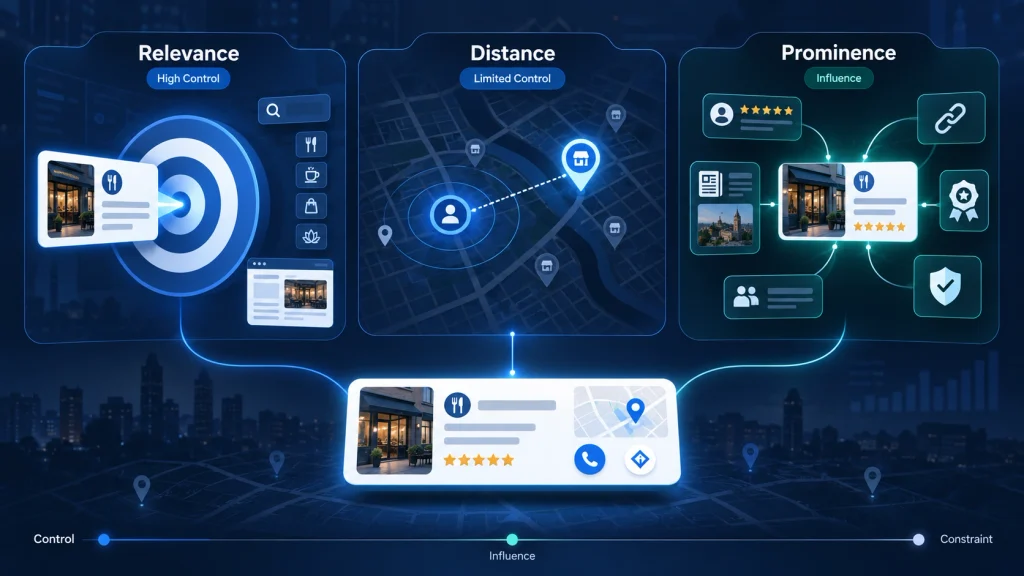
Local SEO Control Matrix: Know What You Can Actually Change
The biggest mistake in local SEO is treating every ranking factor as equally controllable.
They are not.
Use this matrix before deciding where to spend time or money on local SEO services.
| Variable | Level of control | What the business can do |
| Relevance | High | Choose accurate categories, add real services, improve service and location pages, and keep business information complete |
| Distance | Low | Use the real eligible business location or service area; do not manipulate proximity with fake addresses |
| Prominence | Medium–High | Earn genuine reviews, relevant backlinks, local mentions, and wider recognition |
| Business information | High | Keep hours, address, phone number, services, and website details accurate |
| Customer conversion | High | Improve photos, reviews, offers, booking options, calls to action, and contact experience |
| Search demand | Low | Target real demand that already exists and use other marketing channels to create new demand |
| Competitor location and activity | None | Compete through stronger relevance, reputation, service, and customer experience |
What to Work on First
Use a simple diagnosis:
- If the problem is relevance:
Improve how clearly Google can understand the business, services, categories, and locations. - If the problem is prominence:
Build stronger proof through reviews, relevant links, local mentions, and reputation. - If the problem is distance:
Recognize the geographic limitation instead of trying to “SEO” your way around it.
That distinction can save a small business months of work on the wrong problem.
Where Can Local SEO Make Your Business Visible on Google in 2026?
Getting “found on Google” no longer means earning one blue link.
A local customer might discover the same business through Google Maps, the local results shown in Search, a traditional organic page, an AI Overview, AI Mode, or a paid Local Services Ad. These surfaces can appear on the same search journey, but they do not work in exactly the same way.
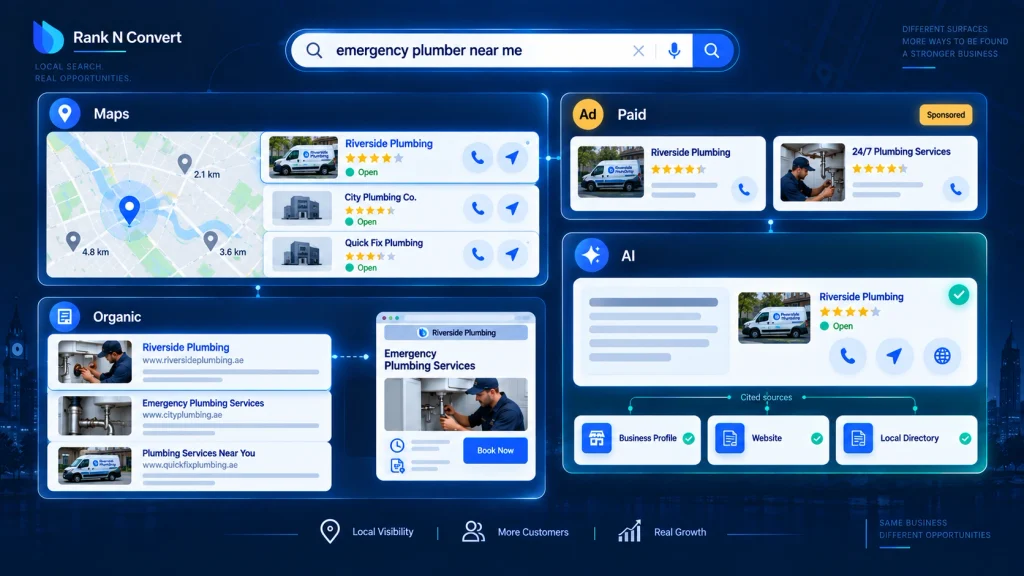
That distinction matters. A business can be highly visible on Maps and barely rank organically, or have strong website rankings while struggling in local results.
Here is the simplest way to think about it:
| Google surface | Main business asset | What local SEO can influence |
| Google Maps / local results | Google Business Profile + local signals | Relevance, business information, reviews, prominence |
| Organic search results | Website pages | Content relevance, technical SEO, links, page quality |
| AI Overviews / AI Mode | Search-indexed content + business information | Strong SEO foundations, useful content, accurate Business Profile data |
| Local Services Ads | Paid Local Services profile | Paid eligibility, bidding, profile quality, responsiveness |
The mistake is treating all four as one ranking system.
Google Maps and the Local Pack: Your Business Profile Drives Local Discovery
For location-based searches such as “dentist near me,” “coffee shop open now,” or “emergency plumber Bristol,” Google can show local business citation results alongside a map.
SEO professionals often call this group of results the local pack.
Your Google Business Profile is central to this type of visibility because it gives Google structured business information such as your category, address or service area, opening hours, services, reviews, website, and contact details.
Google says local results are mainly determined by relevance, distance, and prominence, and that complete and accurate Business Profile information helps Google match a business to relevant searches.
This is why Google Maps SEO works differently from simply optimizing a webpage.
A bakery may have an excellent website, for example, but weak local visibility if its Business Profile has the wrong category, outdated hours, limited reviews, or incomplete information.
The reverse can also happen: a well-managed Business Profile may perform strongly in nearby searches even when the website itself has limited organic reach.
The practical takeaway is simple:
For Maps visibility, treat the Google Business Profile as a core local-search asset, not as a directory listing you complete once and forget.
Traditional Organic Results: Your Website Competes Separately
Below or around local results, Google can also show standard organic webpages.
This is where your website has to compete.
A useful service page such as:
Emergency Boiler Repair in Leeds
can rank organically even if the business is not one of the strongest Maps results for every searcher.
Google’s Search Essentials says organic visibility depends on factors such as helpful, reliable content, crawlable links, clear wording, and pages Google can properly discover and understand.
That creates three common scenarios:
- Strong Maps visibility, weak organic visibility: the Google Business Profile performs well, but the website lacks strong service or location pages.
- Strong organic visibility, weak Maps visibility: the website ranks, but proximity, Business Profile relevance, reviews, or local prominence may be weaker.
- Strong visibility in both: the business has built both a strong local entity and a useful search-ready website.
This is an important distinction for small businesses using local SEO services.
If your problem is organic search, repeatedly editing your Business Profile may not fix it.
If your problem is Maps visibility, publishing another generic blog post may not fix that either.
First identify which search surface is weak.
AI Overviews and AI Mode: Local SEO Still Starts With SEO
AI Overviews and AI Mode add another discovery layer, but they do not require a separate collection of “AI SEO tricks.”
Google’s current guidance, updated in 2026, says its generative search features are rooted in its core Search ranking and quality systems. Google specifically describes retrieval-augmented generation and query fan-out as ways AI experiences retrieve supporting information from Search.
For small businesses, there is an even more useful detail.
Google says Google Business Profiles can help local products and services become visible in AI responses as well as other Google Search results.
So the practical strategy remains familiar:
- keep your Google Business Profile accurate;
- make important website pages crawlable and indexable;
- explain services and locations clearly;
- publish genuinely useful information;
- keep factual business details consistent;
- build real authority rather than artificial mentions.
Google also explicitly says there are no special AI files, special schema markup, or mandatory content “chunking” techniques required for visibility in its generative search experiences.
In other words:
AI visibility is an extension of strong search visibility, not an excuse to abandon local SEO fundamentals.
Local Services Ads: Paid Visibility Is Not Local SEO
Local Services Ads can also appear prominently when people search for eligible local services.
But they belong in a different bucket.
They are paid advertising, not organic local search optimisation.
Google says Local Services Ads can generate calls, messages, and bookings from people searching for relevant services. Advertisers pay for qualifying leads rather than earning placement solely through organic local SEO.
Availability also depends on the business category and location, and participating businesses may need to complete Google’s screening and verification process.
Even the ranking mechanism is different. Google says Local Services Ads are ordered through an auction that considers factors including the advertiser’s bid and overall profile quality.
So do not mix the metrics.
A business appearing above you through Local Services Ads has not necessarily “beaten your local SEO.”
It may simply be paying for a different search surface.
The Useful Way to Think About Local Visibility
Instead of asking:
“Where do I rank on Google?”
Ask four separate questions:
Do I appear in local Maps results?
Check your Google Business Profile and local signals.
Do my service and location pages rank organically?
Check the website.
Can Google use my business and website information in AI-powered search experiences?
Build on the same accurate, useful, crawlable SEO foundation.
Am I competing with paid local services ads?
Treat that as paid acquisition, not an organic ranking problem.
Once those four layers are separated, local SEO becomes much easier to diagnose. You stop chasing one vague idea of “Google ranking” and start improving the exact visibility layer that is holding the business back.
First Identify Your Business Type: Storefront, Service-Area, Hybrid, or Multi-Location
Before changing categories, adding services, or hiring a local SEO specialist, answer one basic question:
How does your business actually meet customers?
Google does not treat a salon that customers visit the same way it treats a plumber who travels to homes. The correct Google Business Profile setup depends on whether customers come to you, you go to them, or both.
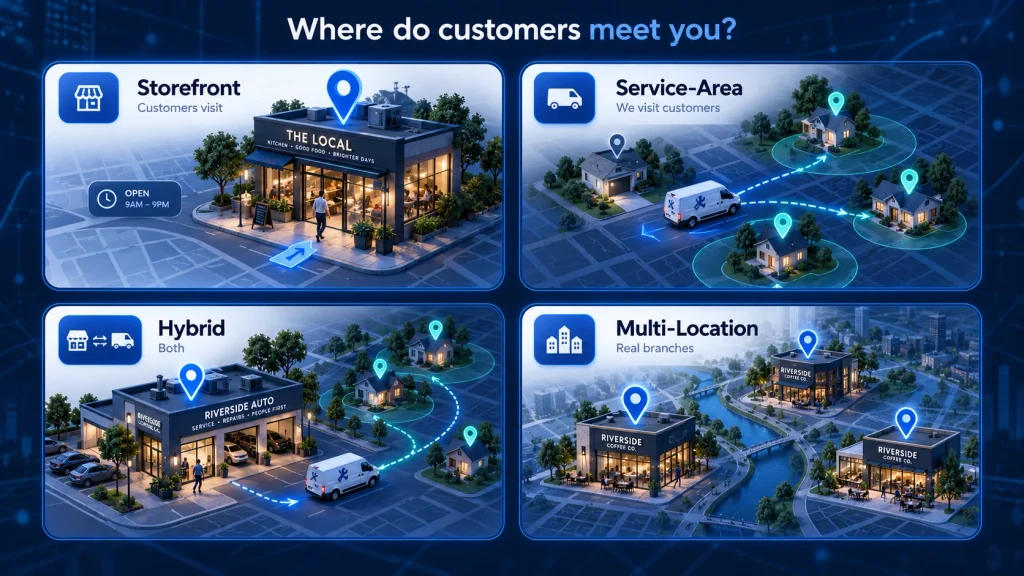
Getting this wrong can create bigger problems than a weak keyword strategy. A home-based cleaner may accidentally publish a private address. A service company may create unnecessary profiles for every city it covers. A business using a virtual office may build its entire local SEO strategy around a location that Google does not consider eligible.
Which Local Business Model Fits You?
| Business model | Typical example | Show business address? | Add service areas? | Main local SEO focus |
| Storefront | Salon, restaurant, dental clinic, retail shop | Yes | Usually not needed unless the business also travels or delivers | Location relevance, category accuracy, reviews and local reputation |
| Service-area business | Plumber, cleaner, mobile locksmith | No, if customers are not served there | Yes | Service relevance, real operating area, reviews and local authority |
| Hybrid business | Restaurant with delivery, garage offering roadside assistance | Yes | Yes | Storefront visibility plus genuine service coverage |
| Multi-location business | Chain, clinic group or company with several staffed branches | Each eligible location can have its own profile. | Depends on each location | Accurate profiles and locally relevant pages for genuine locations |
The distinction is not just terminology. It determines how your address, service area and locations should be represented on Google.
Storefront Business: Customers Come to You
A storefront business serves customers at a physical location during its stated business hours.
Think of:
- a restaurant
- a barber
- a dental clinic
- a bakery
- a retail shop
Google’s guidelines say businesses displaying an address should operate from an actual real-world location. Google also requires businesses showing an address to maintain permanent fixed signage displaying the business name.
For this type of business, the physical location is part of the local-search equation.
A neighbourhood salon in Birmingham, for example, should not hide its genuine storefront address in an attempt to appear more flexible. Its location helps Google and customers understand where the business operates.
The local SEO priorities are therefore fairly clear:
accurate location → correct category → complete profile → useful website → reviews and local reputation
If customers genuinely visit the premises, represent that reality accurately.
Service-Area Business: You Go to the Customer
A service-area business, often shortened to SAB in local SEO, works differently.
Customers do not visit the business location. Instead, the business travels to customers or delivers services directly to them.
Google gives cleaners and plumbers as examples.
This model is especially important in local SEO for service area businesses, because the address rules are often misunderstood.
If you run a plumbing company from your home but customers never come to that house, Google says the address should be removed from the public Business Profile. You then specify the areas where you provide services.
That does not make the business less legitimate. It is simply the correct profile configuration.
How Many Service Areas Can You Add?
Google currently allows a business to select up to 20 service areas, using places such as cities, postal codes or other defined areas.
Google also advises that the overall service area generally should not extend more than about two hours’ driving time from the business base, although it notes that larger areas may make sense for certain businesses.
One important detail: Google no longer asks businesses to define service coverage using a simple radius. The service area should be entered using actual cities, postal codes or similar geographic areas.
But do not turn those 20 available slots into an SEO target.
Being allowed to list 20 service areas does not mean you should add 20 places you barely serve.
Google recommends making the service area as specific and accurate as possible.
And there is another important distinction: Google’s documentation explains service areas as a way to show customers where you provide services. It does not say that adding another town automatically gives you stronger rankings in that town.
So adding Manchester, Liverpool and Leeds to a profile does not magically remove the distance factor discussed earlier.
Your service area should describe your real operation, not your ranking ambitions.
Hybrid Business: Customers Come to You and You Also Go to Them
Some businesses genuinely do both.
Google calls these hybrid businesses.
A dine-in restaurant that also delivers is Google’s own example. Another would be an auto repair garage that accepts customers at the workshop but also provides roadside assistance.
A qualifying hybrid business can:
show its storefront address + define a genuine service areaBut the storefront needs to be real.
Google says that if a business does not have permanent on-site signage, it is not eligible to operate as a storefront and should instead be represented as a service-area business.
This is where a useful local SEO rule appears:
Configure the profile around how customers actually interact with the business, not around which setup you think will rank better.
If customers visit you and your staff serve them there during stated hours, the address belongs on the profile.
If they do not, hide it.
Multi-Location Business: A Profile Requires a Real Location, Not Just a City You Want to Rank In
Multi-location local SEO needs another layer of discipline.
A business can have profiles for separate genuine locations. Google also says service businesses with different locations, separate staff and separate service areas may have one profile for each qualifying location.
The important word is location.
Opening a page called:
“Electrician in Bristol”
does not create a Bristol business location.
Neither does renting a mailbox or using a virtual address.
Google says a virtual office that the business does not actually operate from is not eligible for a Business Profile. A co-working office is also not enough by itself: to qualify, the business needs clear signage, must receive customers there during business hours and must have its own staff present.
For a genuine multi-location company, the structure should reflect the real business:
real staffed location → eligible Business Profile → accurate location information → useful location-specific webpage where appropriate
That is very different from creating dozens of profiles or pages simply because those cities have search volume.
Check Whether You Are Eligible for a Google Business Profile Before Doing Any Local SEO Work
This check should happen before profile optimization.
Google says Business Profiles are intended for businesses that make in-person contact with customers. That can happen because customers visit the business, or because the business travels to customers.
Use this quick test:
| Question | If the answer is “Yes” |
| Can customers visit a genuine staffed business location during stated hours? | You may qualify as a storefront business |
| Do employees travel to customers to provide the service in person? | You may qualify as a service-area business |
| Do both happen? | You may qualify as a hybrid business |
| Is the business completely online with no face-to-face customer contact? | A standard Google Business Profile is generally not eligible |
| Is the address only a mailbox or virtual office where the business does not actually operate? | The location is generally not eligible |
Google specifically lists online-only businesses and lead-generation agents or companies among business types that are not eligible for a Business Profile.
So a website that collects roofing enquiries and sells those leads to contractors cannot simply create a Google Business Profile and present itself as a local roofing company.
Likewise, an online local SEO provider with no in-person customer contact should not assume that adding a city address makes it eligible.
The Rule to Remember
Before thinking about Google Maps rankings, service pages, reviews or local search optimisation, make sure the profile represents a real customer relationship in a real operating area.
For most small businesses, the decision is straightforward:
- Customers visit you → storefront.
- You visit customers → service-area business.
- Both happen → hybrid.
- You have several genuine staffed locations → multi-location.
- Everything happens online → do not force the business into a local profile model it does not qualify for.
Getting this classification right gives every local SEO decision that follows a clean foundation.
Build the Google Business Profile Around Relevance Before Chasing Advanced Tactics
Before worrying about advanced local SEO tools and tactics, make sure Google has the basic facts right.
A Google Business Profile should answer three questions without ambiguity:
- Who is this business?
- What does it actually do?
- Can this business serve the person searching right now?
Google says businesses with complete and accurate information are more likely to appear in relevant local results.
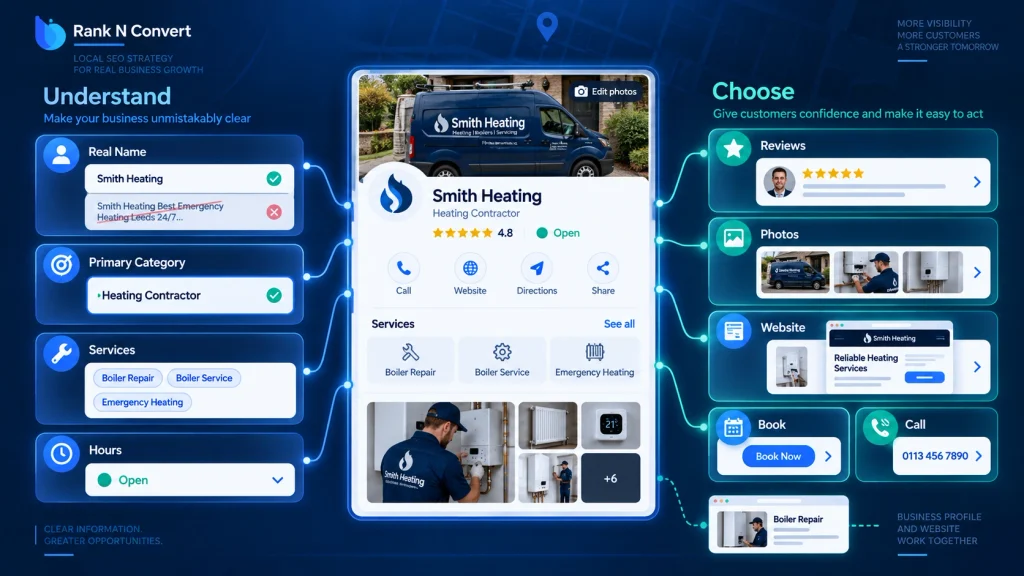
The mistake is treating every profile field as equally important. They are not.
A better approach is to optimize each field for its actual job.
| GBP element | Main job | Priority |
| Business name | Identify the real-world business | Essential |
| Primary category | Tell Google what the business fundamentally is | Essential |
| Secondary categories | Describe genuine additional business functions | High |
| Services | Clarify specific customer offerings | High |
| Hours | Show when customers can actually use the business | Essential |
| Phone / website / booking links | Help customers take the next step | Essential |
| Photos | Reduce uncertainty and improve customer confidence | High |
| Description / attributes | Add useful decision context | Supporting |
That order is far more useful than simply “fill out every field.”
Use the Real Business Name, Not a Keyword-Stuffed Version
Your Google Business Profile name should match the name customers see in the real world.
Google says the name should be represented consistently across things such as your storefront, website, stationery and branding. Adding unnecessary information to the name is not permitted and can lead to profile suspension.
So if the real business is:
Smith Plumbing
do not turn the profile into:
Smith Plumbing Best Emergency Plumber London Drain Cleaning 24/7
just because those phrases have search volume.
Google provides a similar example in its own guidelines. A 24-hour San Francisco coffee shop called Shelly’s Coffee should still use Shelly’s Coffee as the business name. Its address, opening hours and category belong in their proper fields, not in the name.
This distinction matters because keyword-heavy business names can sometimes look tempting when competitors are doing the same thing.
Do not confuse:
something that may appear advantageous in search results
with:
something Google allows.
The correct local SEO decision is to represent the genuine business accurately.
Choose the Primary Category Based on What the Business Is
If there is one Google Business Profile field worth slowing down for, it is the primary category.
Google says categories help connect businesses with customers searching for relevant products or services, and explicitly confirms that the categories selected affect local ranking.
The primary category should describe the business as a whole.
Use this test:
“This business IS a ______.”
Not:
“This business HAS ______.”
A dental clinic may have teeth-whitening services, but the business itself is a dentist or dental clinic.
A restaurant may have delivery, but it is still fundamentally a restaurant.
A plumbing company may offer drain cleaning, but that does not automatically make “Drainage service” the best primary category if “Plumber” more accurately describes the core business.
Google recommends choosing the most specific category available that represents the main business. Its own example is choosing “Nail salon” instead of the broader “Salon.”
This is not only an official recommendation. Whitespark’s 2026 Local Search Ranking Factors survey placed Primary GBP Category first among the factors its expert contributors believed had the strongest impact on Local Pack and Maps rankings. That is practitioner research rather than access to Google’s algorithm, and Whitespark explicitly states that its contributors do not have inside knowledge of Google’s ranking system.
So the evidence should be interpreted carefully:
Google confirms categories affect local ranking.
Practitioner research suggests the primary category is especially influential.
That is enough reason to choose it deliberately.
Add Secondary Categories Only When They Describe Real Parts of the Business
Secondary categories help Google understand other genuine aspects of the business.
But more categories do not automatically mean more visibility.
Google’s own guidance says to use as few categories as possible to describe the overall core business and not to use categories simply as keywords or attributes.
Google currently allows a primary category plus up to nine additional categories.
That is a maximum, not a target.
For example, a genuine dental practice might reasonably use:
- Dentist
- Cosmetic dentist
- Dental implants provider
if those accurately reflect real services.
It should not add loosely related categories simply because they contain attractive local SEO keywords.
A useful rule is:
If you would not naturally describe that category as a real part of the business to a customer, think twice before adding it.
Category stuffing creates noise when the goal should be clarity.
Add Services Customers Actually Look For
Categories explain what kind of business you are.
Services explain what customers can actually buy or book from you.
Google allows eligible businesses to select suggested services or create custom services. Businesses can also add details such as descriptions and prices where the feature is available.
For example, a plumber might list:
- toilet repair
- faucet installation
- boiler repair
- drain cleaning
rather than leaving customers with the vague label “Plumber.”
Google says that when a local customer searches for an offering a business provides, that service may be highlighted on the Business Profile.
That makes the service field useful for both clarity and discovery.
But avoid making a claim Google does not make.
Google does not say:
“Adding more services automatically increases rankings.”
The better reason to add services is that they make the profile more specific and more useful.
Later, those important services should also connect naturally to your website architecture. If boiler repair is a major revenue-driving service, it should not exist only as a line in Google Business Profile. It may deserve a useful, dedicated service page as well.
That creates a clearer relationship between:
Business Profile → service → website evidence → customer action
Keep Regular Hours and Special Hours Accurate
Opening hours look like a basic profile field, but they affect a very practical local-search question:
Can the customer use this business right now?
Google instructs businesses to publish their regular customer-facing operating hours and provides separate special hours for holidays, events or temporary changes.
For example, if a restaurant normally closes at 10 p.m. but shuts at 6 p.m. on a public holiday, update the special hours rather than leaving customers to discover the closure at the door.
There is also useful practitioner evidence here.
Whitespark’s 2026 expert survey ranked “Business is Open at Time of Search” fifth among its Local Pack/Maps factors. Again, this is expert observation and testing, not a Google disclosure of its algorithm.
The safe conclusion is:
Google officially expects accurate hours. Practitioner research suggests being open when the search happens can also materially affect Maps visibility.
Either way, fake or artificially extended opening hours are not a sensible local search optimisation tactic.
Set the hours customers can genuinely expect you to answer, serve or receive them.
Complete the Fields That Help Customers Choose You
Not every valuable Business Profile feature needs to be a confirmed ranking factor.
That distinction matters.
A customer looking at two nearby businesses may care far more about whether one has a working phone number, real photos and an appointment link than whether a particular field carries algorithmic weight.
Complete the fields that remove friction between discovery and action.
Phone Number
Use a number that connects directly to the actual business.
Google recommends using a local phone number rather than a central call centre number where possible, and says the number should be under the business’s direct control.
Website
- Send customers to the most useful page for that location or business.
- For a single-location small business, that may be the homepage.
- For a genuine multi-location company, a location-specific landing page may make more sense.
- Avoid sending customers through unnecessary redirects or unrelated pages.
Booking and Appointment Links
Eligible businesses can add links that let customers take actions such as booking appointments or placing orders. Availability varies by business type and region.
A booking link may not be the reason you rank, but it can be the reason a search becomes a customer.
That matters more.
Business Description
Use the description to explain the business, not to dump keywords.
Google allows up to 750 characters and recommends focusing on useful information about what the business offers rather than promotions, sales or links.
A useful description might clarify:
- main services
- who the business serves
- genuine specialisms
- years in operation, if accurate
- relevant business context
It should sound like a business description, not a list of search queries.
Photos
Real photos can answer questions text cannot.
- A restaurant can show its dining area.
- A clinic can show the entrance and treatment environment.
- A repair company can show its vehicles or team.
Google specifically recommends photos of the storefront, products and services and notes that an exterior photo can help customers recognize the business when they arrive.
For image quality, Google currently recommends JPG or PNG files, a recommended resolution of 720 × 720 pixels, and photos that are well lit, in focus and not excessively altered.
Notice the distinction again:
Photos are clearly useful for customers.
That does not mean every photo-upload tactic is a ranking factor.
Whitespark’s 2026 survey actually lists geo-tagged photos and keywords in image metadata among its lowest-rated local SEO tactics.
So spend your time taking useful real photos, not trying to hide keywords inside image files.
Use This Priority Order Before Paying for Advanced Local SEO
If the profile is incomplete, advanced local SEO services cannot compensate for basic ambiguity.
Work in this order:
- Identity — real business name and legitimate location setup
- Classification — correct primary and secondary categories
- Offerings — accurate services and products
- Availability — regular and special hours
- Action paths — phone, website, bookings and orders
- Decision confidence — photos, description, attributes and useful details
Only after those foundations are accurate should you spend serious time on more advanced areas such as local link building, review acquisition, location-page expansion, hyper local SEO or competitive analysis.
The principle is simple:
First make the business unmistakably clear. Then make it more prominent.
Google cannot confidently match a small business to local searches if the profile itself gives an incomplete or distorted picture of what that business is.
Match Local Search Demand to Services and Pages Instead of Stuffing City Keywords
Local keyword research becomes messy when every variation is treated as a different content opportunity.
A plumber might find:
- plumber Manchester
- Manchester plumber
- local plumber Manchester
- best plumber in Manchester
- plumber near me
Those phrases look different in a keyword tool. To the person searching, however, they may represent essentially the same job: find a plumber who serves Manchester.
That is the distinction that matters.
Use keyword data to understand demand. Use search intent to decide what deserves a page.
A search-volume number can help you prioritize a service. It should not dictate your website architecture.
Start With Service Intent, Not Keyword-Tool Volume
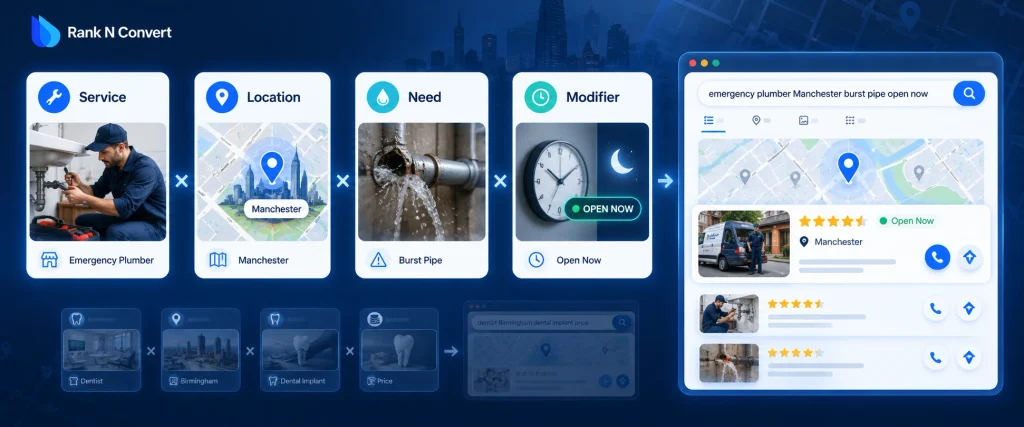
Before looking at hundreds of keyword variations, break the search into four parts:
Service × Location × Need × Modifier
Each part answers a different question.
| Layer | What it tells you | Example |
| Service | What does the customer need? | Emergency plumber |
| Location | Where do they need it? | Manchester |
| Need | What problem are they trying to solve? | Burst pipe |
| Modifier | What condition affects the decision? | Open now |
Put them together:
Emergency plumber × Manchester × burst pipe × open nowThat tells you far more than the phrase “plumber Manchester.”
Another example:
Dentist × Birmingham × dental implant × price
Now the search is not simply about finding a dentist. The person wants a specific treatment, in a specific market, and cost is part of the decision.
That difference should influence the content.
A generic dentist homepage may satisfy:
dentist in Birmingham
But a person searching:
dental implant cost in Birmingham
may need a dedicated implant service page containing useful treatment and pricing information where the clinic can genuinely provide it.
This is what semantic local SEO should do: connect the query to the actual information job, rather than trying to repeat every keyword variation.
Use Search Volume to Prioritize Demand, Not Manufacture Pages
Suppose a keyword tool shows:
boiler repair Leeds—500 searches
and:
emergency boiler repair Leeds—90 searches
The larger keyword may deserve more attention, but that does not automatically mean both phrases need separate pages.
Ask a better question:
Would these searchers need meaningfully different information before taking action?
If both groups ultimately need the same boiler repair service, one strong page may satisfy both.
But if emergency repair involves genuinely different information such as:
- 24-hour availability
- response area
- emergency call process
- what customers should do before the engineer arrives
- emergency pricing or call-out terms, where available
then a separate page may be useful.
The decision should come from different user needs, not merely different keyword wording.
That is the difference between useful local search optimisation and building pages because a spreadsheet told you to.
Separate Discovery Searches From High-Intent Local Searches
Not every local searcher is ready to call a business.
Someone asking:
“Why is my boiler losing pressure?”
is in a different stage from someone searching:
“boiler repair Leeds.”
And both are different from:
“emergency boiler repair near me.”
A simple intent ladder helps decide where each query belongs.
| Search stage | Example query | What the person needs | Best content type |
| Discovery | Why is my boiler losing pressure? | Diagnosis and explanation | Helpful article or troubleshooting guide |
| Commercial local | Boiler repair Leeds | A suitable local provider | Service page |
| Decision | Boiler repair Leeds prices | Cost and buying information | Service/pricing section or page |
| Immediate local | Emergency boiler repair near me | A provider available now | Emergency service page + accurate Business Profile |
| Brand validation | Smith Heating reviews | Trust before contacting | Business Profile, reviews, reputation pages where appropriate |
This prevents two common mistakes.
The first is trying to make every blog post sell immediately.
The second is filling service pages with informational content that distracts people who simply want to call, book or check whether the business serves their area.
A good local SEO strategy lets each page do one clear job.
Match One Intent Cluster to the Page That Solves It Best
Now group search phrases by shared intent rather than exact wording.
For example:
- plumber Manchester
- Manchester plumber
- local plumber Manchester
- plumbing services Manchester
- best plumber Manchester
may belong to the same broad commercial cluster.
If one page can genuinely satisfy all of those searchers, you usually do not need five near-identical pages.
A useful rule is:
One distinct user need = one useful page.
Five ways of wording the same need ≠ five pages.
Your page can naturally use semantic variations without turning each phrase into its own URL.
For example, a Manchester plumbing page might naturally discuss:
- plumbing repairs
- emergency plumbing
- local service coverage
- common household plumbing problems
- booking
- response hours
- customer reviews
- areas genuinely served
That gives Google and customers context without forcing phrases such as “best local plumber Manchester” into every paragraph.
Do Not Build City Pages Just Because the City Has Search Volume
This is where local SEO for service-area businesses often goes wrong.
Imagine a plumbing company based in Leeds that also works in Bradford, Wakefield and Harrogate.
Separate pages could be useful if the business genuinely serves those places and each page contains information that matters to customers there.
For example:
/plumber-bradford/might legitimately contain:
- services actually available in Bradford
- realistic service coverage
- local contact or booking details
- real jobs or case studies from Bradford
- local testimonials, if genuine
- area-specific travel or availability considerations
- relevant FAQs based on customers in that area
That page has a reason to exist.
Now compare it with creating 40 pages where only the city changes:
“Looking for the best plumber in Bradford? We provide high-quality plumbing services in Bradford.”
Then:
“Looking for the best plumber in Wakefield? We provide high-quality plumbing services in Wakefield.”
Then the same thing for another 38 towns.
That is not hyper local SEO. It is duplication with a postcode attached.
Google’s current spam policies specifically identify doorway abuse as creating multiple substantially similar pages targeted at regions or cities that funnel people toward the same destination. Google also warns against scaled content created primarily to manipulate rankings while providing little additional value.
So the question is not:
“Can I rank for this city?”
It is:
“Do I have enough genuine local value to justify a page for this city?”
Use This Test Before Creating a New Service or Location Page
Before publishing another URL, ask four questions.
1. Is the search intent meaningfully different?
“Emergency plumber” may deserve different treatment from general plumbing if the customer needs immediate availability and emergency-specific information.
2. Does the business genuinely provide this service in this location?
Do not create pages for markets you hope to serve someday.
3. Can the page contain information that is materially different from the existing page?
Changing the city name is not enough.
4. Would the page still be useful if Google did not exist?
If the answer is no, the page may exist primarily for rankings rather than customers.
That last question is especially useful.
A genuine Birmingham dental implant page can help a patient understand the treatment, clinic, location and next step.
A page whose only purpose is to repeat “dental implants Birmingham” ten times has little reason to exist outside search engines.
Build an Intent-to-Page Map Before You Write
For a small business, the final keyword map can stay surprisingly simple.
Take a plumbing company as an example:
| Intent cluster | Example searches | Best destination |
| Core business | plumber Manchester, local plumber Manchester | Main plumbing/location page |
| Emergency service | emergency plumber Manchester, plumber open now | Emergency plumbing page |
| Specific service | boiler repair Manchester | Boiler repair page |
| Specific problem | burst pipe plumber Manchester | Relevant service page, supported by useful problem content |
| Informational | why is my boiler losing pressure? | Blog/troubleshooting guide |
| Location variation | plumber Salford | Separate page only if genuinely served and locally useful |
| Near-me intent | plumber near me | Do not create a “near me” page; strengthen local relevance and Business Profile data |
This is where keyword research becomes useful rather than noisy.
You are no longer asking:
“How many keywords can this website target?”
You are asking:
“What pages does this customer journey actually require?”
The Rule to Keep
For local SEO, search volume tells you where demand exists.
Intent tells you what the user needs.
Your services tell you what the business can legitimately offer.
And page architecture should sit where those three overlap.
That is how you expand local visibility without turning the website into a collection of city-swapped pages built for search engines rather than customers.
Build a Local Website Architecture That Proves What You Do and Where You Actually Operate
Your Google Business Profile can tell Google that you are a plumber in Leeds. Your website has to prove what that actually means.
A strong local SEO site should make three relationships obvious:
Who the business is → what it provides → where it genuinely provides it
When those relationships are buried inside one generic “Services” page, both customers and search engines have to work harder to understand the business.
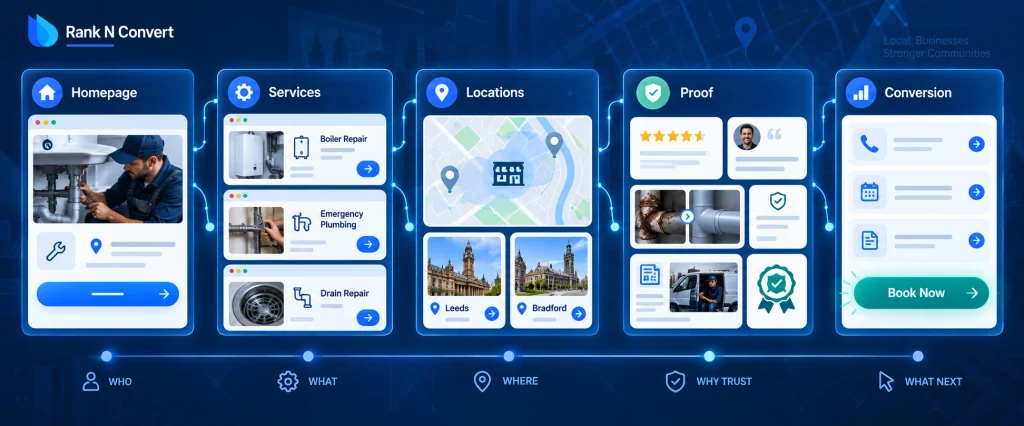
A cleaner structure looks more like this:
Homepage
→ Service pages
→ Genuine location pages
→ Supporting proof and useful content
→ Call, booking or enquiry
The goal is not to create more URLs. It is to give each important customer need a clear place on the site.
Homepage: Make the Core Business Entity Obvious
The homepage should answer the basic questions within seconds:
Who are you?
What is your main service or business category?
Where do you primarily operate?
What should the customer do next?
For example:
Smith Heating provides boiler repair, servicing and heating services across Leeds.
That sentence is far more useful than:
Welcome to Smith Heating, your trusted solution for all your needs.
The first version establishes the business, service and location without forcing keywords.
For a single-location business, the homepage can often act as the main local landing page. A genuine multi-location business may instead use dedicated location pages for each staffed branch.
The homepage should then guide visitors toward the important service and location pages rather than trying to explain every service in full.
Think of it as the reception desk, not the entire building.
Create Dedicated Pages for Services That Deserve Their Own Decision
If a plumbing company offers boiler repair, drain unblocking, bathroom plumbing and emergency call-outs, squeezing all four into a few paragraphs on /services/ limits how well each customer need can be answered.
A clearer structure might be:
But a separate service page should exist because the service requires distinct information, not simply because a keyword tool found another phrase.
A useful boiler repair page, for example, can explain:
- which boiler problems the business handles
- where the service is available
- whether emergency support is offered
- what the booking process looks like
- relevant qualifications or guarantees, where genuine
- pricing or call-out information, if the business publishes it
- real customer questions
- a clear next action
That creates substantially more value than listing “boiler repair” beside 24 other services.
There is useful practitioner evidence behind this approach. In Whitespark’s 2026 Local Search Ranking Factors survey, its local SEO contributors ranked “Dedicated Page for Each Service” first among local organic factors and also highly for Maps and AI-search visibility. Whitespark is clear that this is an expert survey based on experience, testing and observation, not access to Google’s algorithm.
That distinction matters.
We can reasonably say that dedicated service pages are a strong local SEO practice when they satisfy distinct user intent.
We should not claim that Google guarantees higher rankings simply because every service receives its own URL.
Create Location Pages Only When the Location Changes the Information
Location pages can be valuable.
They can also become some of the weakest pages on a local business website.
The difference is whether the page contains real local information.
A useful location page for a Birmingham dental clinic or a plumbing company genuinely serving Bradford might include:
| Useful local evidence | What it helps the visitor understand |
| Services available there | What can actually be booked in that location |
| Real address or genuine service coverage | Whether the business can serve them |
| Opening hours | When the location is available |
| Local staff | Who customers may deal with |
| Directions and access | How to reach the premises |
| Parking or transport details | What arrival will involve |
| Original location photos | What the branch or operating area looks like |
| Local testimonials | Evidence from customers in that market |
| Relevant projects or case studies | Proof that the business has actually worked there |
| Local contact or booking details | The correct next step |
Not every location needs every item. The principle is that the page should contain information that is true and useful because that location is different.
Compare that with:
We provide plumbing services in Bradford. Our Bradford plumbers provide high-quality plumbing services throughout Bradford. Contact our Bradford plumbing team today.
Then copy it 49 times and swap the city name.
That is not a local content strategy.
Google’s spam policies explicitly identify doorway abuse as creating multiple similar pages targeted at different cities or regions that funnel visitors toward the same destination. Google also warns against substantially similar pages placed between search results and a genuinely useful site hierarchy.
So use a simple test before creating a location URL:
If I removed the city name, would this page still contain information unique to this location?
If the answer is no, the page probably needs more substance or may not deserve to exist.
Do Not Confuse Service Areas With Location Pages
This distinction is especially important for local SEO for service area businesses.
A plumber may genuinely serve Leeds, Bradford, Wakefield and nearby towns.
That does not automatically mean the website needs:
- /plumber-leeds/
- /plumber-bradford/
- /plumber-wakefield/
- /plumber-harrogate/
- /plumber-york/
for every town inside the operating radius.
A location page makes sense when the business has enough real evidence and customer need to justify it.
Otherwise, a strong service page that clearly explains genuine coverage may be the better option.
This protects the site from turning into a collection of thin, city-swapped pages created only for local search optimisation.
Connect Services, Locations and Proof With Internal Links
Pages should not sit in isolation.
Google says it uses links to discover new pages and as a signal for understanding page relevance. It also recommends crawlable HTML links with descriptive anchor text that helps people and Google understand the destination.
For a local site, internal linking should mirror the customer’s journey.
A useful relationship is:
Location → Service → Proof → Conversion
For example:
Leeds location page
→ links to Boiler Repair
→ which links to a relevant boiler replacement case study
→ which leads to Book an Engineer
Or:
Emergency Plumber page
→ links to Areas We Serve
→ links to a relevant Bradford location page
→ provides a Call Now action
Internal linking should make these relationships obvious rather than scattering links simply because “internal links are good for SEO.”
Whitespark’s 2026 expert survey also ranked internal linking across the website highly for local organic search, but this remains practitioner evidence rather than an official Google weighting.
A Simple Local Website Architecture for a Single-Location Service Business
A small-business website does not need a complicated architecture to support local SEO.
For example:
This is only a model, not a requirement.
If the business has one genuine location and no meaningful reason for separate city pages, the Areas We Serve section may simply explain coverage on one useful page.
Architecture should reflect the real business, not an SEO template.
Make Important Local Pages Easy for Google to Find and Index
A brilliant service page cannot rank if Google cannot properly access or index it.
Keep the technical check focused on a few fundamentals.
1. Make sure important pages are indexable
Google’s Search Essentials explains that meeting its technical requirements makes a page eligible to appear in Search, although eligibility never guarantees crawling, indexing or ranking.
For important service and location pages, check that they are not accidentally blocked by:
- noindex
- robots.txt restrictions
- authentication
- broken redirects
- server errors
Use Google Search Console’s URL Inspection tool when an important page is not appearing as expected.
2. Make pages discoverable through crawlable links
Do not create important local pages that can only be reached through a search box, script or obscure sitemap.
Google says it generally discovers links when they use standard HTML <a> elements with an href attribute.
If “Boiler Repair” is an important service, users and Google should be able to reach it through the site’s normal navigation or relevant internal links.
3. Check canonical signals when similar pages compete with each other
A canonical URL is the version Google chooses as representative when it finds duplicate or very similar pages.
Google says redirects and rel=”canonical” are strong canonical signals, while sitemap inclusion is weaker. Google can still select a different canonical if its systems believe another URL is more representative.
This becomes relevant when local sites accidentally create several versions of the same page through:
- HTTP and HTTPS URLs
- parameters
- duplicate CMS URLs
- nearly identical regional pages
If Google keeps choosing the wrong canonical, first ask whether those supposedly different location pages are actually different enough.
Google’s troubleshooting guidance specifically recommends ensuring clustered pages contain clear, significant content differences.
4. Make the mobile version complete and usable
Google uses the mobile version of a site’s content for indexing and ranking under mobile-first indexing.
That matters enormously for local businesses because a customer searching for a locksmith, restaurant or dentist may need to call, navigate or book immediately.
Do not hide essential local information on mobile.
The mobile page should make it easy to find:
- phone number
- address or coverage area
- opening hours
- services
- booking/contact action
5. Keep performance useful, not obsessive
Google recommends good Core Web Vitals and currently defines the “good” thresholds as:
- LCP: within 2.5 seconds
- INP: below 200 milliseconds
- CLS: below 0.1
These metrics cover loading, responsiveness and visual stability.
But do not turn local SEO into a PageSpeed score competition. Google says page experience involves multiple aspects rather than one isolated metric.
The real question is whether a mobile customer can load the page, understand the offer and contact the business without fighting the website.
6. Serve the site securely over HTTPS
Google recommends HTTPS rather than HTTP for user and site security.
For a small business collecting bookings, enquiry forms or customer details, that should be basic infrastructure rather than an “advanced SEO tactic.”
Use This Architecture Rule
A local website should not grow because you found more keywords.
It should grow when the business has another meaningful service, genuine location, customer question or piece of proof that deserves its own page.
A useful architecture therefore follows this logic:
- Homepage = who you are
- Service pages = what you do
- Location pages = where you genuinely do it
- Case studies, reviews and useful content = why people should believe you
- Internal links = how those facts connect
- Calls, bookings and enquiries = what happens next
That is a far stronger foundation for local SEO than a website filled with 100 pages whose only meaningful difference is the city name.
Use LocalBusiness Schema to Clarify Facts, Not as a Local Ranking Shortcut
LocalBusiness schema can help Google understand factual information about a business. It cannot turn a weak local presence into a strong one.
Google describes structured data as a standardized way to classify page information. For local businesses, Google says LocalBusiness markup can communicate details such as the business type, physical location, opening hours and other business information. It also recommends using the most specific LocalBusiness subtype available, such as Restaurant, DaySpa or HealthClub, rather than using the broadest possible type.
That makes schema useful for clarity, not magic.
Which LocalBusiness Properties Are Actually Useful?
The markup should describe facts that are genuinely true for that business and page.
| Property | What it tells Google | Example |
| @type | What kind of local business this is | Dentist, Restaurant, Electrician |
| name | The real business name | Smith Heating |
| address | The physical business location, where applicable | Full postal address |
| telephone | Main customer contact number | +44… |
| url | The URL for that business/location | Location or business page |
| openingHoursSpecification | When the location is open | Monday–Friday, 09:00–18:00 |
| geo | Latitude and longitude of the business location | Geographic coordinates |
Google’s LocalBusiness documentation lists address and name among the required properties for Local Business rich-result eligibility and supports properties including geo, telephone, url and openingHoursSpecification. Google also specifies that geographic coordinates should use at least five decimal places of precision.
But schema should mirror reality.
If a service-area business does not publicly serve customers at its home address, do not invent a storefront or publish a misleading address simply to complete markup. Mark up facts the business can legitimately stand behind.
What LocalBusiness Schema Does Not Do
There is an important line between:
helping Google understand business information
and:
causing a business to rank higher in the Local Pack.
Google’s structured-data documentation explains how LocalBusiness markup can make business facts understandable and potentially support eligible Search features. Google’s local-ranking documentation, however, identifies relevance, distance and prominence as the main local ranking considerations. It does not identify LocalBusiness schema as an independent Map Pack ranking factor.
So this claim goes too far:
“Add LocalBusiness schema and you will rank higher in Google Maps.”
There is no official Google evidence supporting that promise.
A better way to think about schema is:
Schema confirms facts. It does not create facts.
Markup cannot compensate for:
- an ineligible Google Business Profile;
- the wrong business category;
- weak or inaccurate service information;
- poor location pages;
- few genuine reviews;
- limited local authority;
- a business that is physically far from the searcher.
If a local SEO specialist or local SEO provider sells schema as a shortcut to Map Pack rankings, ask what evidence supports that claim.
Use structured data because it makes your business information clearer and more machine-readable, not because someone promised it would unlock a hidden local ranking boost.
Build a Review System That Improves Trust Without Violating Google’s Policies
Reviews should not be collected in bursts whenever rankings drop.
They should come from a simple process that runs after real customer interactions.
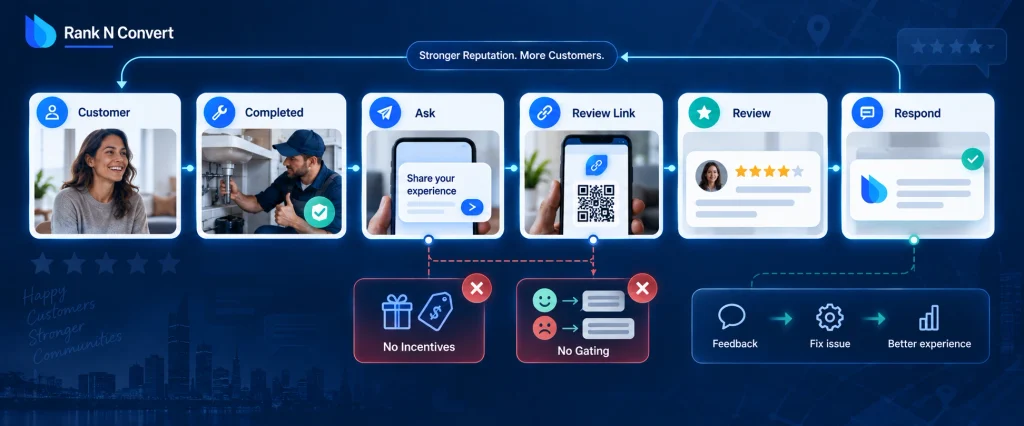
Google says reviews appear with Business Profiles across Maps and Search and can give potential customers useful information. Google also says more reviews and positive ratings can help local ranking.
That makes reviews important for two separate reasons:
They help people choose a business.
They can also contribute to local visibility.
The safest strategy is therefore not to chase five-star reviews. It is to make it easy for real customers to leave honest feedback consistently.
Ask Genuine Customers at a Repeatable Moment
Do not leave review collection to memory.
Choose one natural trigger in the customer journey and make the request part of the process.
For example:
| Business | Good review-request trigger |
| Plumber | After the repair is completed and payment is confirmed |
| Dental clinic | After the appointment or treatment |
| Restaurant | On the receipt or after an online order |
| Cleaner | After the completed cleaning visit |
| Salon | After the appointment |
| Online booking business | Follow-up email after the completed service |
Google currently lets businesses create an official review link or QR code from the Business Profile. Google specifically suggests using it on receipts, in thank-you emails, at the end of chat interactions or as a displayed QR code in-store. It also says review requests can be sent through channels such as email or WhatsApp.
A simple workflow looks like this:
Service completed → customer receives thank-you message → review link is offered → customer chooses whether and what to write
No pressure. No script telling them what rating to leave.
That is sustainable local search optimisation.
Do Not Buy, Discount or Reward Reviews
A free coffee for a review may sound harmless.
A 10% discount for a five-star rating may sound like smart marketing.
Google considers both a policy problem.
Google explicitly prohibits offering payments, discounts, free goods or free services in exchange for posting a review, changing a review or removing a negative review. Google classifies this as fake engagement or rating manipulation.
That means businesses should avoid offers such as:
“Leave us a Google review and get £10 off your next appointment.”
The issue is not whether the customer genuinely visited.
The incentive can influence whether the review is posted and how positive it is.
Google says reviews should reflect a genuine and unbiased experience.
For small businesses using local SEO services, this is worth checking carefully. A review campaign that produces numbers quickly is not useful if it creates policy risk later.
Google can remove policy-violating reviews, and suspicious review activity can also lead to review-posting restrictions or consumer warnings on a Business Profile.
Do Not Use Review Gating
Review gating usually looks innocent.
A business asks:
“Were you happy with our service?”
Customers who answer yes are sent to Google.
Customers who answer no are sent to a private feedback form.
That creates a filtered review pool.
Google’s policy is unusually clear here: merchants must not discourage negative reviews or selectively solicit positive reviews.
So the safer process is to use the same invitation rule for genuine customers.
For example:
Every customer receives the review link 24 hours after a completed job.
Not:
Only customers whom staff believe are happy receive the link.
You can still collect private customer feedback. What you should not do is use that feedback to decide who is allowed to receive the Google review request.
Google also says merchants should not pressure customers to leave a review while on the premises, require staff to collect a specific number of reviews, or tell customers what specific content to include.
That last point matters.
Do not ask:
“Please mention ‘emergency plumber Manchester’ in your review.”
Ask for an honest review and let the customer describe the experience naturally.
Respond to Reviews for the Customer, Not for Keyword Placement
Review replies have a real purpose.
They show that someone is listening.
Google itself recommends responding to reviews because it shows customers that their feedback matters.
So a useful response to a negative review might:
acknowledge the issue → clarify what can be clarified → offer a practical next step
A positive review may only need a brief, genuine thank-you.
What it does not need is this:
“Thank you for choosing Smith Plumbing, the best emergency plumber in Manchester for boiler repair, drain cleaning and plumbing services.”
That reads like the customer accidentally reviewed a meta title.
There is little reason to write review responses this way.
Whitespark’s 2026 Local Search Ranking Factors survey placed keywords in owner responses to reviews among the lowest-rated local SEO tactics in its “Local SEO Myths” section, with a score of 28 in that expert survey. Whitespark’s results are practitioner opinion and testing, not an official Google ranking disclosure.
The practical rule is stronger than the SEO myth:
Write the reply for the person who left the review and the next customer who may read it.
If relevant service terms appear naturally, fine.
Do not force them.
Use a Review System You Can Run Every Week
A healthy review process does not need complicated software.
For many small businesses, the system can be:
1. Complete the real customer interaction.
Only request feedback after an actual service, purchase or appointment.
2. Send the same neutral request to eligible customers.
Do not filter based on expected sentiment.
3. Use Google’s official review link or QR code.
Remove unnecessary steps between the customer and the review form.
4. Never attach an incentive.
No discounts, gifts, payments or rewards.
5. Read and respond like a business owner, not an SEO tool.
Thank customers, address problems and move on.
That creates something far more useful than a temporary spike in five-star ratings:
a steady record of genuine customer experience.
For local SEO, that is exactly the kind of signal worth building.
Build Prominence Through Local Proof, Not Hundreds of Random Directory Listings
A small business does not become prominent because its name appears in 300 low-value directories.
Google describes prominence as how well known a business is and says local ranking can consider information such as how many websites link to the business and how many Google reviews it has. More reviews and positive ratings can also help local ranking.
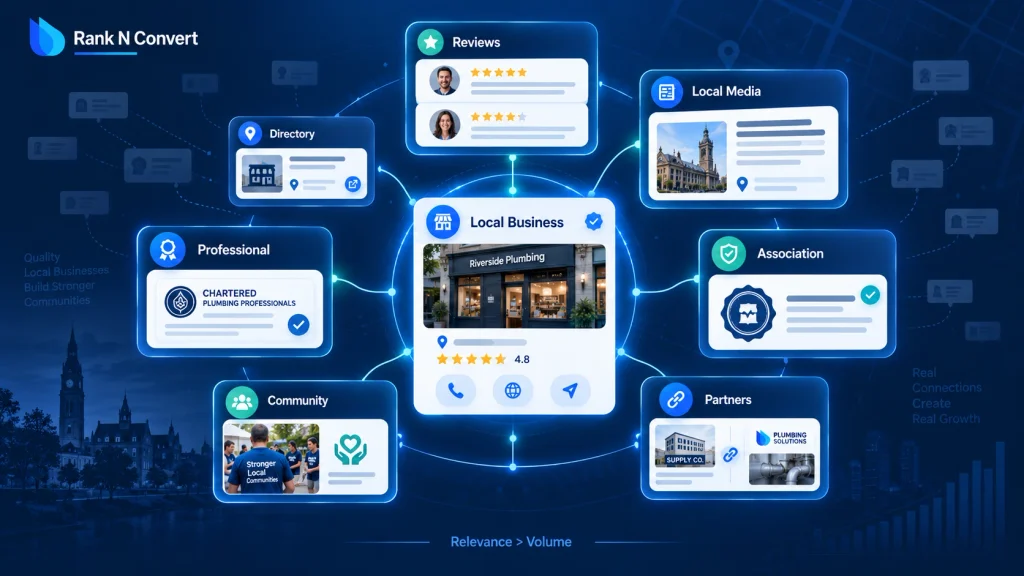
That gives small businesses a better goal than “build citations”:
Create enough trustworthy evidence across the web to show that this is a real, active and recognized business in its market.
A directory listing can contribute to that picture. But a relevant industry association, local newspaper mention or supplier link may tell customers and search engines far more than another generic business directory nobody uses.
Fix Core Business Information Where It Actually Matters
Your basic business information should be accurate anywhere customers or Google are likely to encounter it.
That normally means keeping details such as your:
- business name
- address or legitimate service area
- phone number
- website
- opening hours
accurate on your Google Business Profile, official website and important third-party listings.
Google says Business Profile information can be compiled from several sources, including the business owner, the official website, publicly available web content, licensed third-party data and user contributions.
That makes accuracy important.
But it does not mean every tiny formatting difference deserves an emergency SEO project.
For example:
25 King Streetand:
25 King St.clearly describe the same place.
There is no official Google documentation saying that fixing every harmless abbreviation or punctuation difference across obscure directories will increase local rankings.
What matters more is correcting information that could genuinely create confusion:
- Wrong: old phone number
- Wrong: closed office still listed as active
- Wrong: incorrect address
- Wrong: different business name
- Wrong: website pointing to the wrong branch
Those are meaningful problems because they affect both customer trust and Google’s understanding of the business.
Prioritize Sources That Mean Something in Your Market
Not every mention carries the same practical value.
Before paying a local SEO provider to submit the business to hundreds of sites, ask:
Would a real customer, journalist, supplier or industry professional have a reason to trust or use this source?
A useful priority model looks like this:
| Source type | Example | Why it may matter |
| Official / professional | Trade body, professional register, licensing organization | Confirms genuine industry presence |
| Local organization | Chamber of commerce, town association | Connects the business to its actual market |
| Industry source | Supplier, manufacturer, specialist directory | Reinforces what the company actually does |
| Local media | City newspaper, regional magazine | Builds local recognition and links |
| Community source | Charity, sports club, neighborhood project | Provides genuine local evidence |
| Relevant directory | Established category-specific platform | Helps discovery where customers actually search |
| Generic directory | Broad listing site with little audience | Lower priority unless customers or search engines meaningfully use it |
This does not mean every chamber membership or directory link improves rankings.
The point is to prioritize relevant proof over raw listing count.
A roofing contractor listed by a recognized roofing association has a logical relationship with that source.
The same contractor appearing on “GlobalTopBusinessLinks247” does not suddenly become locally authoritative because another citation was created.
Earn Links by Doing Things Worth Referencing
Google explicitly mentions links when explaining local prominence. It also advises website owners that the best way to earn links naturally is to create something unique and compelling that other sites genuinely want to reference.
For local businesses, “link building” therefore does not have to begin with outreach spreadsheets.
It can begin with real activity.
A veterinary clinic might publish a useful local guide to emergency pet care.
An independent restaurant might participate in a city food festival.
A plumbing company might sponsor a community sports team.
A solicitor might contribute expert commentary to a regional publication.
A retailer might partner with a local charity.
Those activities can naturally create:
local mentions → relevant links → brand recognition → referral traffic → stronger prominence
Useful opportunities can include:
- local partnerships
- community initiatives
- event participation
- sponsorships
- original local research
- useful regional resources
- supplier relationships
- expert commentary
- professional memberships
The important distinction is that the relationship comes first.
Do not sponsor a random organization only because somebody promised a backlink. Do not publish weak “research” purely to manufacture citations.
The activity should make sense even if Google did not exist.
A Local Link Should Pass the “Why Here?” Test
Before pursuing a listing, mention or backlink, ask:
Why would this website naturally mention this business?
If there is a clear answer, the opportunity is worth examining.
For example:
- Local newspaper → because the company opened a new branch.
- Manufacturer website → because the business is an authorized installer.
- Professional association → because the owner is a qualified member.
- Community organization → because the company sponsors its annual event.
- Local university → because the business funded or contributed to genuine research.
The connection itself provides context.
Compare that with:
- Unrelated overseas blog → because someone accepted $40 for a guest post.
That may technically create a link, but it provides little meaningful evidence of local reputation.
Google also warns that paid links and link schemes intended to manipulate rankings can violate its spam policies.
Don’t Confuse NAP Perfection With Local Authority
NAP means Name, Address and Phone number.
Keeping those core details accurate is sensible.
But “NAP consistency” is sometimes treated as though every character must match across every website before anything else in local SEO can work.
That can send small businesses into weeks of cleanup while larger problems remain untouched.
Imagine a dental clinic with:
- the wrong primary category
- 11 Google reviews while nearby competitors have far stronger reputations
- no page for dental implants
- weak local links
- an incomplete Google Business Profile
- a website that barely explains its services
Spending the next three weeks changing every instance of:
Road
to:
Rd
is unlikely to be the highest-value task.
Use this priority order instead:
1. Fix genuinely incorrect business information.
Wrong address, number, URL, hours or business identity comes first.
2. Fix the major sources people actually use.
Google, the official website, important industry platforms and meaningful local listings deserve attention.
3. Strengthen the things that create authority.
Reviews, useful service pages, relevant links, local mentions and real-world reputation.
4. Clean up minor listing inconsistencies when they are worth the effort.
That is a more practical approach to local search optimisation than treating citation cleanup as an endless hunt for perfect punctuation.
The goal is not to make the business appear on the most websites.
It is to make the business appear in the right places, with accurate information and enough real-world proof to deserve recognition.
Do You Need “Near Me” Keywords on Your Website?
No. You do not need to repeatedly add “near me” to your website copy to qualify for near-me searches.
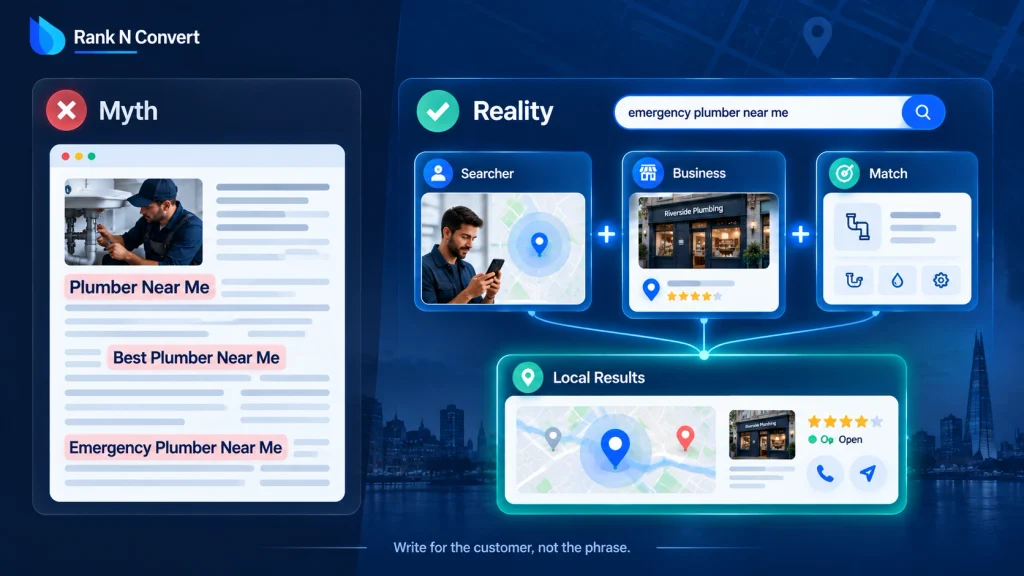
Google already uses the searcher’s location when determining local results. Google says distance is calculated from the business to the person searching, and if the person does not explicitly provide a location, Google uses what it knows about that person’s location. Google also uses relevance to determine how closely a Business Profile matches the search.
In simple terms, Google already has three important pieces:
Searcher location + business location + business relevance
You do not need to write:
Best Emergency Plumber Near Me Bristol Near You
to explain the relationship.
Emergency Plumber in Bristol is clearer to both people and search engines.
What the 2025 “Near Me” Research Actually Found
BrightLocal tested this issue in research published in June 2025.
Its methodology included 24 industry-specific “near me” search terms. BrightLocal then manually examined Google’s results, looking at the top three Local Pack results and first five organic results to see whether ranking websites showed evidence of deliberately optimizing for “near me.” The searches in the study were conducted around Paterson, New Jersey.
The most useful finding was:
94% of the Local Pack results examined showed no evidence of “near me” optimization.
Only 6% showed such optimization. Across all Local Pack and organic results combined, 31% showed evidence of “near me” optimization and 69% did not.
That is useful evidence, but it needs the correct label.
This was an observational study, not a controlled Google experiment and not a disclosure of Google’s algorithm.
It does not prove that “near me” wording can never help an organic page.
It does show that businesses clearly do not need to stuff “near me” into website copy to appear in local packs.
That fits Google’s own explanation of local search: proximity is already part of how Google determines local results.
“Near Me” Is Usually a User Signal, Not a Phrase You Need to Copy
When someone searches:
dentist near me
they are not normally asking to read the words “near me” on a webpage.
They are asking:
Which suitable dentist is close to where I am?
Likewise:
coffee shop near me
really means:
Show me a relevant coffee shop nearby.
And:
emergency locksmith near me
means:
Find a locksmith who serves my current location and can help quickly.
The words reveal local intent.
Your local SEO job is to satisfy that intent through accurate business information, legitimate location signals, strong service relevance and a useful customer experience.
Use Real Locations and Natural Language Instead
For service and location pages, write the way a customer would expect a legitimate business to describe itself.
Natural
Emergency plumbing services across Bristol, including burst pipes, leaks and urgent boiler problems.
Forced
Looking for the best emergency plumber near me Bristol? Our local plumber near me service offers plumbers near you in Bristol.
The second version does not make the location relationship clearer.
It simply makes the page harder to trust.
Semantic SEO does not mean hiding dozens of keyword variations inside a paragraph. It means giving enough clear context for the topic, service, location and user need to make sense together.
What to Optimize Instead of “Near Me”
If you want stronger hyper local SEO visibility, put your effort into signals with a clearer relationship to the search:
Make the business location or service area accurate.
Google cannot interpret proximity correctly if the underlying business information is misleading.
Choose the correct Business Profile category.
Google explicitly says categories affect local ranking.
Create strong pages for genuine services and locations.
Explain what is available and where it is actually provided.
Keep opening hours accurate.
This matters especially for “open now” searches.
Build genuine reviews and local prominence.
Google explicitly connects reviews and links with local prominence.
Make location context clear where it helps the reader.
Use real city, neighborhood or service-area names naturally instead of trying to force “near me.”
So keep “near me” where it belongs:
in the customer’s query, not stuffed into every paragraph of your website.
If an affordable local SEO service recommends adding “near me” dozens of times across titles, headings and body copy, ask what evidence supports that tactic.
In 2026, a better local SEO strategy is to make the business, service and location relationship unmistakably clear. Google can handle the words the customer uses to express proximity.
Local SEO for AI Search in 2026: What Actually Changes?
AI Overviews and AI Mode change how people can discover a local business, but they do not erase the local SEO fundamentals covered so far.
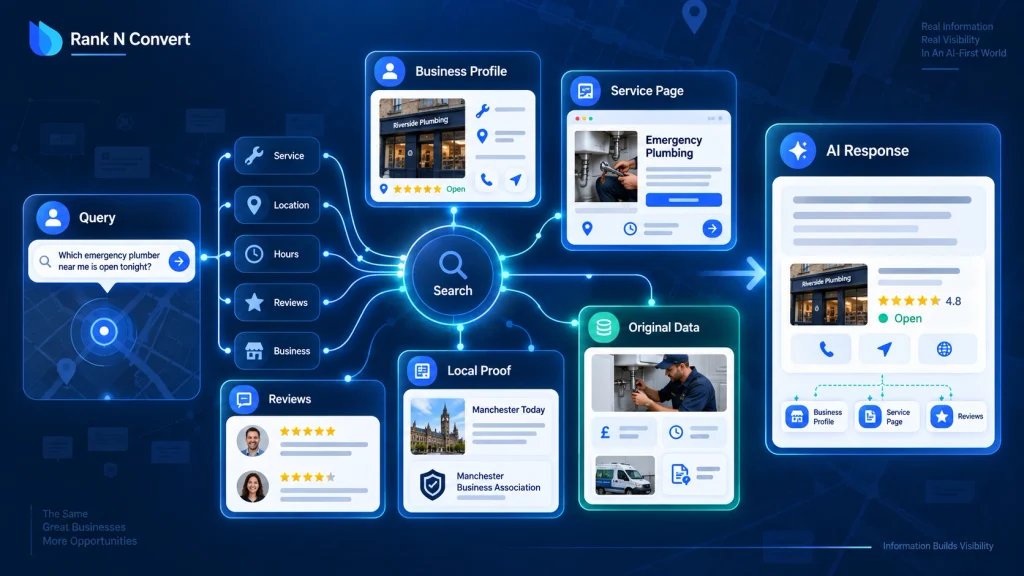
Google’s current guidance is unusually direct: its generative Search features are built on the same core Search ranking and quality systems used elsewhere in Google Search. They use techniques such as retrieval-augmented generation (RAG) to retrieve current webpages and query fan-out to run related searches when a question needs more information.
So a search such as:
“Which emergency plumber near me can repair a burst pipe tonight and has strong customer reviews?”
may involve more than one information need:
service → location → availability → reputation → suitability
That creates an opportunity for local businesses with clear, useful information.
It does not create a need for a completely separate collection of “AI SEO hacks.”
Google Does Not Require a Separate GEO Playbook
Terms such as GEO (Generative Engine Optimization) and AEO (Answer Engine Optimization) are now common in marketing.
Google’s position is simpler.
Its July 2026 generative-search guidance says optimizing for generative AI Search is still, from Google’s perspective, SEO. Existing SEO best practices continue to apply because AI Overviews and AI Mode are rooted in Google’s core Search systems.
Google also explicitly says you do not need:
- an llms.txt file for Google Search;
- special AI-specific markup;
- special schema just for AI results;
- artificial “content chunking” into tiny paragraphs;
- a different writing style designed only for AI;
- a separate page for every possible fan-out query.
Google says llms.txt neither helps nor harms Google Search visibility because Google Search ignores it. It also says there is no required content chunk size or ideal page length for its generative Search experiences.
That is an important correction for small businesses.
You do not need to rebuild your website because someone renamed SEO as GEO.
You still need to make the business:
crawlable → understandable → relevant → useful → trustworthy
If an affordable local SEO service starts with “AI files” before fixing an incomplete Google Business Profile or weak service pages, the priority is backwards.
Keep Your Google Business Profile Complete Because AI Search Can Use Local Business Information
For local businesses, Google’s 2026 guidance adds one detail that matters a lot.
Google says its generative AI responses can include information about local businesses, and specifically says that using and maintaining a Google Business Profile can help products and services become visible in AI responses as well as other Google Search results.
That connects AI visibility directly to the work already covered in this guide.
Keep accurate:
- business category;
- services;
- location or legitimate service area;
- opening hours;
- phone number;
- website;
- other customer-facing details.
Google also recommends keeping Business Profile information current when optimizing for AI Overviews and AI Mode.
This does not mean completing every GBP field guarantees inclusion in an AI response.
Google does not make that promise.
It means accurate Business Profile data is one of the official sources Google recommends maintaining when local products or services may be relevant to generative Search.
Put Decision-Worthy Facts on the Website
A common local SEO page says:
“We offer professional plumbing services throughout Bristol. Contact us today.”
It tells a customer almost nothing.
A stronger page answers the questions that actually affect the decision:
Do you repair burst pipes?
Which areas do you cover?
Are emergency appointments available?
What happens after I call?
Are call-out charges published?
What qualifications does the engineer hold?
Those facts also give search and AI systems more useful information to retrieve when answering detailed questions.
Depending on the business, useful local facts may include:
- exact services offered;
- genuine service areas;
- opening and emergency hours;
- prices or price ranges where the business publishes them;
- booking steps;
- eligibility or customer requirements;
- professional qualifications;
- guarantees and policies;
- limitations or exclusions;
- real project examples;
- location-specific details;
- answers to questions customers repeatedly ask.
The rule is simple:
Publish the information a customer would need to make a confident decision without having to guess.
Google says pages shown as supporting links in AI Overviews or AI Mode must still be indexed and eligible to appear in normal Google Search with a snippet. There are no separate technical eligibility requirements for AI Search.
So useful information that Google cannot crawl or index is still difficult to surface.
Build Information Competitors Cannot Easily Recreate
This is where AI-era local SEO becomes more interesting.
Google’s 2026 guidance says unique, useful, non-commodity content is likely to influence long-term generative Search presence more than the other recommendations in its guide. It specifically advises publishers not to recycle what other sites already say or what a generative AI system could easily recreate from existing content.
For a local business, original information does not require a university-sized research budget.
A heating company could publish:
Local boiler repair price analysis
What common jobs cost based on genuine internal or published data.
Real response-time data
For example, median emergency response times by service area, if the business actually records them.
Neighbourhood service guides
Real access, parking, housing-stock or service considerations for areas the company genuinely works in.
Customer-question analysis
The most common questions received across 200 real enquiries, if that dataset genuinely exists.
Project evidence
Before-and-after examples showing the problem, work completed, location and outcome.
Expert explanations
Why one repair makes sense in one situation but replacement makes more sense in another.
This type of content is harder to substitute because the information belongs to the business.
Compare:
“Boilers need regular maintenance.”
with:
“Across the 126 boiler call-outs recorded by our Leeds team between January and June 2026, pressure loss was the most common reason customers contacted us.”
The second statement would be far more distinctive if the company genuinely had that dataset.
Never invent data to create originality.
If no first-hand dataset exists, use verified primary sources, clearer comparisons and better decision logic instead.
The AI-Search Rule for Local Businesses
You do not need to write strangely for AI.
Google explicitly says its systems understand synonyms, concepts and variations in how people express the same need.
So focus on this:
Make the page useful enough for a customer to trust and specific enough for a search system to retrieve when the question fits.
That is a more durable AI-search strategy than chasing the GEO tactic of the month.
Why Isn’t My Business Ranking? Diagnose the Constraint Before Doing More SEO
When local visibility stalls, the instinct is usually:
“We need more SEO.”
Maybe.
But more is not useful until you know what is actually broken.
Local SEO has several separate systems working together: Business Profile eligibility, relevance, distance, prominence, website indexing, organic authority and customer conversion.
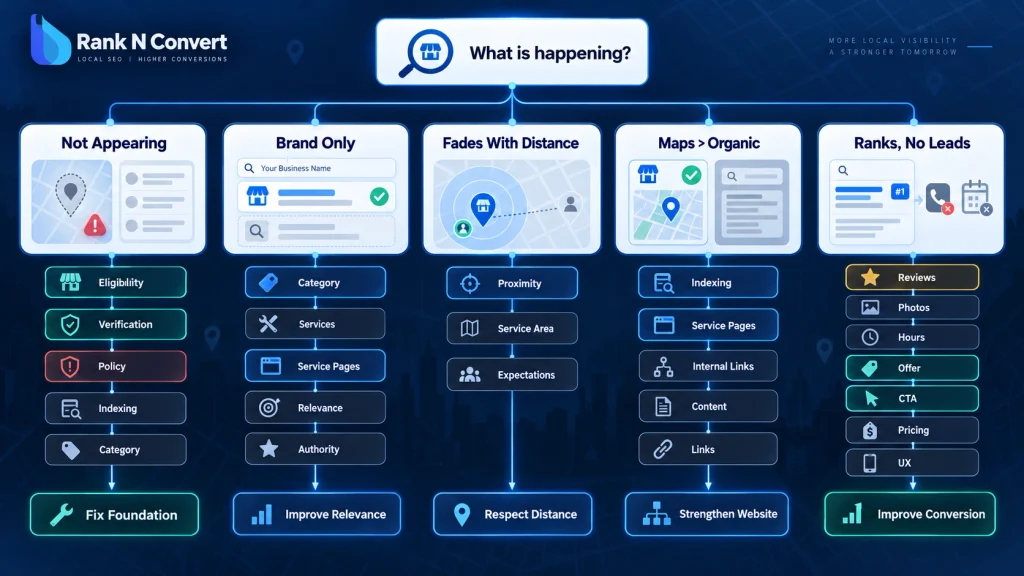
A problem in one should not automatically trigger work in all the others.
Use the symptom first.
Then diagnose the constraint.
Local SEO Diagnosis Tree
| What you see | First constraint to investigate | What to check next |
| Business does not appear at all | Eligibility / verification / policy / indexing | GBP eligibility → verification → suspension → profile accuracy → website indexability |
| Business appears for its name but not main services | Relevance | Primary category → services → service pages → location relevance → authority |
| Business ranks nearby but disappears farther away | Distance | Searcher location → business location → genuine service coverage |
| Business appears in Maps but website barely ranks organically | Website SEO | Indexing → service pages → internal links → content relevance → links |
| Business ranks but produces few calls or bookings | Conversion | Reviews → hours → photos → offer → CTA → pricing → page experience |
The order matters.
Problem 1: Your Business Does Not Appear at All
Do not begin by buying backlinks.
First check whether the business is actually eligible and available to appear.
Step 1: Confirm Google Business Profile eligibility
Google requires most eligible Business Profiles to represent businesses that make in-person contact with customers during their stated hours. Online-only businesses and lead-generation companies are among the examples Google lists as ineligible.
If the profile model itself is invalid, optimization will not solve the problem.
Step 2: Confirm the profile has been added and verified
Google says adding and verifying a Business Profile allows customers to find the business across Google Search and Maps and allows the owner to control the information displayed.
If verification is pending, finish that process before diagnosing rankings.
Step 3: Check for a suspension or policy problem
Google can suspend or disable profiles that do not follow its Business Profile guidelines. A suspended profile may require an appeal supported by evidence such as business registration, licences, tax documents or utility bills.
Do not create another profile for the same business while an appeal is under review; Google specifically advises against this.
Step 4: Check whether the website’s important pages are indexed
A visible Business Profile and an indexed website are separate issues.
Open the important service or location URL in Google Search Console’s URL Inspection tool.
The tool can show:
- whether the URL is indexed;
- whether crawling is allowed;
- whether noindex is blocking indexing;
- which canonical Google selected;
- when Google last crawled the page.
If the page is not indexable, improving its copy will not fix the technical barrier.
Problem 2: You Appear for Your Brand Name but Not for Your Services
Suppose Smith Heating appears when someone searches:
“Smith Heating”
but not when someone searches:
“boiler repair”
That is often a relevance problem before it is a link-building problem.
Start with the information Google uses to understand what the business does.
Check the primary category
Google explicitly says Business Profile categories affect local ranking and recommends selecting the category that best describes the business.
If the main business is a plumber but the profile is classified too broadly or incorrectly, start there.
Check the services listed
Google allows eligible businesses to list specific services, and says a relevant service may be highlighted on the profile when someone searches for that offering.
Again, adding a service is not a guaranteed ranking boost.
It simply helps make the offering clearer.
Check the website
If boiler repair is an important service, does the site actually contain a strong boiler repair page?
Or is the phrase buried inside a list of 25 services?
The website should provide evidence that supports the Business Profile:
Category → service → page → local context → customer action
Only after those relevance signals are strong should you move deeper into links, mentions and local prominence.
Problem 3: You Rank Nearby but Disappear Several Miles Away
This is where many small businesses waste money.
Imagine your plumbing company appears in the local results when searching two kilometres from the office but drops sharply when the same search is performed 15 kilometres away.
That does not automatically mean the local SEO campaign has failed.
Google explicitly uses distance as one of its main local-ranking considerations. If the customer does not state a location, Google uses what it knows about that person’s location.
So first ask:
Does visibility weaken mainly as the search location moves farther from the business?
If yes, proximity may be a major constraint.
That means the wrong response may be:
- creating 30 thin city pages;
- stuffing more location keywords into titles;
- buying random directory listings;
- adding fake office addresses.
You cannot backlink your way physically closer to the searcher.
For service-area businesses, continue representing the genuine operating area accurately, but do not assume listing a city as a service area guarantees rankings there.
Sometimes the correct diagnosis is simply:
The business is relevant and credible, but another eligible business is materially closer to that searcher.
Knowing that prevents months of chasing the wrong fix.
Problem 4: You Appear in Maps but Not in Organic Search
This tells you something useful.
Your Google Business Profile may have enough local relevance to appear in Maps, while the website is not strong enough to compete for traditional organic results.
Now move away from repeatedly editing the profile and inspect the site.
Check:
- Indexability.
Are the important service and location pages actually indexed? - Service-page depth.
Does each major service have enough useful information to satisfy its search intent? - Internal links.
Can users and Google easily move from the homepage to important services and locations? - Content overlap.
Are several pages competing with nearly identical city-swapped copy? - Canonical signals.
Is Google treating the intended page as canonical? - External authority.
Do relevant sites link to or mention the business?
Search Console’s URL Inspection tool can show whether an individual page is indexed and which canonical URL Google selected. Google also says sufficiently similar pages may be clustered together, and recommends making genuinely different pages clearly and significantly different.
So if five location pages keep collapsing into one canonical, the question may not be:
“How do I force Google to index them?”
It may be:
“Are these actually five distinct pages?”
That is a much more useful SEO question.
Problem 5: You Rank but Customers Still Do Not Call or Book
This is the point where improving rankings may no longer be the highest-value action.
Suppose the business already appears prominently for:
“dentist Birmingham”
but enquiries remain weak.
The next problem may be the customer decision experience.
Look at the result as a customer would.
Reviews
- Does the business have enough recent, credible feedback to reduce uncertainty?
Opening hours
- Is the business actually available when customers search?
Photos
- Can customers see the location, team, work or environment?
Offer and service clarity
- Can someone immediately understand what the business provides?
Phone and booking actions
- Can the customer call or book without hunting through the page?
Pricing
- If cost strongly affects the decision, does the business provide enough pricing context to reduce uncertainty where appropriate?
Website experience
- Does the page load properly on mobile? Is the phone number visible? Is the enquiry form usable?
At this point, the distinction matters:
Ranking creates the opportunity to be considered. It does not guarantee the customer will choose you.
A local SEO provider can move a business from position eight to position four and still fail to generate meaningful business value if the listing and website do not convert attention into action.
Diagnose Before You Optimize
Use this sequence whenever local visibility or lead generation drops:
Each answer points to a different solution.
That is why “do more local SEO” is not a diagnosis.
A better local SEO strategy identifies the exact constraint first, then spends time and budget only where that constraint can actually be changed.
Measure Local SEO by Customers, Not Just Rankings
A number-one ranking looks impressive in a report.
It matters much less if nobody calls, books, visits, or buys.
That is why local SEO measurement should not stop at:
“We moved from position 7 to position 3.”
The useful question is:
“Did greater local visibility create more qualified customer actions and business value?”
In June 2026, that became easier to measure. Google introduced a direct connection between Google Business Profile and Google SEO Analytics, allowing businesses to bring seven GBP metrics into Analytics: interactions, calls, bookings, direction requests, website clicks, messages, and menu interactions.
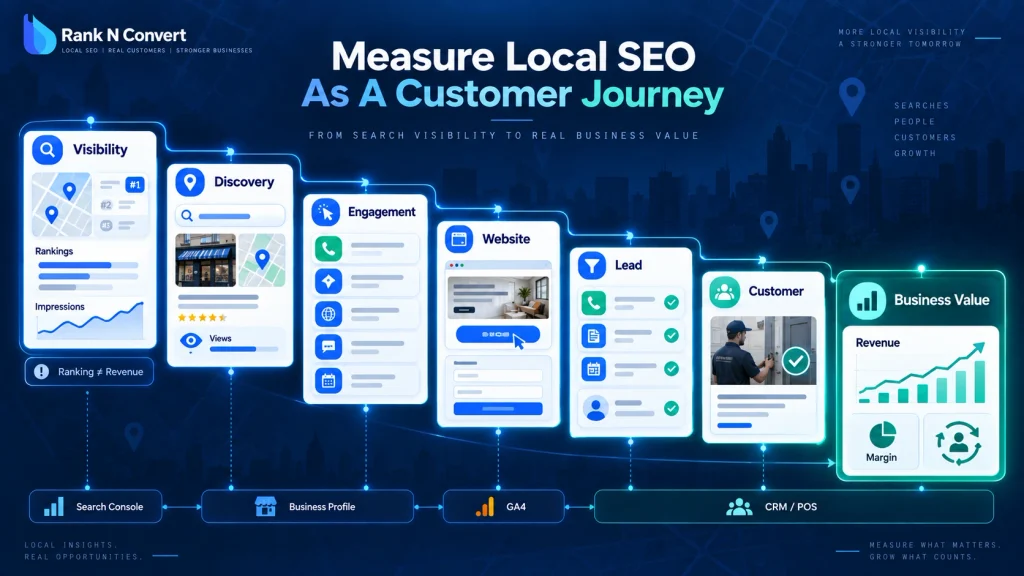
That means a small business can now look beyond rankings and follow more of the journey from local discovery toward conversion.
Local SEO Measurement Funnel
| Stage | What to measure | What the metric tells you |
| Visibility | Local rankings, Maps presence, organic impressions | Are people getting opportunities to discover the business? |
| Discovery | GBP views and search queries | Is the Business Profile appearing for relevant searches? |
| Engagement | Calls, directions, website clicks, messages, bookings | Are searchers taking the next step? |
| Website | Landing sessions, form starts, booking actions | What happens after someone reaches the site? |
| Lead | Qualified calls, forms, appointments | Is visibility producing genuine enquiries? |
| Customer | Completed job, visit, treatment, purchase | Did the lead become a customer? |
| Business value | Revenue, margin, customer value | Was the local SEO activity commercially worthwhile? |
The further down the funnel you measure, the closer you get to the metric a business owner actually cares about.
Measure Local Rankings Geographically, Not From One Desk
A single manual Google search is a poor picture of local visibility.
Google explicitly uses distance when deciding local results. If the user does not provide a location, Google uses what it knows about where that person is.
So a plumber may rank strongly:
2 km from the office
and much weaker:
12 km away
for the same search.
That does not necessarily mean something broke between the two searches.
The search context changed.
This is why a report saying:
“You rank #2 for emergency plumber”
is incomplete unless you also know where that ranking was measured.
For local SEO, look at visibility across the real customer area:
- around the business location;
- key neighborhoods;
- genuine service areas;
- locations that generate meaningful revenue.
Do not expect a business to hold the same local position across an entire city when proximity itself is part of Google’s system.
What to Look For
If rankings are:
strong close to the business but fade with distance
→ proximity may be the main constraint.
If rankings are:
weak everywhere
→ investigate relevance, prominence, eligibility, or profile quality.
If Maps visibility is:
strong but the website performs poorly organically
→ investigate website SEO rather than endlessly editing the Business Profile.
Geographic measurement turns ranking data into diagnosis.
Give Each Measurement Tool One Clear Job
One reason local SEO reports become confusing is that four different systems are asked to answer the same question.
They should not.
Use them like this:
| Tool | Best question it answers |
| Google Search Console | Are people seeing and clicking our website in Google Search? |
| Google Business Profile | How are people finding and interacting with our local listing? |
| Google Analytics 4 | What do visitors do after reaching our website or app? |
| CRM / booking system / POS | Which enquiries became customers and revenue? |
Google Search Console = Search Visibility
Search Console reports metrics such as:
- impressions;
- clicks;
- click-through rate;
- average position;
- search queries;
- landing pages;
- country;
- device.
Google describes the Performance report as a way to understand how often a site appears in Search, which queries produce visibility, and which pages receive clicks.
Use it to answer questions such as:
- Is our boiler repair page gaining impressions?
- Which local searches already trigger the site?
- Which important service pages receive impressions but few clicks?
That is far more useful than looking only at one tracked keyword.
Google Business Profile = Local Profile Interaction
Business Profile performance tells you how people discover and interact with the listing across Search and Maps.
Google currently reports applicable metrics including:
- views;
- searches;
- directions;
- calls;
- website clicks;
- messages;
- bookings.
Google notes that some metrics appear only when they apply to the specific business. For example, booking data requires bookings to be managed through a supported booking provider.
There is another detail worth understanding:
A call metric records clicks on the call button. It does not automatically prove that every click became a qualified phone enquiry or sale.
Likewise:
direction request ≠ store visit
and:
website click ≠ customer
Treat these as signals of intent, not final business outcomes.
GA4 = What Happens After the Click
The new 2026 Business Profile integration helps bring local listing engagement closer to website and app reporting.
To connect them, Google says you need an Editor or Administrator role in GA4 and must be an owner or manager of the Business Profile. The connection is configured under Admin → Product links → Google Business Profile links.
Once linked, the dedicated GBP reporting collection can show:
- interactions;
- website clicks;
- calls;
- directions;
- messages;
- bookings;
- menus.
But there are important limitations.
Google currently keeps these GBP metrics in Analytics on a rolling six-month window. If several Business Profiles are connected to one GA4 property, the GBP metrics are added together, and Google says they cannot currently be filtered down to an individual linked profile inside that report.
That matters for multi-location businesses.
If five branches are connected, the Analytics total may tell you how the group performs, but not which branch generated each GBP interaction.
For branch-level analysis, you may still need the individual Business Profile performance data or another reporting setup.
That is the kind of measurement limitation a generic “connect GA4” recommendation usually misses.
CRM or POS = Actual Business Value
Google Analytics can tell you that someone submitted a form.
Your CRM should tell you whether the enquiry was useful.
For example:
42 form submissions
sounds successful.
But if:
- 14 were spam;
- 12 were outside the service area;
- 8 wanted a service you do not provide;
- 8 became qualified enquiries;
then the useful number is 8, not 42.
Go one step further:
If 5 of those 8 enquiries became paying customers, measure the value of those customers.
The funnel becomes:
Search visibility → interaction → lead → qualified lead → sale → revenue
That is the measurement chain local SEO services should ultimately be accountable to.
Track Results by Service, Not Just by Website
Whole-site averages often hide the most useful information.
Suppose a plumbing company reports:
“Organic traffic increased 18%.”
Useful, but incomplete.
A much stronger business insight would be:
“Emergency plumbing generated 22 qualified calls, while boiler servicing generated 11 booking requests.”
Use exact service-level numbers only when your tracking genuinely supports them.
That can require:
- dedicated service pages;
- call tracking;
- form source tracking;
- booking tags;
- CRM service categories;
- revenue attribution.
The goal is not more dashboards.
It is to answer:
Which local services are generating profitable customers?
A local SEO provider who cannot move beyond impressions, traffic, and ranking screenshots is measuring only the top of the funnel.
Use This Reporting Order
When reviewing local SEO each month, read the data in this sequence:
1. Visibility
Are relevant local queries producing impressions and Maps exposure?
2. Interaction
Are people clicking, calling, requesting directions, messaging, or booking?
3. Conversion
Are website visitors completing useful actions?
4. Lead quality
Are those enquiries relevant and serviceable?
5. Revenue
Are they becoming paying customers?
This order prevents a common mistake:
celebrating higher visibility while the actual customer pipeline remains flat.
What Should a Small Business Fix First? Use This Priority Framework
Local SEO rarely fails because a small business has not tried enough tactics.
More often, the tactics are being done in the wrong order.
A company may be buying backlinks while its primary category is wrong.
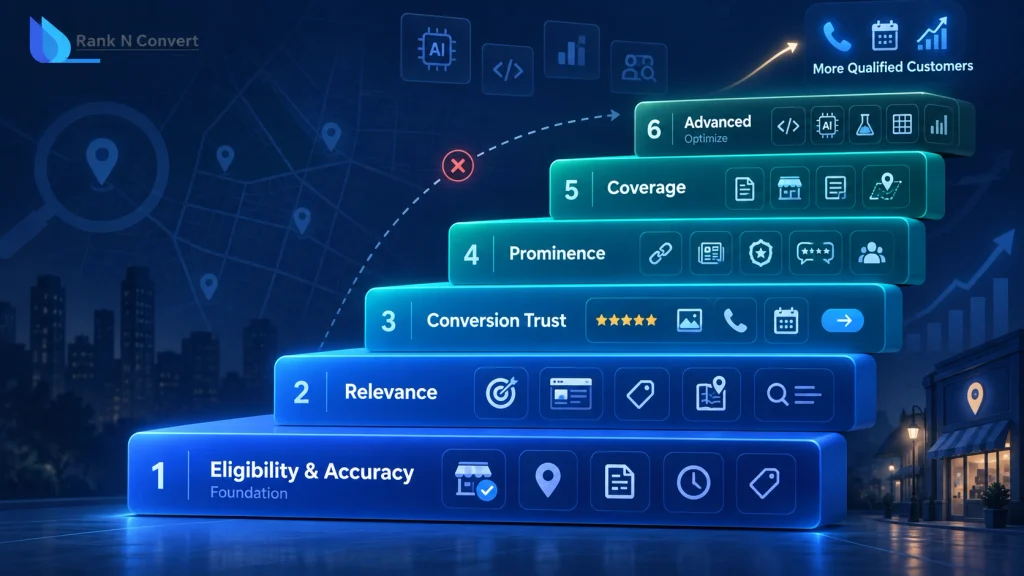
Another may be paying for advanced local SEO ranking factors optimization services while its opening hours are inaccurate.
Another may be discussing AI-search visibility while important service pages are not indexed.
The right question is:
What is the earliest broken step in the local search journey?
Fix that first.
Local SEO Priority Ladder
| Priority | Fix first | Why it comes before the next stage |
| 1. Eligibility & accuracy | Eligibility, verification, name, address/service area, category, hours | Google needs a valid, accurate business entity |
| 2. Relevance | Services, service pages, titles, location information | Google needs to understand what you provide and where |
| 3. Conversion trust | Reviews, photos, booking/contact experience | Visibility has little value if customers do not choose you |
| 4. Prominence | Links, mentions, meaningful citations, reputation | External evidence helps strengthen local authority |
| 5. Coverage | Genuine additional services, locations and content | Expand only after the foundation works |
| 6. Advanced optimization | Schema refinements, AI monitoring, testing, deeper competitive analysis | Optimization should improve a working system, not replace one |
Priority 1: Fix Eligibility and Accuracy Before Anything Else
Start here if the foundation is wrong.
Check:
- Is the business eligible for a Google Business Profile?
- Is the profile verified?
- Is the real-world business name accurate?
- Is the address or service-area setup correct?
- Is the primary category right?
- Are customer-facing opening hours accurate?
Google says complete and accurate Business Profile information helps it understand businesses and match them to relevant searches. Google also identifies relevance, distance, and prominence as the main factors behind local results.
If these basics are wrong, advanced work rests on bad data.
Priority 2: Improve Relevance
Once the business entity is correct, make the offering unmistakable.
Check:
- important services;
- Business Profile service information;
- service pages;
- titles and headings;
- genuine location information;
- internal linking between services and locations.
Ask:
If someone searched for our most important service, could Google and the customer clearly see that we provide it?
If the answer is unclear, this is where to work next.
Do not jump to link building simply because ranking is weak.
Weak relevance and weak prominence are different problems.
Priority 3: Fix the Customer Decision Experience
A business can rank and still lose.
Once visibility exists, inspect what the customer sees:
- review quality and recency;
- real photos;
- opening hours;
- phone number;
- booking path;
- service clarity;
- pricing context where appropriate;
- mobile page experience.
If 500 people see the profile but only three meaningful actions follow, another 100 impressions may not be the highest-value objective.
The next improvement may be conversion, not ranking.
Priority 4: Build Prominence
Only now move harder into:
- relevant backlinks;
- industry mentions;
- local media;
- professional associations;
- useful citations;
- community relationships;
- reputation.
Google explicitly includes links and reviews when explaining prominence.
This is where local SEO marketing services can add value, but only if they are building meaningful authority rather than selling bulk directory submissions.
Priority 5: Expand Coverage Only Where the Business Has Real Depth
Once the foundation works, expand carefully.
That may include:
- another important service page;
- a genuine location page;
- a useful local guide;
- another supported service area;
- original case studies;
- customer-question content.
Do not create coverage merely because a keyword tool found another city or phrase.
Expansion should follow real business capability + real customer demand + enough unique information to justify the page.
Priority 6: Use Advanced Optimization to Improve a Working System
Only after the earlier layers are healthy should you spend serious time on:
- LocalBusiness schema refinements;
- detailed competitor-gap analysis;
- local grid analysis;
- AI Overview or AI Mode monitoring;
- content experiments;
- conversion tests;
- advanced reporting.
These can be valuable.
They are simply lower priority than fixing an incorrect category, missing service page, poor reviews, or broken contact experience.
Think of advanced local SEO like tuning a car.
It helps when the engine already runs.
It does not replace the engine.
How to Choose the Next Local SEO Task
Use the first broken stage:
Profile invalid or inaccurate?
→ Fix eligibility and accuracy.
Google does not clearly understand the service?
→ Fix relevance.
People see you but do not choose you?
→ Fix conversion trust.
Competitors have stronger reputation and external proof?
→ Build prominence.
The existing system works and you want more reach?
→ Expand coverage.
Everything above is healthy?
→ Move into advanced optimization.
This is a better use of a small-business budget than buying a long checklist of tactics all at once.
The best local SEO plan is not the one with the most tasks. It is the one that fixes the highest-impact constraint first, then measures whether that change produced more customers.
Some businesses handle these priorities internally, while others outsource local SEO once implementation becomes too time-consuming or technical. For freelancers and consultants on the other side of that relationship, our guide to the best platforms to find freelance clients covers where to look for new project opportunities.
A Small-Business Local SEO Checklist for 2026
At this point, the checklist should feel less like a pile of SEO tasks and more like a final systems check.
The goal is not to tick every box because a local SEO guide told you to.
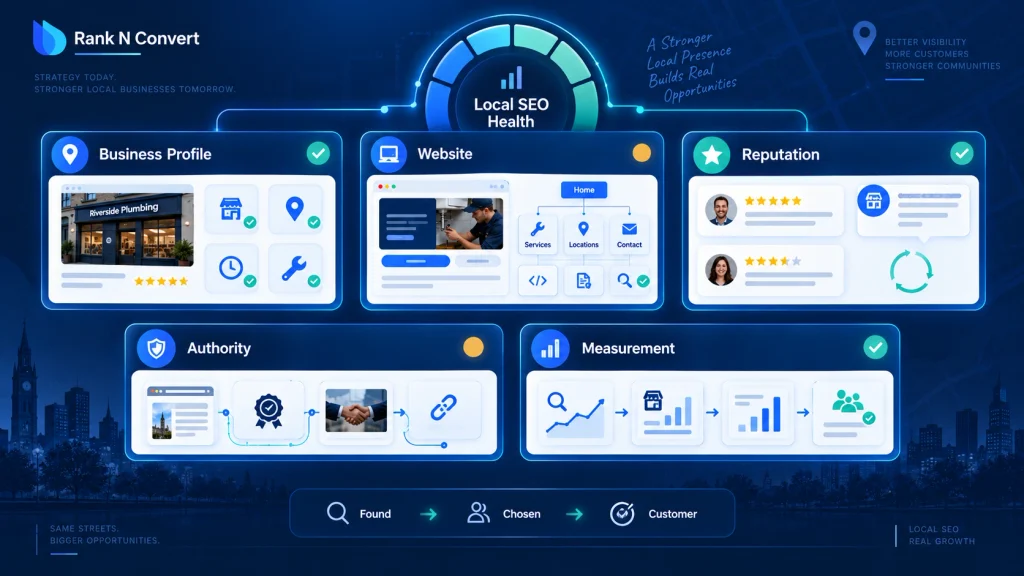
The goal is to confirm that Google can identify the business, understand what it offers, trust the information around it, surface the right pages, and connect visibility to real customer actions.
Use this checklist in order.
Google Business Profile: Can Google Identify the Business Correctly?
✅ The business is eligible for a Google Business Profile
The business should genuinely meet customers in person, either at a staffed location or by travelling to them. Do not force an online-only or lead-generation business into a local profile model it does not qualify for.
✅ The Business Profile is verified
Without control of the verified profile, even basic information can become difficult to manage.
✅ The business name matches the real-world name
Use the name customers actually see on signage, the website, stationery and branding.
Do not turn:
Smith Plumbing
into:
Smith Plumbing Emergency Plumber Manchester 24/7 Drain Repair
Google says unnecessary information in the business name is not permitted and can result in profile suspension.
✅ The primary category accurately describes what the business is
Choose the most specific category that represents the core business.
✅ Additional categories describe genuine secondary functions
Use only the categories needed to explain the business. Google specifically recommends using as few categories as possible and says categories should not be added merely as keywords.
✅ The address or service area reflects the real operation
A service-area business that does not receive customers at its address should hide that address.
Google allows service-area and hybrid businesses to define real service areas and currently allows up to 20, while advising that the total area normally should not extend more than about two hours’ driving time from the business base.
✅ Important services are listed accurately
The profile should clearly show what customers can actually book or buy.
✅ Regular and special opening hours are accurate
Update holiday closures and temporary changes instead of making customers discover them at the door.
✅ Phone, website and booking links work
Test them yourself.
A perfectly optimized profile that sends customers to a dead phone number or broken booking page has failed at the part that matters most.
Website: Can Google and Customers Understand What You Do and Where?
✅ Important services have useful dedicated pages
Do not hide every revenue-driving service inside one long /services/ page.
A separate page makes sense when the service creates a distinct customer need and enough useful information exists to justify it.
✅ Genuine locations have genuinely useful location pages
A branch, clinic or real operating market may deserve its own page.
A city name alone does not.
✅ Important pages are indexable
Check priority service and location URLs in Google Search Console.
Pages blocked by noindex, broken redirects, access restrictions or technical errors cannot compete normally in organic search.
✅ Internal links connect locations, services and proof
The structure should make sense to a person:
Location → Service → Evidence → Contact
Not:
Homepage → 75 isolated SEO pages
✅Business contact information is accurate
Check the business name, phone number, address where applicable, contact forms and location details.
✅ LocalBusiness structured data is used where it accurately describes the visible page
Google says LocalBusiness structured data can communicate facts such as business type, location and opening hours. It should reflect real page content, not invent information purely for search engines.
✅ The mobile experience makes contacting the business easy
A customer searching from the street should not have to zoom, hunt through menus or complete a 15-field form just to call.
Reputation: Are Real Customers Creating Trust?
✅ There is a repeatable review-request process
Decide when genuine customers receive the request:
completed job → thank-you message → Google review link
is enough for many small businesses.
✅ Review requests are neutral
Ask customers to share their experience.
Do not ask only happy customers.
Google’s fake-engagement policy prohibits discouraging negative content or selectively soliciting positive feedback.
✅ No payment, discount, gift or free service is offered for reviews
Google explicitly prohibits incentives in exchange for posting, changing or removing reviews.
✅ Google’s official review link or QR code is being used where helpful
Google suggests using the review link or QR code on receipts, thank-you emails, at the end of chat interactions and in-store displays.
✅ Reviews are monitored and answered
Respond because customers are reading, not because you want another place to stuff keywords.
✅ Repeated complaints are fixed operationally
If five customers complain about missed calls, the answer is not a clever review response.
Fix the phone process.
Local SEO cannot permanently hide a weak customer experience.
Authority: Does the Business Have Proof Beyond Its Own Website?
✅ Important third-party listings contain accurate information
Prioritize the platforms customers, search engines and industry participants are actually likely to encounter.
✅ The business appears on relevant industry sources
That may include professional registers, associations, supplier directories or industry bodies.
✅ The business has genuine local mentions
Look for logical opportunities through:
- local publications;
- community organizations;
- chambers;
- partnerships;
- suppliers;
- events.
✅ Relevant backlinks are being earned, not simply manufactured
Google explicitly includes links among the information that can contribute to local prominence.
One relevant local newspaper link can make more contextual sense than dozens of unrelated directory submissions.
If you outsource local SEO, ask the provider to explain why each target website is relevant to your business, not simply how many links the package includes.
Measurement: Can You Connect Search Visibility to Customers?
✅ Google Search Console is configured
Monitor:
- impressions;
- clicks;
- CTR;
- average position;
- queries;
- landing pages.
Google itself recommends focusing on trends in clicks and impressions rather than position alone.
✅ GA4 is configured
Track what happens after users reach the website.
✅ Google Business Profile is linked to GA4 where useful
Google launched the direct GBP-to-Google Analytics integration on June 8, 2026.
It can import seven Business Profile metrics:
- interactions;
- calls;
- bookings;
- directions;
- website clicks;
- messages;
- menus.
✅ Calls, forms and bookings are tracked
Do not stop at “website traffic increased.”
✅ Qualified leads are distinguished from raw enquiries
Ten calls from customers you cannot serve are not the same as ten qualified opportunities.
✅ Revenue or completed appointments are connected where possible
The strongest local SEO reporting eventually answers:
✅ Which search visibility created customers and revenue?
That is the point where local search optimisation becomes a business system rather than a ranking exercise.
The 10-Minute Final Check
If you need a shorter version, verify these first:
- Is the Business Profile valid and accurate?
- Is the primary category correct?
- Are genuine services and service areas clear?
- Do important services have useful pages?
- Are those pages indexed?
- Can customers contact or book easily?
- Are real reviews being collected without incentives?
- Does the business have meaningful local or industry proof?
- Are calls, forms and bookings tracked?
- Can you tell which local SEO work produces qualified customers?
If several answers are no, fix those before chasing advanced tactics.
Local SEO Mistakes That Can Waste Time or Put Visibility at Risk
Some local SEO mistakes merely waste effort.
Others can leave a Business Profile suspended, create weak pages Google does not want to rank, or produce reports that look successful while the business receives few customers.
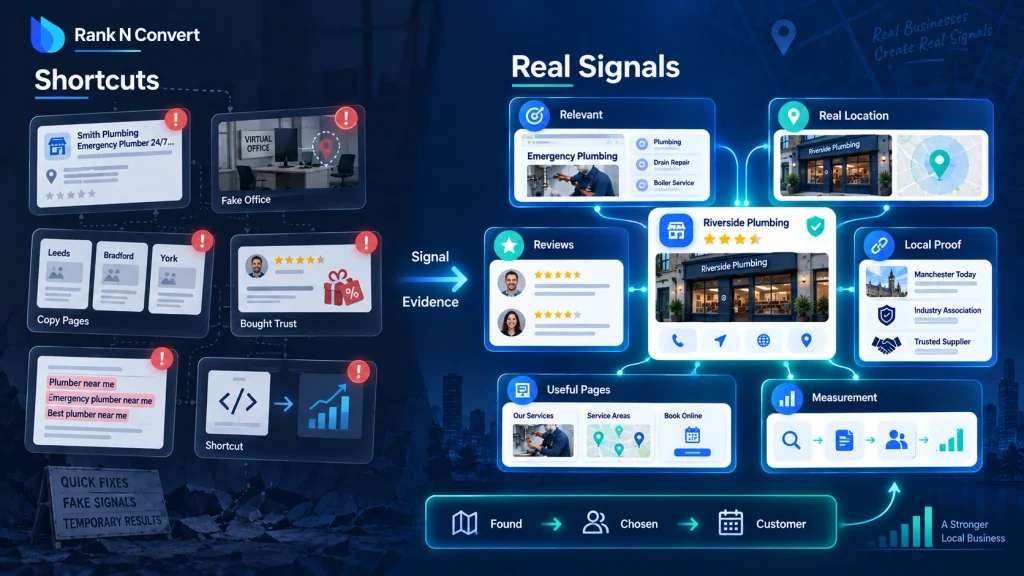
These are the ones worth watching.
Adding Keywords to the Official Business Name
Keyword stuffing the Google Business Profile name can look attractive because business names are highly visible in local results.
But Google’s rule is clear: the profile name should match the business’s real-world name, as used consistently across the storefront, website, stationery and branding.
Unnecessary Google Business Profile optimization, such as adding irrelevant services, locations, opening hours, or marketing language, is not permitted and may lead to suspension.
Real name
Smith Plumbing
Manipulated name
Smith Plumbing Emergency Plumber Manchester Drain Cleaning 24/7
If competitors are breaking the rule, copying them is not a long-term local SEO strategy.
Creating Fake Offices to Rank in More Cities
A service-area business cannot create a pretend branch simply because another city has attractive search volume.
Google says a virtual office where the company does not actually operate is not eligible for a Business Profile.
A co-working location must have clear signage, receive customers during stated hours and be staffed by the business’s own team to qualify as a storefront.
For service-area businesses that do not serve customers at their base address, Google says to hide that address and use the service-area configuration instead.
The safe rule is simple:
A city you want customers from is not automatically a business location.
Creating Dozens of Near-Identical City Pages
There is nothing wrong with a useful location page.
The problem starts when a business creates:
/plumber-leeds/
/plumber-bradford/
/plumber-york/
/plumber-wakefield/
and every page says almost exactly the same thing.
Google defines doorway abuse to include pages targeted at specific cities or regions that funnel users toward the same destination, as well as substantially similar pages created mainly to capture search traffic.
A location page should therefore contain a reason to exist beyond replacing one city name.
If there is no local staff, project evidence, service difference, access information, genuine coverage detail or other useful local context, ask whether the page is really needed.
Buying or Incentivizing Google Reviews
Never trade:
- money → review
- discount → review
- free service → review
- gift → review
Google classifies incentives for reviews as fake engagement. The policy also covers incentives to change or remove negative reviews.
The safer model is much less complicated:
Ask genuine customers consistently and let them decide what to say.
A smaller set of authentic reviews is more defensible than a sudden wave of suspicious five-star ratings.
Stuffing “Near Me” Into Titles and Headings
A page does not need to read:
Best Dentist Near Me Birmingham Near You
for Google to understand proximity.
Google already considers distance when generating local results. It can estimate the searcher’s location even when the user does not explicitly type a city.
Use natural geographic language instead:
Emergency Dentist in Birmingham
The job is to make the service and genuine location clear, not to imitate the customer’s search query word for word.
Treating LocalBusiness Schema as a Map-Pack Ranking Hack
Structured data helps communicate facts.
Google says LocalBusiness markup can describe details such as business type, hours and location information.
Google does not say:
“Add LocalBusiness schema and your Maps ranking will increase.”
So implement schema when it truthfully describes the visible business information.
Do not sell or buy it as a secret local-ranking switch.
Tracking One Ranking From One Location
Searching your keyword once from the office and recording:
“We’re #3”
does not describe local visibility.
Google uses distance in local ranking. That means the same business can perform differently when the search happens from another neighborhood.
Track the areas customers actually come from.
Then look for patterns.
Strong nearby, weak farther away may point to proximity.
Weak everywhere may point to relevance or prominence.
A single ranking number cannot tell you that.
Optimizing for Traffic While Ignoring Calls and Bookings
Traffic is useful only when it supports the business objective.
A local SEO marketing services report might show:
Organic traffic: +35%
Impressions: +60%
Rankings: +18 positions
Those numbers sound strong.
But the business owner still needs to know:
Did qualified calls, appointments, store visits or sales improve?
Google’s June 2026 Business Profile integration with Analytics makes it easier to bring interactions such as calls, bookings, directions and website clicks into the same reporting environment.
Use that visibility.
If rankings rise while qualified customer actions remain flat, investigate the conversion path before ordering more local SEO optimization services.
The Pattern Behind Most Local SEO Mistakes
Most bad tactics come from optimizing the signal while forgetting what the signal is supposed to represent.
Keyword-stuffed names try to fake relevance.
Fake offices try to fake proximity.
Bulk directory links try to fake prominence.
Incentivized reviews try to fake reputation.
Thin city pages try to fake local expertise.
Schema abuse tries to fake clarity.
None is stronger than building the thing itself:
a real business, accurately represented, serving genuine locations, answering real customer needs, earning real proof, and measuring real outcomes.
That is the foundation the best local SEO work should strengthen.
Frequently Asked Questions About Local SEO for Small Businesses
How long does local SEO take to work?
Local SEO has no universal timetable. Results depend on current visibility, competition, distance, website condition, prominence, business history and the query itself. Google notes that even new businesses can take up to a month to appear in search results.
Can a small business do local SEO without a website?
Yes. A small business can gain Google Maps visibility through an eligible, verified Google Business Profile without a website. But a website expands organic search opportunities, supports service pages, builds relevance and gives customers more information before contacting you.
Can a service-area business rank without showing its home address?
Yes. A service-area business can rank without displaying its home address. Google says businesses that visit customers and do not serve them at their address should hide that address and define accurate service areas instead.
Does Google Business Profile posting improve rankings?
Google Business Profile posts are useful for sharing offers, events and updates with customers, but Google does not identify posting frequency as a confirmed local ranking factor. Use posts for communication and conversion, not as a guaranteed ranking tactic.
Do citations still matter for local SEO in 2026?
Yes, but citations should support accuracy and credibility, not become a volume game. Keep important listings correct and prioritize relevant local, industry and professional sources. Google also uses public web and third-party information when building Business Profile data.
Does LocalBusiness schema improve Google Maps rankings?
There is no official Google evidence that LocalBusiness schema directly improves Google Maps rankings. Use it to clarify business facts such as type, address and opening hours, while relying on relevance, distance and prominence for local ranking.
Can local SEO help a business appear in Google’s AI results?
Yes. Google says Business Profiles can help local products and services appear in generative AI responses and other Search results. Strong local SEO, accurate business data, crawlable pages and useful original content remain the foundation for AI visibility.
Conclusion: Fix the Constraint That Is Holding Local Visibility Back
Start with the constraint stopping Google or customers from choosing your business. If the profile is inaccurate, fix the Google Business Profile. If Google cannot understand your services, improve relevance. If competitors have stronger proof, build reviews, links and local prominence. If visibility drops by neighborhood, account for distance. If rankings are strong but calls and bookings are weak, improve the customer decision experience instead of chasing more positions.
Need a focused local SEO strategy built around leads, not vanity metrics? Visit Rank N Convert and turn local visibility into measurable growth.