

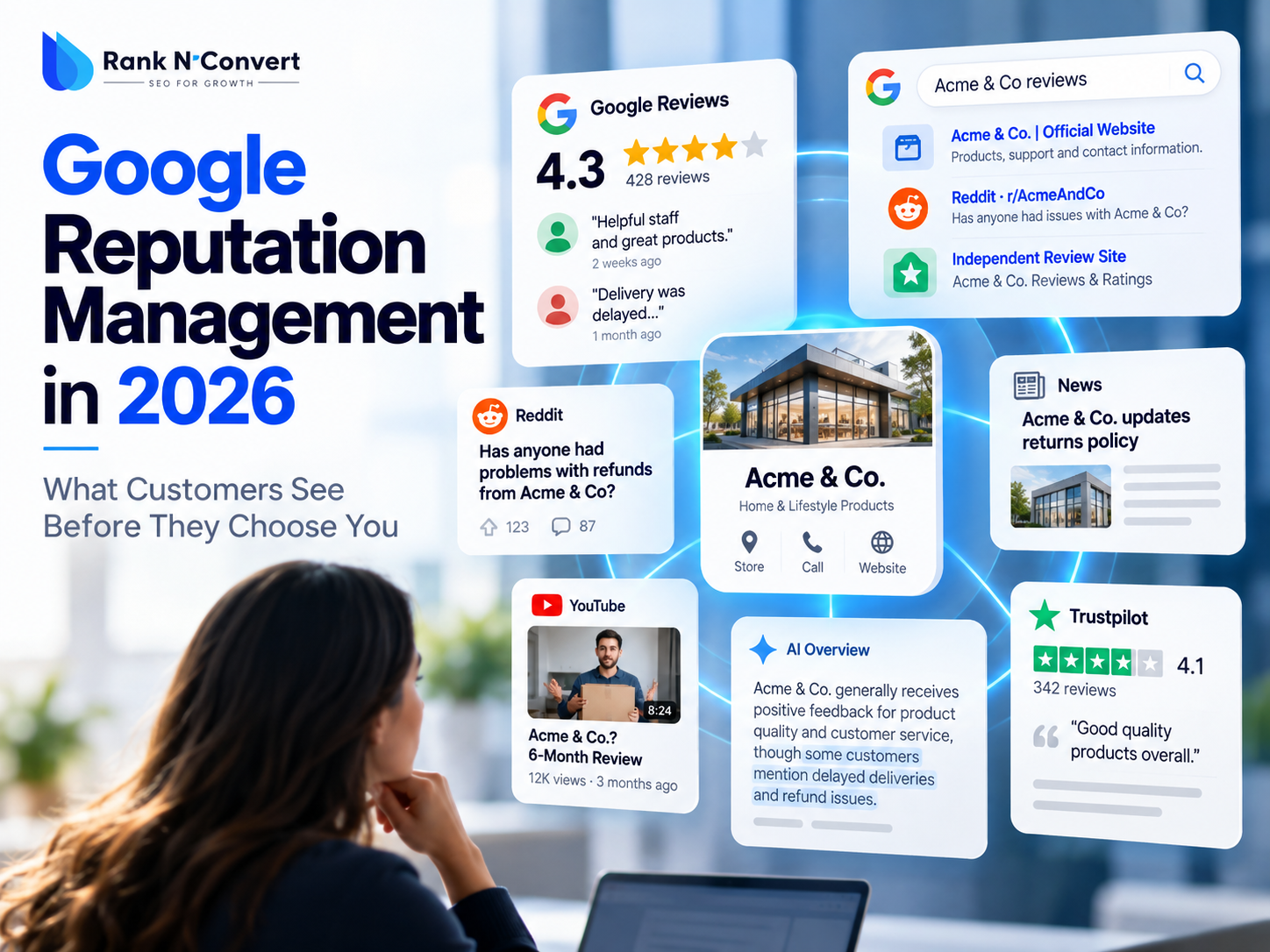
Google reputation management matters before a customer ever contacts you: in BrightLocal’s 2026 U.S. consumer survey, 85% said positive reviews make them more likely to use a business, while 77% said negative reviews make them less likely. But your reputation on Google is bigger than a star rating. A damaging Reddit thread, suspicious one-star reviews, outdated search results, recurring complaints, or an inaccurate AI-generated answer can all shape what customers think of your business.
The challenge is knowing what actually needs fixing. Should you respond, report a review, correct outdated information, improve the customer experience, or address what ranks for your brand? This guide shows you how to diagnose the real problem, protect your business, repair genuine reputation issues, and measure whether your Google reputation is actually improving.
What Does “Google Reputation” Actually Include?
Google reputation management is the process of monitoring and improving what people see about a business when they search for it on Google, including reviews, Google Maps, search results, and other visible mentions.
Example: If a business receives several negative Google reviews about slow delivery, reputation management means checking whether the complaints are genuine, responding appropriately, fixing the delivery problem, and monitoring whether customer feedback improves over time.
Google Business Profile and Maps Reputation
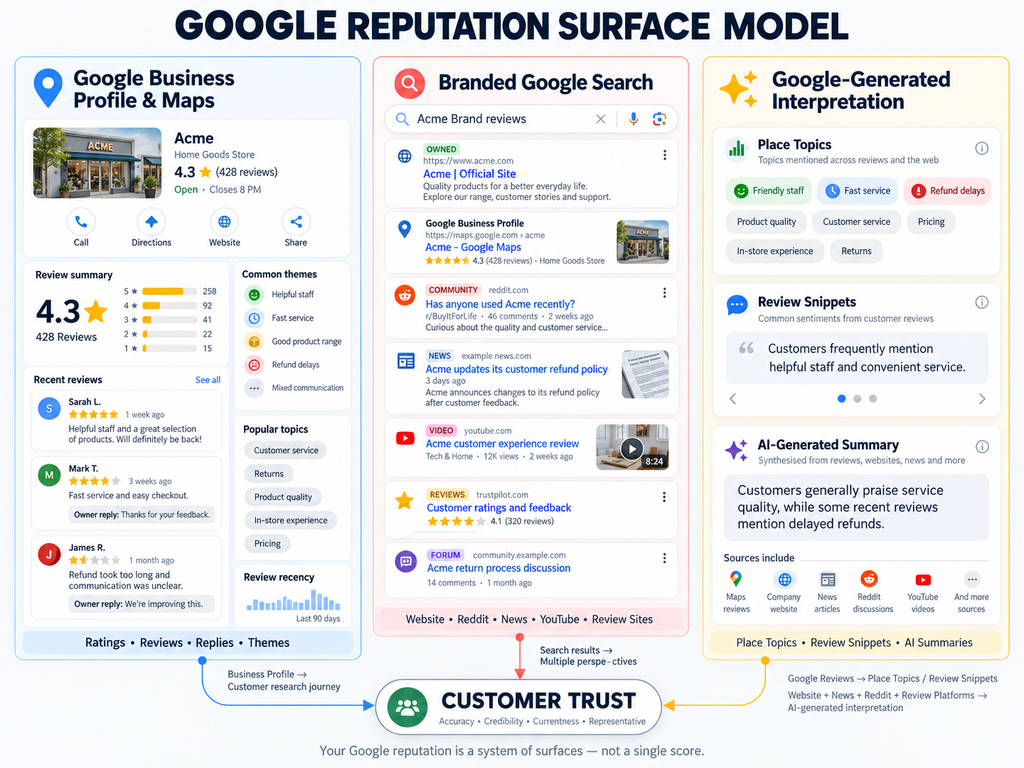
For local businesses, Google Business Profile often acts as the first reputation checkpoint. Customers can see your rating, review count, recent reviews, individual comments, owner responses, and recurring themes. Google also uses review content to create Place Topics and review snippets when enough review data exists. These features draw on repeated words, phrases, information, and sentiment from customer reviews.
A high rating can still hide a real issue. Two businesses may both show 4.4 stars, but one may receive scattered complaints while the other receives repeated recent complaints about refunds. The score looks similar; the underlying reputation risk does not.
Track:
- rating and review volume;
- review recency;
- recurring positive and negative themes;
- response quality;
- Place Topics or snippets where available.
Verified businesses can reply publicly to reviews, letting future customers see how the business handles feedback.
Google Search Reputation
Your Google Search reputation extends beyond Maps.
Your Google Search reputation begins when someone searches your company rather than only opening your Business Profile.
A customer might search:
[Brand Name]and then continue with:
[Brand Name] reviews[Brand Name] complaints[Brand Name] Reddit[Brand Name] scamThis result set forms your branded SERP.
A business can hold a strong Google rating and still face a reputation problem if a negative third-party page ranks prominently. That is why Google reputation management must audit the branded SERP, not only the Business Profile.
For each prominent result, ask:
- What does it say?
- How visible is it?
- Is it accurate and current?
- Does it reflect a real issue, outdated information, or misinformation?
Google-Generated Reputation
Google also creates a third layer by interpreting available information. Review snippets and Place Topics surface recurring review themes, while AI Overviews can synthesize information from multiple web sources and provide supporting links. Google warns that AI-generated responses can make mistakes.
Businesses do not directly write these interpretations. They influence the information ecosystem Google reads.
If Google repeatedly surfaces “slow delivery,” identify the reviews or sources behind that theme, verify the issue, correct inaccurate information, and fix the underlying customer-experience problem.
The Google Reputation Surface Model
| Surface | What users see | Typical problem |
| Business Profile & Maps | Ratings, reviews, replies, themes | Low rating, fake reviews, recurring complaints |
| Google Search | Website, Reddit, news, forums, review sites | Negative branded SERP |
| Generated interpretation | Place Topics, review snippets, AI summaries | Misleading or negative themes |
| Third-party evidence | Videos, forums, review platforms, media | External trust problem |
Use this model as the starting point for your Google reputation strategy: identify which reputation surface is creating the trust problem before you try to improve the score.
First Diagnose the Problem: Which Type of Google Reputation Issue Do You Have?
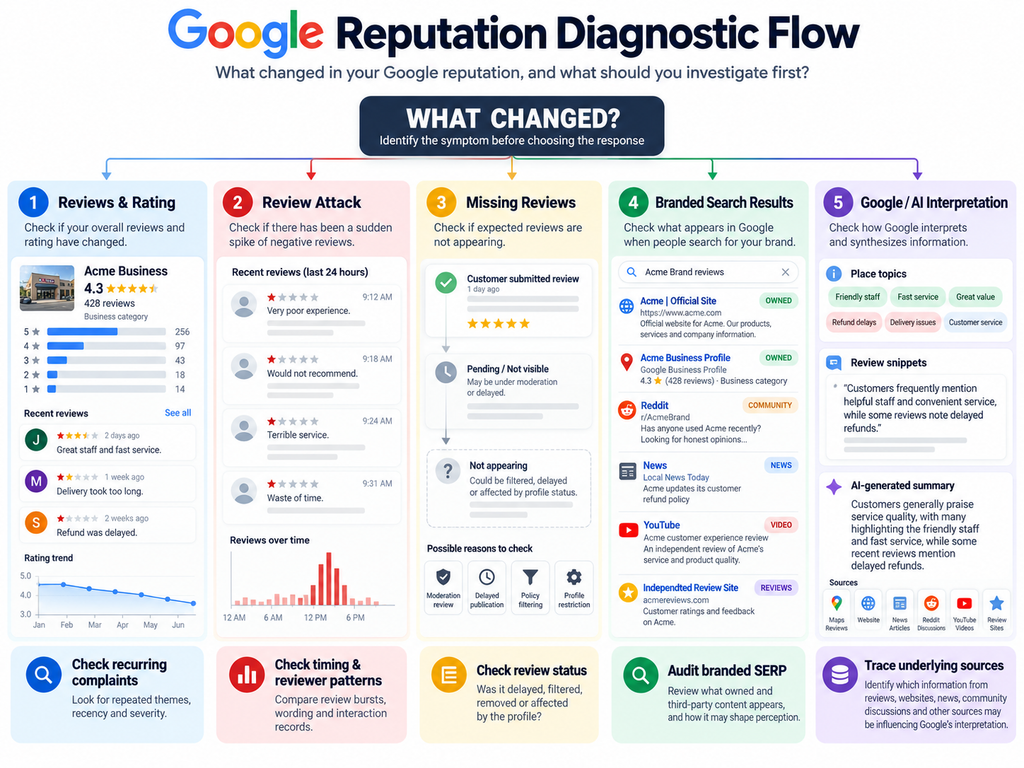
Before you try to repair your Google reputation, identify what actually changed.
A falling star rating, ten one-star reviews appearing overnight, a negative Reddit thread ranking for your brand, and an inaccurate AI summary may all damage customer trust, but they represent different reputation problems. Treating every issue as “bad reviews” can send you toward the wrong solution.
Start with the visible symptom, then investigate the evidence behind it.
Google Reputation Diagnostic Matrix
| What you’re seeing | Likely problem | Investigate first | What you need to establish |
| Rating falls gradually over several weeks or months | Customer-experience/review problem | Recent low-star reviews and recurring complaints | Whether one operational issue keeps appearing |
| Several one-star reviews arrive within hours | Possible review bombing or coordinated attack | Reviewer accounts, timing, repeated wording and customer records | Whether the pattern looks abnormal before calling individual reviews fake |
| Legitimate reviews disappear | Moderation/filtering/profile issue | Which reviews vanished, when they disappeared and current profile status | Whether Google delayed, filtered or removed them |
| Negative Reddit thread ranks for your brand | Google Search reputation problem | Branded SERP position, accuracy, freshness and engagement | Whether the content creates an active trust problem |
| One real customer leaves an angry review | Customer-service issue | Transaction, complaint and staff interaction | What happened and whether the criticism identifies a real failure |
| Someone says, “Pay us and the reviews disappear” | Potential review extortion | Messages, review URLs, dates and sender information | Whether the demand directly connects payment or favors with review removal |
| Profile shows 5.0 but reviews look repetitive or unnatural | Credibility/policy risk | Reviewer patterns, timing, incentives and solicitation process | Whether the profile reflects genuine customer experiences |
| The same complaint appears repeatedly | Operational reputation problem | Review-language and sentiment patterns | Which business process creates the recurring complaint |
| An old negative article ranks prominently | Search-remediation problem | Accuracy, publication date, source and removal eligibility | Whether you need correction, removal or search-result remediation |
| Google-generated summary looks wrong | Source-information problem | Reviews and webpages that contain the disputed claim | Which underlying source may support the interpretation |
Do Not Diagnose a Fake Review From the Reviewer Name Alone
One of the easiest mistakes in Google review management is assuming that an unfamiliar reviewer must be fake.
Google requires Maps contributions to reflect a genuine experience, but that experience does not necessarily require a completed purchase. A person may have called, visited, requested a quote or interacted with staff without appearing in your sales records. Google also prohibits unusual review patterns that indicate rating manipulation.
So treat “not in our CRM” as evidence to investigate, not final proof.
If several suspicious reviews appear together, compare:
- posting times;
- wording and repeated phrases;
- services or employees mentioned;
- customer, booking and enquiry records;
- reviewer activity where visible;
- any messages received before or after the reviews.
The later section on how to prove and report fake Google reviews should then take the reader from suspicion to evidence.
Separate Missing Reviews From Review Attacks
Do not automatically classify disappearing reviews as an attack against the business.
Google says it may delay reviews while checking policy compliance, and it may remove reviews for spam or other policy violations. Profile mergers can also temporarily delay review display.
That means the diagnostic question becomes:
Did customers stop leaving reviews, did Google delay them, or did previously published reviews disappear?
Each situation requires a different investigation.
Treat Review Extortion as Its Own Incident Type
A sudden negative-review spike becomes a different problem when somebody demands money, goods or services in exchange for removing the reviews. Google provides a dedicated merchant-extortion reporting process and advises businesses to preserve screenshots, direct review links, dates, contact details and other communications rather than paying or engaging with the attacker.
Use the later Google review extortion section for that workflow rather than treating the incident like ordinary negative feedback.
Diagnose Search Reputation Separately From Review Reputation
If your Google rating remains strong but Reddit, news coverage, complaint pages or review platforms dominate your branded SERP, you have a Google Search reputation problem rather than a rating problem.
Likewise, if Google’s AI-generated output presents inaccurate information, trace the underlying source before trying to “optimize” the answer. Google itself warns that AI Overviews can make mistakes.
Use one rule throughout your Google reputation management strategy:
Identify the failure mode before choosing the remedy.
A reputation problem may originate in customer experience, review manipulation, moderation, search visibility, third-party content or source information. Once you know which one you face, the next step becomes much clearer.
Run a Google Reputation Audit Before You Change Anything
Do not start Google reputation management by replying to reviews, requesting new ratings, publishing content, or trying to remove search results. First record what customers can see right now.
A baseline lets you answer two questions later:
- What was actually damaging the reputation?
- Did your actions improve it?
Audit three areas separately: your Google Business Profile, your branded Google SERP, and the recurring themes inside customer feedback.
Audit Your Google Business Profile
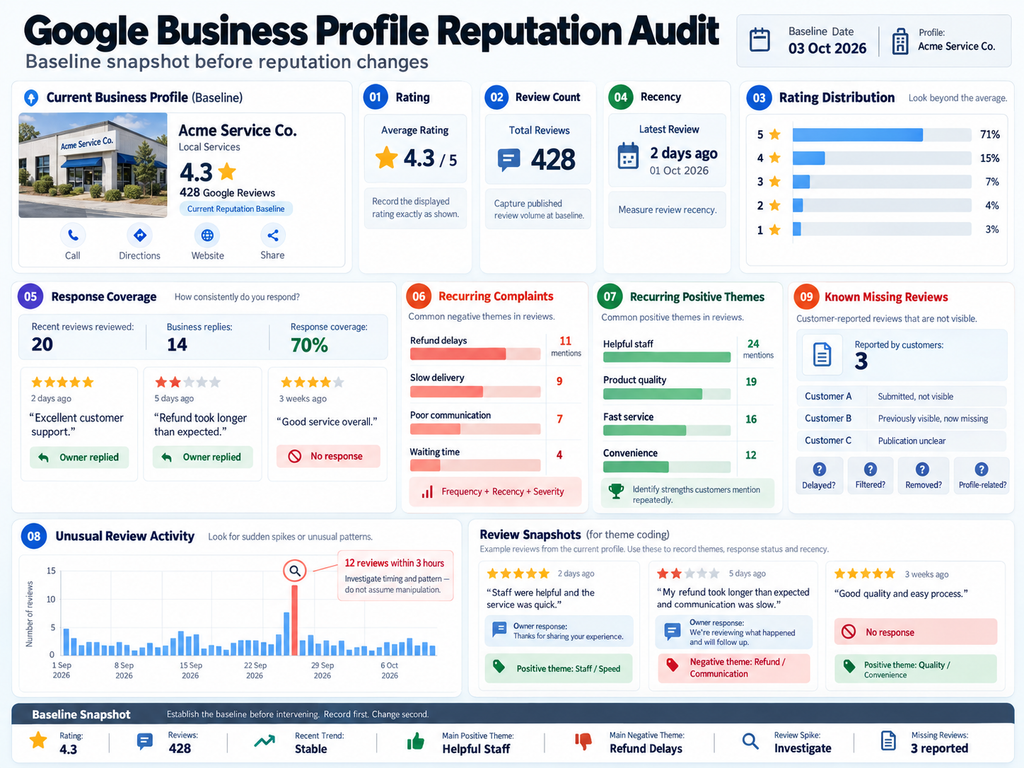
Open your Business Profile in Google Search and Maps and capture a dated snapshot. Do not record only the average star rating.
Record:
| Audit field | What to capture | Why it matters |
| Current rating | Displayed average rating | Establishes the starting point |
| Total review count | Number of published reviews | Gives the rating context |
| Rating distribution | 1-star through 5-star mix where available | Reveals polarization hidden by the average |
| Newest reviews | Recent feedback and dates | Shows the current customer experience |
| Older relevant reviews | Historical complaints still appearing prominently | Separates persistent issues from new ones |
| Response coverage | Which reviews received owner replies | Shows how consistently the business engages |
| Repeated complaints | Themes appearing across several reviews | Identifies operational reputation risks |
| Repeated praise | Consistent positive themes | Identifies real competitive strengths |
| Unusual review spikes | Sudden increase in volume or rating changes | Flags patterns that need investigation |
| Missing reviews | Reviews customers say they posted but you cannot find | May require a separate review-status investigation |
Google checks reviews against its policies, and reviews can appear late or disappear for several reasons, including moderation and profile changes. Google also states that reviews removed for policy violations will not return.
Do not automatically classify missing reviews as manipulation or platform failure. Follow the later section on why legitimate Google reviews disappear before drawing a conclusion.
For some service businesses, Google also displays ratings for specific aspects of the experience, such as price. Capture those aspect-level signals where Google shows them because they can reveal a problem that the headline rating hides.
Audit rule: Save the evidence before you try to change the outcome.
Take screenshots and record the audit date. That gives you a defensible before-and-after record.
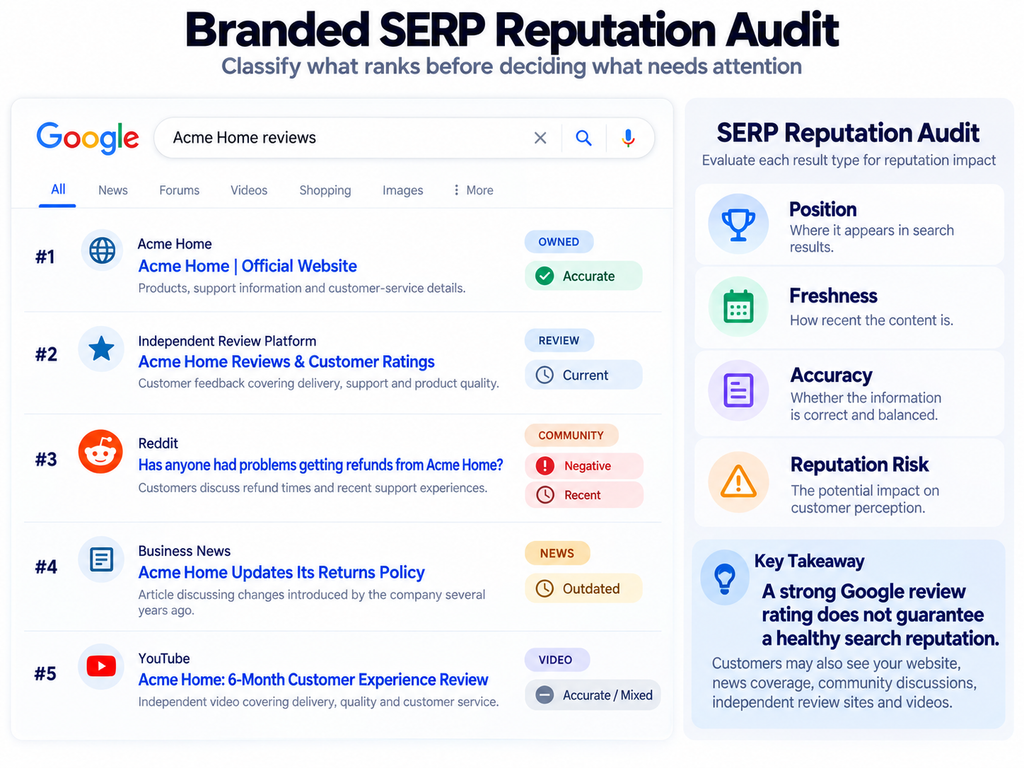
Audit What Appears When Someone Googles Your Brand
Next, move beyond Google Maps and audit your branded SERP.
Run several searches because customers rarely use only the company name:
- [Brand Name]
- [Brand Name] reviews
- [Brand Name] complaints
- [Brand Name] scam
- [Brand Name] Reddit
- [Brand Name] customer service
Review the prominent results and classify each one.
| Result type | Examples | What to evaluate |
| Owned | Website, official social profiles | Accuracy, freshness, visibility |
| Earned | News, interviews, editorial coverage | Tone, accuracy, authority |
| Community | Reddit, forums, YouTube discussions | Visibility, engagement, recurring concerns |
| Review | Third-party review platforms | Rating, complaints, freshness |
| Problematic | Outdated, misleading or harmful pages | Accuracy, policy status, potential remedy |
Do not label every negative result a “removal problem.”
First determine whether the content is:
- accurate and current;
- accurate but negative;
- outdated;
- factually incorrect;
- potentially policy violating;
- a possible legal issue;
- legitimate customer criticism.
Google generally does not remove ordinary web content from Search simply because a business dislikes it. Google limits removal to specific circumstances, including certain legal, policy and webmaster-controlled cases.
That distinction will matter later when you decide between removal, correction and search-result suppression.
Search for Reputation Themes, Not Just Individual Reviews
Individual reviews tell you what one person experienced. Themes tell you whether the problem repeats.
Create categories that match your business, such as:
- delivery;
- customer service;
- refund delays;
- communication;
- pricing;
- staff behaviour;
- product quality;
- waiting time;
- returns;
- booking or fulfilment.
Then code each relevant review against one or more themes.
A simple audit might look like this:
| Theme | Mentions | Recent or old? | Typical sentiment | Priority |
| Delivery | 14 | Mostly recent | Negative | High |
| Staff behaviour | 9 | Mixed dates | Positive | Low |
| Refund delays | 7 | Recent | Negative | High |
| Product quality | 18 | Ongoing | Positive | Low |
| Communication | 11 | Recent | Mixed | Medium |
Do not treat this as a Google ranking formula. Use it as an editorial diagnostic method.
Prioritize a reputation theme when three conditions overlap:
frequency + recency + business impact.
For example, five recent complaints about failed refunds may deserve more attention than twelve three-year-old complaints about parking.
This method connects directly to the later section on tracking reputation themes instead of only your star rating.
Google Reputation Audit Sheet
Your baseline should contain five blocks:
| Audit block | Record |
| Business Profile health | Rating, review volume, rating mix, response coverage |
| Review pattern health | Spikes, missing reviews, suspicious patterns |
| Reputation themes | Repeated positive and negative topics |
| Branded SERP health | Owned, earned, community, review and problematic results |
| Baseline evidence | Date, screenshots, URLs and observations |
Repeat the same audit after meaningful reputation work. If your rating rises but refund complaints increase, the reputation has not necessarily improved. If a negative Reddit result disappears from page one but customer complaints remain unresolved, you fixed visibility rather than the underlying problem.
If Your Reviews Suddenly Collapse, Treat It as an Incident Before Treating It as Marketing
If your Google Business Profile receives several unexpected one-star reviews within hours, do not immediately launch a review campaign to “balance them out.” First treat the situation as a reputation incident and preserve what happened.
A sudden review burst can indicate several things: genuine complaints following one event, unrelated customers posting at similar times, fake engagement, coordinated rating manipulation, or a potential Google review extortion attempt. Google specifically identifies unusual review volumes or contribution patterns as one possible signal of rating manipulation, but a spike alone does not prove that every review is fake.
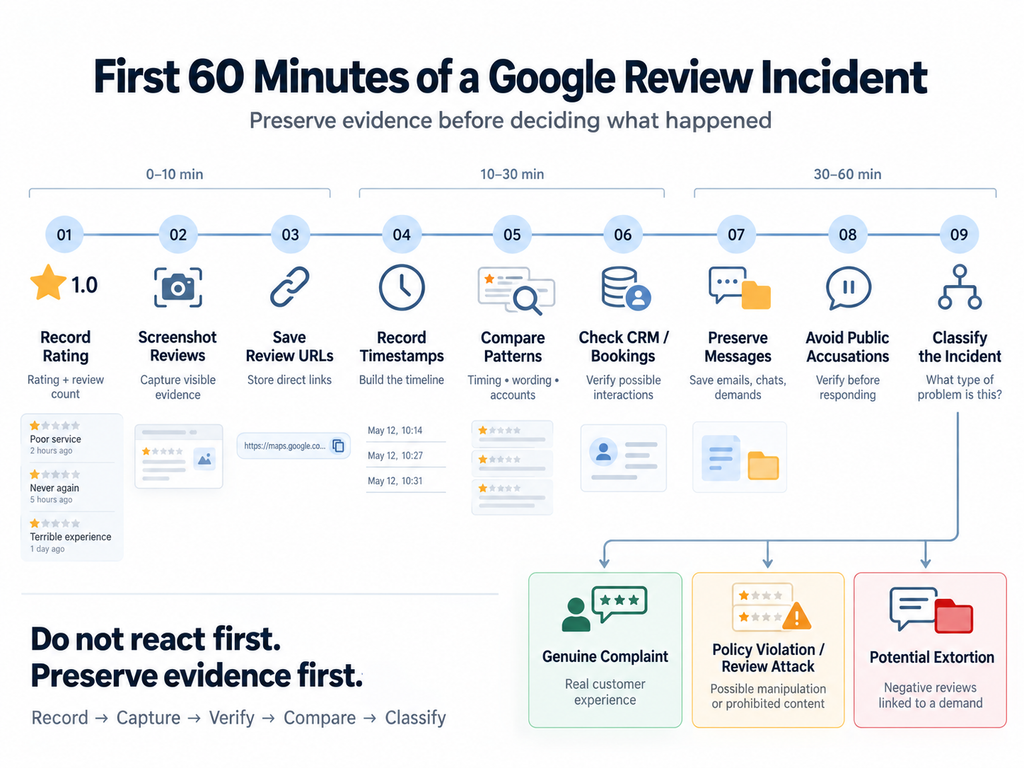
What to Do in the First Hour of a Suspected Google Review Attack
Use this first-hour response protocol to create an evidence trail before reviews, profiles, messages or ratings change.
- Record your current rating and review count.
Note the exact time. Compare the numbers with your latest Google reputation audit so you can quantify the change. - Screenshot every suspicious review.
Capture the reviewer name, rating, review text and visible posting time. - Save the direct URL for each review.
Screenshots show what appeared; URLs identify the specific contribution if you later need to report it. - Build a simple incident timeline.
Record when the first review appeared, how quickly others followed and when you discovered them. - Look for patterns without declaring guilt.
Compare wording, services mentioned, unusual repetition, reviewer activity where visible, and the spacing between posts. Google prohibits content posted from multiple accounts at one person’s request and identifies unusual contribution patterns as potential rating manipulation. - Check your customer and interaction records.
Search bookings, CRM records, support tickets, emails, calls, quotations and recent complaints. - Preserve external communication.
Save emails, WhatsApp messages, Telegram messages, social DMs or calls connected with the reviews. - Do not publicly accuse reviewers before you verify the facts.
Separate what you know from what you suspect. A defensive response can create a second reputation problem if the reviewer had a genuine interaction. - Determine which incident class fits the evidence.
Decide whether you appear to face a genuine complaint, an ordinary policy violation, coordinated fake Google reviews, or potential extortion. Then use the appropriate process covered in which negative Google reviews can actually be removed or Google review extortion.
Google advises merchants facing review extortion to collect evidence immediately and retain direct review links, screenshots, timestamps and sender details. Its dedicated extortion guidance also tells businesses not to pay or engage with the attacker.
Fake Review or Real Customer? Don’t Decide Based on the Name Alone
One of the weakest arguments a business can make is:
“I cannot find this name in our CRM, so the review must be fake.”
Treat the missing CRM match as supporting evidence, not proof.
Google’s Maps policy requires reviews to represent a genuine experience with the business. As Google puts it, contributions should reflect a “genuine experience at a place or business.”
A person could still have interacted with your business without completing a transaction. Check whether the reviewer may have:
- visited your premises;
- called your team;
- requested a quotation;
- submitted an enquiry;
- contacted customer support;
- attempted to purchase;
- dealt with the business under another name or account.
The investigation should therefore ask:
Does the available evidence support a genuine experience, contradict the review, or remain inconclusive?
That distinction matters because Google removes reviews for policy violations, not simply because the business disputes them. Google explicitly tells businesses not to report a review merely because they dislike or disagree with it.
Fake Google Review Evidence Strength Matrix
Use evidence cumulatively rather than relying on one clue.
| Evidence | Diagnostic strength | What it may indicate | Important limitation |
| No matching CRM/customer record | Supporting | Reviewer cannot immediately be linked to a known transaction | Does not prove no genuine interaction occurred |
| No matching booking, enquiry, call or support record | Stronger when combined | Business cannot verify several common interaction routes | Reviewer may have used different details |
| Review describes a product, location or service you do not offer | Strong | Content may not accurately represent the business | Document the contradiction clearly |
| Identical or near-identical review text appears elsewhere | Strong manipulation signal | Possible repetitive or coordinated content | Pattern alone does not determine Google’s decision |
| Several low-star reviews arrive in an unusual burst | Suspicious pattern | Possible rating manipulation or coordinated activity | A genuine event can also trigger multiple complaints |
| Reviewer has a visible conflict of interest | Potential policy evidence | Competitor, professional or personal affiliation may create bias | Establish the relationship rather than assuming it |
| One person appears to coordinate multiple accounts | Strong policy relevance | Google prohibits multi-account content posted by or at one person’s request | Preserve evidence connecting the accounts |
| Message demands money, goods or services to remove reviews | Potential extortion evidence | Review extortion rather than an ordinary review dispute | Preserve the original communication and review URLs |
Google’s current fake engagement policy specifically prohibits reviews that do not reflect genuine experiences, paid reviews, multi-account manipulation and reviews based on certain conflicts of interest. It also identifies unusual contribution volumes or patterns as possible signs of rating manipulation.
Build an Evidence File, Not an Argument
For every suspicious review, create one record containing:
- review URL;
- screenshot;
- reviewer name;
- date and time observed;
- review text;
- relevant CRM or booking search;
- factual inconsistencies;
- related messages;
- suspected policy category;
- confidence level: confirmed fact / supporting evidence / unresolved.
This approach strengthens your Google review management process because it separates evidence from emotion. It also prevents a common reputation-management mistake: treating every critical customer as an attacker.
Your goal at this stage is not to prove that your business did nothing wrong. Your goal is to establish what happened, what evidence exists, and which Google reputation problem you actually need to solve next.
Which Negative Google Reviews Can Actually Be Removed?
A bad review does not become removable simply because it hurts your rating, contains criticism, or describes the situation differently from your records. Google bases Google review removal on its Maps content policies.
Google states the rule clearly:
“Do not report a review just because you disagree with it or dislike it.”
Google removes reviews when they violate its policies; it does not act as an arbitrator in ordinary disputes between businesses and customers.
That distinction should guide every decision about a negative Google review.
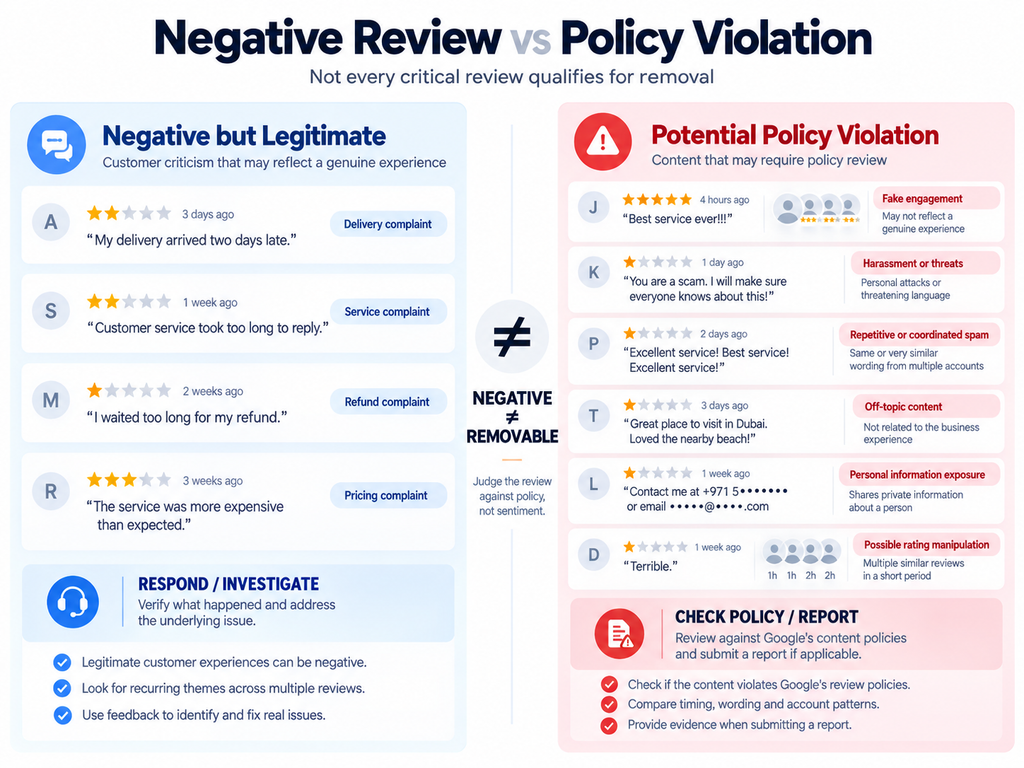
A Negative Review Is Not Automatically a Policy Violation
Start by separating two categories.
Negative but legitimate feedback may include:
- poor service;
- delayed delivery;
- rude staff;
- pricing complaints;
- refund disputes;
- dissatisfaction with product quality;
- a customer’s subjective description of a genuine experience.
Google allows users to describe negative experiences respectfully. A business may strongly disagree with the review and still lack a valid removal reason.
Policy-violating content can include:
- fake engagement that does not reflect a genuine experience;
- paid or incentivized reviews;
- reviews posted from multiple accounts at one person’s request;
- unusual review patterns connected with rating manipulation;
- repetitive content;
- off-topic commentary unrelated to an experience at the location;
- harassment or specific threats;
- doxxing or prohibited personal information;
- offensive or deliberately provocative attacks;
- unsubstantiated allegations of criminal or unethical conduct;
- prohibited advertising or solicitation.
This means the right question is not:
“Is this review unfair?”
Ask:
“Which Google Maps content policy does this review appear to violate, and what evidence supports that conclusion?”
That shift turns an emotional disagreement into a policy-based Google review removal assessment.
If you suspect coordinated fake engagement, first use the evidence collected in the review-attack incident process rather than reporting every low-star review automatically.
When Should You Report, Respond or Investigate?
Use the nature of the review, not the star rating, to choose the next action.
| Situation | Primary action | Why |
| Genuine customer complaint | Investigate + respond | The review may reflect a real experience even if you disagree with parts of it |
| Clear fake engagement or spam | Report | Google prohibits content that does not represent a genuine experience |
| Reviewer identity looks unfamiliar | Investigate first | No CRM match alone does not prove that no interaction occurred |
| Off-topic rant unrelated to the business experience | Check policy + report if applicable | Google requires Maps contributions to relate to experiences at the location |
| Harassment, threats or prohibited personal information | Check the relevant policy + report | Google has specific restrictions for these content types |
| Several suspicious reviews arrive together | Preserve evidence + investigate + report qualifying reviews | A review spike may indicate manipulation, but the pattern needs context |
| Someone demands payment or favors for removal | Use Google’s extortion process | Google treats negative-review extortion separately from ordinary review reporting |
Google’s fake engagement policy specifically prohibits reviews that do not reflect genuine experiences, paid reviews, multi-account manipulation and certain attempts to distort ratings.
For potential extortion, do not treat the incident like ordinary spam. Google provides a dedicated reporting channel and tells businesses not to pay or engage with the attacker. Follow the separate Google review extortion process.
How to Report a Policy-Violating Google Review
For an ordinary policy violation, Google lets businesses flag the review directly from their Business Profile or use the Reviews Management Tool.
Google’s current process lets you:
- open your Business Profile;
- select Read reviews;
- choose the review;
- select Report;
- choose the reason, such as spam or profanity;
- submit the report.
You can also use Google’s Reviews Management Tool to report reviews and track the decision. Google says review evaluation typically takes several days.
Do not select a policy category simply because it sounds most likely to produce removal. Match the report to the actual content and preserve evidence that supports your reasoning.
What Happens After Google Rejects the Report?
A rejected report does not necessarily end the process, but it also does not guarantee that an appeal will succeed.
Use the Reviews Management Tool to check the review’s status. Google currently displays statuses including:
- Decision pending — Google has not completed the review;
- Report reviewed – no policy violation — Google did not identify a violation;
- Escalated – check your email for updates — Google has escalated the appeal and will send the result by email.
If Google finds no violation and you believe the review genuinely breaches policy, Google allows a one-time appeal through the Reviews Management Tool. You can select up to 10 eligible reviews when submitting an appeal.
Before appealing:
- identify the exact policy provision involved;
- review your screenshots and direct review URL;
- document factual inconsistencies;
- include evidence of manipulation where available;
- distinguish suspicion from verifiable facts;
- check whether several reviews connect to the same incident.
If the review complies with Google’s policies after appeal, Google leaves it live. At that point, stop treating removal as the only reputation-management option. Assess whether you should respond to the negative review, correct the underlying customer problem, or address a broader reputation theme.
Do not repeatedly submit unsupported reports or invent new violation categories just because the first decision went against you.
The practical rule for removing negative Google reviews is simple:
Report policy violations. Respond to legitimate criticism. Investigate uncertainty before choosing either path.
That approach protects your credibility and keeps your Google reputation management strategy focused on evidence rather than trying to erase every negative customer experience.
Review Extortion Requires a Different Response From an Ordinary Fake Review
Treat Google review extortion as a separate reputation incident, not simply another fake-review complaint.
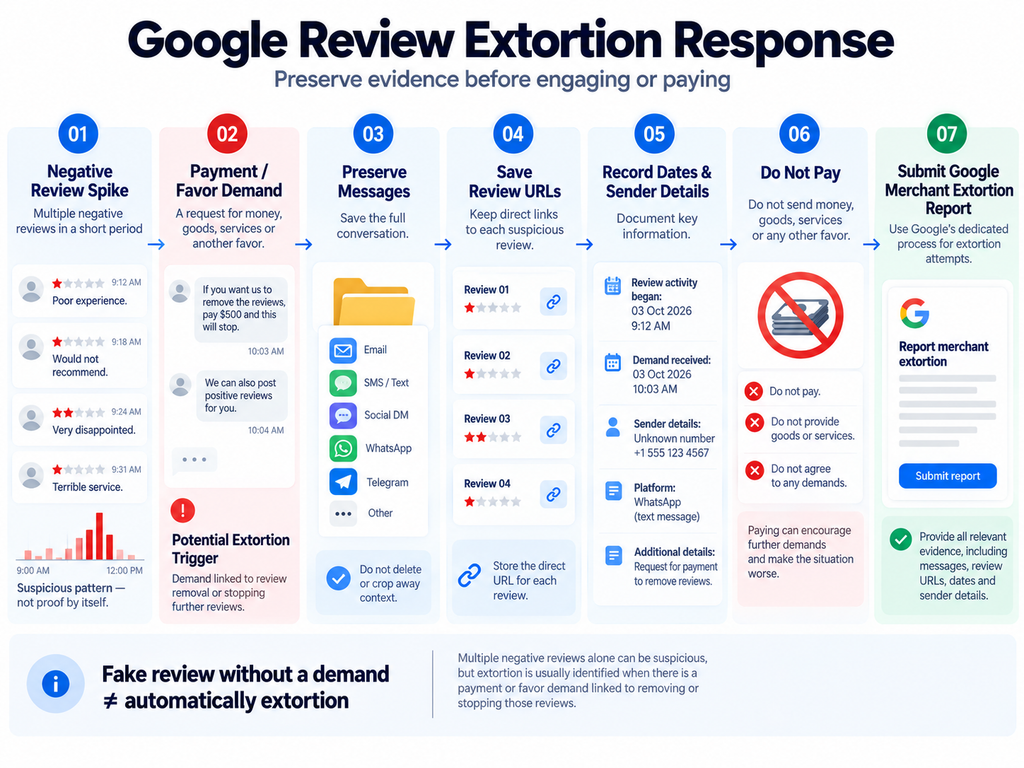
Google describes the pattern as a sudden increase in one-star or two-star reviews followed by someone demanding money, goods, services, or another favor in exchange for removing the negative reviews. Google maintains a dedicated merchant extortion reporting process for these cases.
A fake review without a demand does not automatically equal extortion.
If suspicious reviews appear without any demand, use the normal Google review removal and reporting process. If someone connects payment or another favor to removing, stopping, or changing reviews, preserve the incident as potential extortion.
What to Do When Someone Demands Payment to Remove Google Reviews
Act in this order:
- Preserve every message. Save emails, WhatsApp or Telegram chats, SMS messages, social DMs, and other written demands.
- Save direct links to the suspicious reviews. Google specifically asks merchants to provide review URLs when submitting an extortion report.
- Capture dates and times. Record when the review spike started and when the first demand arrived.
- Retain sender details. Keep usernames, phone numbers, email addresses, and social profiles connected with the demand.
- Take complete screenshots. Include the demand, sender identity where visible, date, time, and surrounding context.
- Do not pay or negotiate. Google warns that payment does not guarantee review removal and may encourage further attempts.
- Avoid escalating the confrontation. Preserve evidence instead of threatening or publicly accusing the suspected attacker.
- Submit Google’s Merchant Extortion Report. Include your Business Profile details, suspicious-review links, communications, and supporting files. Google says its team investigates the submitted claim and then notifies the merchant about the outcome.
Recent 2026 Google Business Profile Community reports show merchants describing review-bombing incidents followed by WhatsApp, Telegram, or reputation-service payment demands, which reinforces why businesses should document the connection between the reviews and the demand rather than relying only on the review pattern. Treat those reports as community experiences, not proof that every similar review spike constitutes extortion.
If the incident also involves credible threats, fraud, stalking, or other potentially unlawful conduct, consider appropriate local legal or law-enforcement advice in addition to Google’s reporting route.
The practical distinction is simple: fake reviews create a content-policy problem; fake reviews tied to a demand create a potential extortion incident.
Why Are Legitimate Google Reviews Disappearing?
A customer tells you they left a five-star review, but it never appears. Or worse, a review you already saw on your Google Business Profile disappears later.
Do not assume Google has “lost” the review. A missing Google review can result from publication delays, policy moderation, automated filtering, profile changes, or Business Profile restrictions. Google does not expose the exact moderation logic behind every individual review, so diagnose what you can verify before drawing conclusions.
A Review Can Be Delayed, Filtered or Removed
Google says it checks reviews for policy compliance, and that process can sometimes delay publication for several days. Reviews may also take time to display after Business Profiles merge. Customers using outdated devices or older versions of Google Maps can also experience problems when posting reviews.
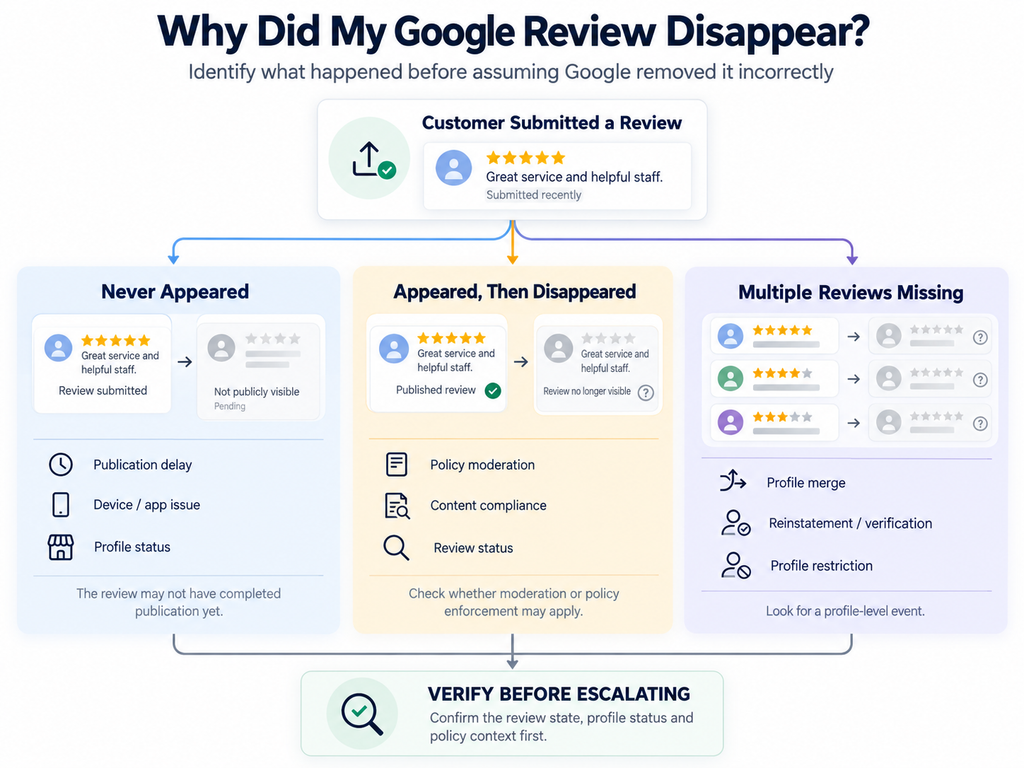
Start by distinguishing three situations:
| What happened? | What it may mean | What to check |
| Review never appeared | Publication/moderation delay | Date posted, app/device, profile status |
| Review appeared, then vanished | Possible policy removal | Review content and Google policies |
| Several reviews disappear together | Profile-level change or restriction | Merges, reinstatement, verification, restrictions |
Google says reviews removed for policy violations will not be restored. Its prohibited-content rules cover fake engagement, incentivized reviews, conflicts of interest, rating manipulation and other restricted content.
Google can also restrict a Business Profile after fake-engagement violations. Restrictions may temporarily prevent new reviews, unpublish existing reviews, or display a warning that Google removed fake reviews. Google says it notifies business owners by email when it plans to apply such a restriction.
What Businesses Should Check Before Assuming Google Is Broken
Work through this checklist:
- Was the review ever publicly visible? A review that never appeared differs from one that appeared and later disappeared.
- When did the customer submit it? Google says moderation can delay publication for several days.
- Did the review comply with Google’s content policies? Check for spam, copied content, conflicts of interest or other prohibited material.
- Did you offer an incentive? Google prohibits reviews exchanged for payments, discounts, free goods or services.
- Did you tell the customer what to write? Google prohibits merchants from requesting specific review content, including requiring staff to solicit reviews containing particular wording.
- Did your Business Profile recently merge, become suspended, get reinstated, or change verification status? Google identifies profile merges as one cause of delayed reviews, and its appeal guidance notes that unverified profile content may not appear across Google.
- Did several reviews disappear at the same time? Check for a profile-level event rather than investigating every customer individually.
- Did Google email you about a restriction? Review restrictions can affect both new and existing reviews.
Avoid trying to replace missing reviews by suddenly asking large numbers of customers for five-star feedback. An unusual review pattern can itself raise rating-manipulation concerns under Google’s policies.
If the review appears legitimate and none of these explanations fits, document the missing review and contact Google Business Profile support. Then continue with the later section on how to request Google reviews without manipulating your reputation.
The key diagnostic rule is simple: first establish whether the review was delayed, removed, or affected by a profile-level restriction. Only then decide what to do next.
How to Ask for More Google Reviews Without Manipulating Your Reputation
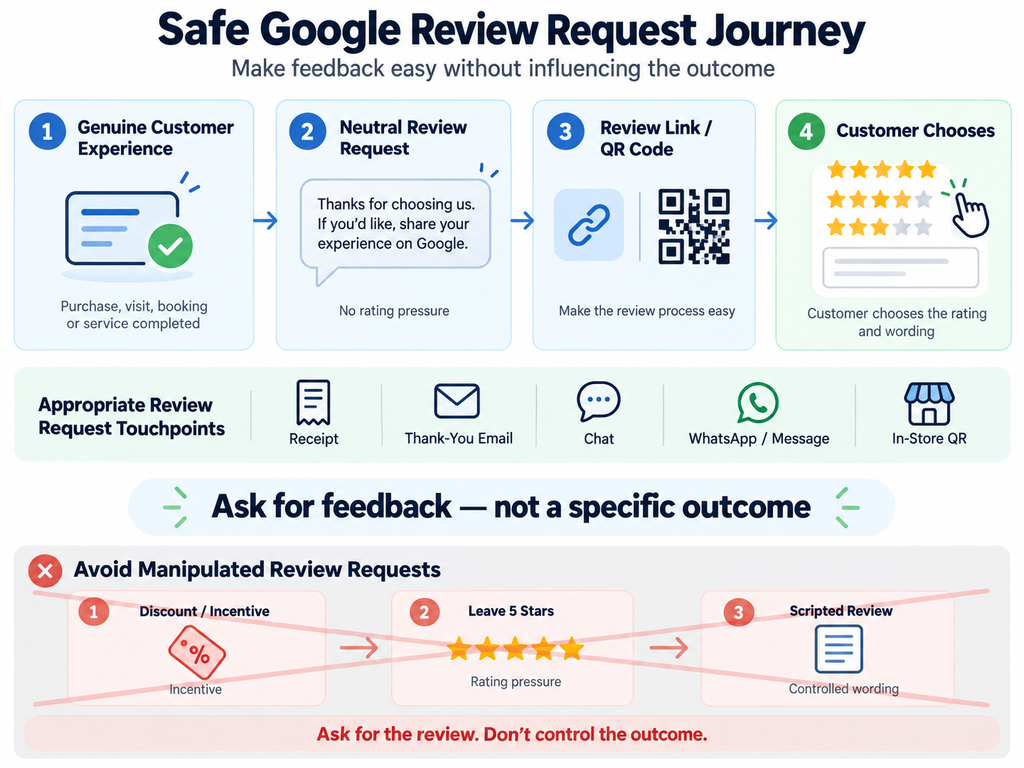
Once you resolve fake reviews, missing reviews, or customer-service problems, rebuild your Google review profile with genuine customer feedback. The safest approach is simple: make reviewing easy, ask consistently, and let customers decide both the rating and what they want to say.
Google explicitly allows businesses to create a direct Google review link or QR code and share it with customers. Google suggests placing the link on receipts, in thank-you emails, at the end of chat interactions, or displaying the QR code in-store. Businesses can also send review requests through channels such as email or WhatsApp.
What Google Allows
Build review requests into normal customer touchpoints rather than chasing only customers who already praise you.
For example:
- send a Google review link after an order or service finishes;
- include the link in a neutral post-purchase email;
- place a Google review QR code on a receipt or counter;
- send the link after a customer-support chat closes;
- invite customers to share an honest review, without suggesting a rating.
Google’s core standard requires reviews to represent a genuine experience.
A neutral request can be as simple as:
“Thanks for choosing us. If you’d like to share your experience, you can leave us a Google review here.”
Do not add “Please leave five stars” or tell customers which product, employee, or phrase they should mention.
What Crosses the Line
Google draws a much clearer boundary than many businesses realize.
| Review practice | Status under Google’s policy | Why |
| Ask customers neutrally for feedback | Appropriate | Customer controls the rating and content |
| Share Google’s direct review link | Appropriate | Google provides this feature |
| Display a Google review QR code | Appropriate | Google specifically supports QR-code requests |
| Offer a discount, gift, or free service for a review | Prohibited | Google classifies incentivized reviews as fake engagement |
| Ask only customers who say they are happy | Prohibited review gating | Google prohibits selectively soliciting positive reviews |
| Prevent or discourage unhappy customers from reviewing | Prohibited | It manipulates the review sample |
| Tell customers to leave a five-star rating | Rating-manipulation risk | The request pushes the outcome rather than requesting unbiased feedback |
| Require staff to generate a set number of reviews | Prohibited | Google explicitly prohibits review quotas for staff |
| Ask reviewers to mention a particular employee or phrase | Prohibited | Google says merchants should not request specific review content |
Google’s current Maps policy prohibits merchants from discouraging negative reviews or selectively soliciting positive reviews. It also prohibits incentives such as discounts, payments, free goods, or services in return for reviews. When requesting feedback, businesses should not pressure customers on the premises or request specific review content.
If your existing process sends satisfied customers to Google but redirects dissatisfied customers to a private feedback form, review the process carefully. That pattern can become review gating because it selectively exposes only positive customers to the public-review opportunity.
Why “Get as Many Five-Star Reviews as Possible” Is the Wrong Goal
A sustainable Google reputation strategy should not optimize for artificial perfection.
Aim for:
a consistent stream of genuine, unbiased reviews from real customer experiences.
Not:
the fastest possible path to a 5.0 rating.
Google monitors fake engagement and unusual review patterns, and it may remove content that indicates rating manipulation. If your current rating needs recovery, use the later Google rating recovery calculation to understand the mathematical task instead of manipulating the review process.
Also connect review acquisition with the earlier Google reputation audit. If customers repeatedly mention delivery delays, refund problems, or poor communication, adding more review requests will not solve the underlying reputation issue.
The safest rule is straightforward:
Ask for the review. Never ask for the rating.
That approach gives you something more valuable than a manufactured five-star profile: a credible Google reputation built from genuine customer experiences.
Should You Respond to Every Google Review?
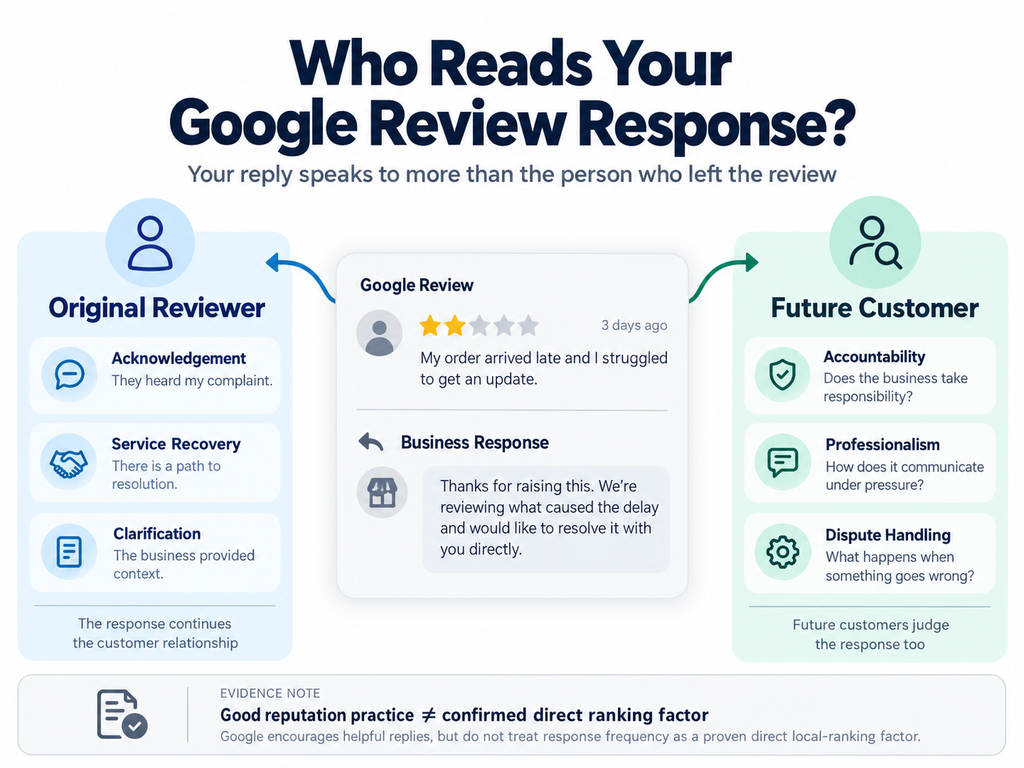
For Google reputation management, respond to genuine customer reviews consistently when you can add something useful. A thoughtful reply acknowledges the customer, shows how your business handles feedback, and gives future customers context they cannot get from the star rating alone.
But do not tell businesses to reply to every review because “Google rewards responses with higher rankings.” Google does not make that claim in its local-ranking documentation.
Why Review Responses Matter to Humans
Your response speaks to two audiences:
the person who wrote the review and everyone who reads it later.
A useful Google review response can:
- acknowledge positive or critical feedback;
- clarify a misunderstanding without attacking the reviewer;
- show how the business handles complaints;
- move a complex dispute into a private support channel;
- demonstrate that the business listens and takes service recovery seriously.
Google itself says replying shows customers that you value their feedback and adds:
“Positive reviews and helpful replies can help your business stand out.”
Independent consumer research supports the trust value of responding. BrightLocal’s 2026 Local Consumer Review Survey found that 80% of surveyed U.S. consumers said they were likely to use a business that responds to all reviews, while 42% said they were unlikely to use one that never responds. The same study found that generic or templated responses made 50% less likely to choose the business.
That does not mean every reply needs an essay. Match the response to the review.
A one-line five-star comment may need a short thank-you. A detailed complaint may require acknowledgement, factual context, and a clear next step.
If you suspect fake engagement, review bombing, or extortion, investigate before replying publicly. Follow the fake-review incident process or the Google review extortion process instead of treating the review like an ordinary customer complaint.
Don’t Turn Good Reputation Practice Into an Unsupported Ranking Claim
This is where Google review SEO advice often becomes less precise.
Google says local results mainly depend on relevance, distance, and prominence. Under prominence, Google specifically says that more reviews and positive ratings can help local ranking. Its review-response guidance says helpful replies can help a business stand out, but it does not state that response rate directly improves local rankings.
Keep different evidence types separate:
| Evidence type | What it means | Example for review responses |
| Google confirmed | Google states it in official documentation | Replies show customers you value feedback; more reviews and positive ratings can help local ranking |
| Independent research | A study measures consumer behavior or an observed relationship | Consumers report greater willingness to use businesses that respond consistently |
| Practitioner observation | Local SEO professionals report patterns from client work | Useful for hypotheses, not proof of Google’s algorithm |
| Community experience | Business owners describe what happened to them | Useful for finding problems and edge cases |
| Unverified claim | No strong evidence establishes the statement | “Replying to every review directly boosts your Google Maps ranking” |
Do not blend these categories.
A consumer survey can establish what surveyed consumers say influences their trust. It cannot prove what Google’s ranking algorithm does. Practitioner experience can reveal patterns worth testing, but it cannot replace Google’s documentation or a controlled experiment.
So, does replying to Google reviews improve rankings?
The evidence supports a narrower answer:
Google recommends responding because replies demonstrate engagement and can help your Business Profile stand out to customers. Google also confirms that review quantity and positive ratings can contribute to local ranking. Its public documentation does not establish reply frequency itself as a direct ranking factor.
Respond because the reply improves your reputation, customer communication, and service-recovery record. Treat any SEO benefit beyond Google’s documented claims as something that requires separate evidence.
Then use your Google reputation audit to track whether better review handling coincides with stronger customer sentiment, fewer recurring complaints, and improved business outcomes rather than assuming every change came from rankings.
Don’t Track Only Your Star Rating: Read the Reputation Hidden Inside the Reviews
Your Google star rating tells you the average outcome of published ratings. It does not tell you why customers feel that way.
Google confirms that a Business Profile’s review score reflects the average of its published Google ratings. Google’s guidance on review scores But Google also uses the language inside customer reviews to surface Place Topics and review snippets, which can highlight frequently mentioned subjects and, in some cases, prevalent sentiment. Google’s Business Profile summary documentation
That makes review text a separate reputation signal worth auditing.
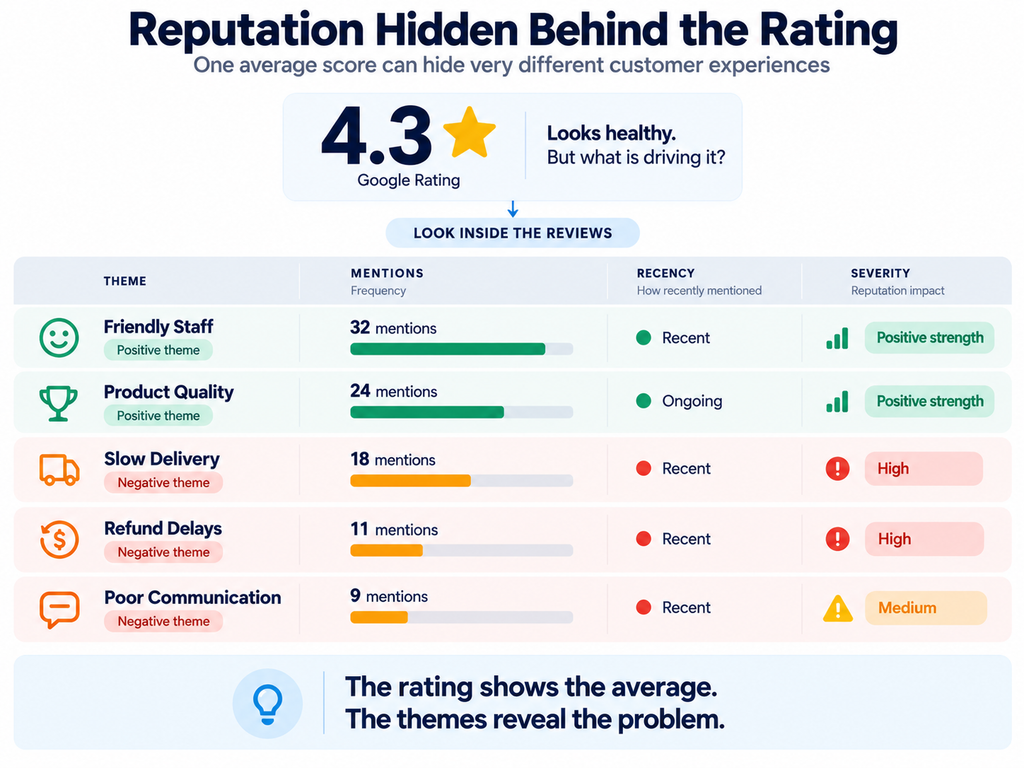
Identify Recurring Reputation Themes
Group recent reviews by the experience they describe rather than reading each review in isolation.
Positive themes may include:
- helpful staff;
- fast service;
- product quality;
- easy booking;
- convenient delivery.
Negative themes may include:
- delayed orders;
- refund problems;
- poor communication;
- unexpected pricing;
- long waiting times;
- staff behaviour.
Then assess each theme across three dimensions:
- Frequency: How often does it appear?
- Recency: Are customers mentioning it now or only in older reviews?
- Severity: Does it describe a minor inconvenience or a failure that can stop someone from buying, returning, booking, or trusting the business?
| Theme | Frequency | Recency | Severity | Reputation priority |
| Friendly staff | High | Recent | Positive | Protect |
| Slow delivery | High | Recent | High | Urgent |
| Parking | Low | Old | Low | Monitor |
| Refund delays | Medium | Recent | High | Urgent |
Use this as a reputation diagnostic framework, not a Google ranking formula.
Google itself advises eligible service businesses to use aspect-level rating information to identify areas customers rate poorly and improve the service. Google’s guidance on service-business review aspects
Why Two Businesses With the Same 4.3 Rating Can Have Very Different Reputation Risk
Imagine two businesses both show 4.3 stars.
- Business A receives occasional unrelated complaints about parking, price, waiting time, and product availability. No single problem dominates recent feedback.
- Business B receives repeated recent complaints about delayed refunds and customers struggling to reach support.
The headline rating looks identical. The reputation problem does not.
Business B faces a concentrated operational risk because customers repeatedly describe the same failure. Adding more positive reviews may improve the average eventually, but it does not remove the underlying reason customers complain.
That is why your Google reputation audit should track both rating movement and recurring review themes.
A useful rule is:
Treat repeated recent complaints as an operating signal, not merely a review-management problem.
Fixing the customer experience can address the source of future negative feedback. Trying to bury the theme with additional reviews only treats the visible score.
How Many Five-Star Reviews Would You Actually Need to Recover Your Rating?
“Get more five-star reviews” sounds actionable until you ask the obvious question:
How many?
Google states that its review score equals the average of all ratings published on Google for the business. Google also notes that a new review can take up to two weeks to appear in the updated review score. Google’s review-score calculation guidance
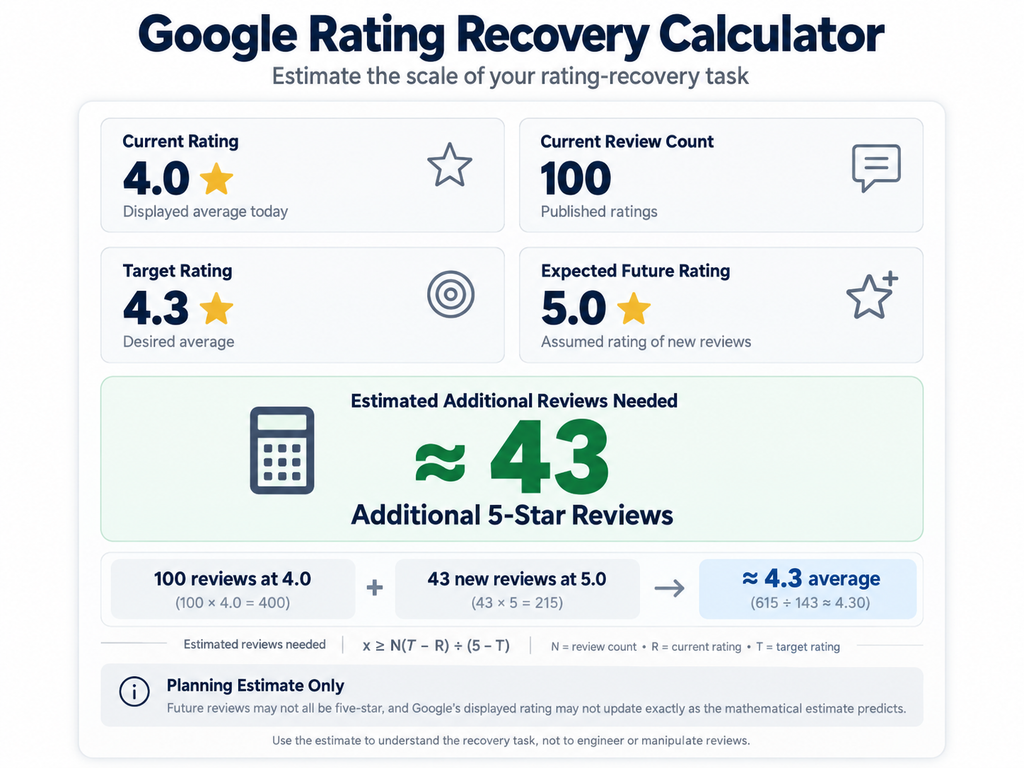
You can therefore estimate the number of new five-star ratings needed to reach a target average.
Let:
- N = current number of Google reviews;
- R = current average rating;
- T = target rating;
- x = number of additional five-star ratings required.
Use:
Then round up to the next whole review when the result is not already an integer.
Example: Assume You Currently Have 100 Reviews
| Current rating | Target rating | Approx. additional 5-star reviews needed |
| 3.8 | 4.0 | 20 |
| 4.0 | 4.3 | 43 |
| 4.2 | 4.5 | 60 |
For example, a business with exactly 100 reviews averaging 4.0 starts with the equivalent of 400 rating points. Adding 43 five-star ratings produces:
That shows why repairing an established rating can require much more than a handful of new reviews.
Treat the Calculation as a Planning Estimate, Not a Promise
The formula assumes that:
- your current average is exactly the number entered;
- every additional review receives five stars;
- no existing ratings disappear;
- no lower ratings arrive during recovery.
Real customer feedback will rarely follow those assumptions exactly.
Google also controls how and when the displayed score updates, so the visible Business Profile rating may not change immediately after each new review. Google’s review-score documentation
Most importantly, do not use the calculation as justification for manipulating reviews. Google’s policies prohibit incentivized reviews and unusual review patterns intended to manipulate a business’s rating. Google’s fake-engagement and rating-manipulation policy
Use the calculator to understand the scale of the recovery task. Then use safe Google review acquisition alongside fixes for the recurring issues your review-theme analysis uncovered.
The rating tells you how far the score needs to move. The review themes tell you what must change to make that recovery sustainable.
What If the Problem Isn’t Your Reviews but What Ranks When People Search Your Brand?
A business can have a 4.7 Google rating and still look risky when someone searches its name.
If the first page contains an old controversy, a prominent Reddit thread, negative news coverage, a complaint page, or outdated information, the problem sits in your branded search reputation, not your Google Business Profile.
That requires a different audit.
Audit the First Page of Your Branded Search Results
Start with the same searches from your Google reputation audit:
Record the first-page results, their positions, URLs, titles, and dates.
Do not treat “negative” as a source type. A Reddit result can be negative, outdated, or inaccurate at the same time. Use two classifications instead:
| Source class | Examples |
| Owned | Website, help centre, official profiles |
| Earned | Editorial coverage, interviews, independent mentions |
| Review | Trustpilot or relevant industry review sites |
| Community | Reddit, forums, YouTube discussions |
| News | Current or archived media coverage |
Then give each result a risk label:
positive / neutral / negative / outdated / inaccurate / irrelevant.
Also record its ranking position, freshness, accuracy and search intent relevance.
If inaccurate names, addresses, phone numbers or business details appear across directories, run a local citation audit as a separate cleanup process.
Google notes that search results can vary by time, location, context and personalization, so one SERP screenshot should not represent what every customer sees.
Removal, Correction and Suppression Are Three Different Strategies
Do not use “remove the negative Google result” as a catch-all strategy.
| Strategy | When it fits | What it actually changes |
| Removal | Content qualifies under source-platform rules, Google policy or applicable law | Removes or restricts access to the result/content where approved |
| Correction | Information contains inaccurate or outdated facts and the publisher can update it | Fixes the source itself |
| Suppression / displacement | Accurate, lawful content remains online and stronger relevant pages compete for visibility | Attempts to move another result above it, without guaranteeing disappearance |
Google says it can remove Search results under specific policy or legal conditions. If the content itself remains online and does not qualify for removal, Google recommends addressing it at the source where possible.
Correction should usually come before suppression when the source contains factual errors.
For example, if an article still says your company operates from an old address or names a discontinued policy, contact the publisher with verifiable updated information. If the publisher changes or deletes the page but Google still displays stale information, Google’s Refresh Outdated Content process can request an updated result.
Suppression, sometimes called search-result displacement in online reputation management, means producing or strengthening legitimate, relevant pages that may compete with the problematic result.
That can include:
- authoritative company pages;
- useful product or service pages;
- expert-led resources;
- legitimate media coverage;
- accurate executive or company profiles;
- genuinely useful third-party coverage.
Do not promise that suppression will push a result to page two or make it disappear. Google ranks pages through multiple automated systems and signals, and rankings change over time.
Also avoid manufacturing low-value content solely to manipulate the branded SERP. Google’s Search guidance explicitly prioritizes helpful, reliable, people-first content over content created primarily to manipulate rankings.
Removing Something From Google Is Not the Same as Removing It From the Internet
These outcomes are fundamentally different:
| Outcome | What happens |
| Source removal | The publisher deletes the webpage or content itself |
| Google Search removal/delisting | Google stops showing or restricts the result under qualifying conditions, but the source may still exist |
| Ranking displacement | The page remains indexed but another result ranks above it |
Google states that preventing content from appearing in Search does not remove that content from the website hosting it. The site owner controls the source.
Legal removals can also depend on jurisdiction. Google explains that content found unlawful under a specific local law may receive restrictions only in the relevant country or region.
So before choosing a Google Search reputation management strategy, ask:
Do we need the information deleted, corrected, delisted, or simply evaluated differently by searchers?
Those are four different problems.
How Reddit, Forums, Review Sites and YouTube Shape Your Google Reputation
Customers do not necessarily stop researching after seeing your Google Business Profile.
In BrightLocal’s 2026 U.S. consumer survey, 66% of respondents said they conduct additional research after reading positive reviews. The study found that consumers often continue to business websites, additional review sources and social platforms before deciding.
That validation journey makes third-party reputation signals important whenever Google surfaces them for branded searches.
Audit sources such as:
- Reddit threads;
- relevant industry forums;
- YouTube reviews or complaint videos;
- Trustpilot or sector-specific review platforms;
- news and media coverage;
- social discussions that rank in Google.
Do not measure these platforms purely by whether the conversation feels positive or negative. Measure their visibility and credibility in the customer’s search journey.
Don’t Try to “Control” Every Negative Discussion
A legitimate critical Reddit post does not automatically require removal or suppression.
First determine whether it contains:
accurate criticism, incorrect facts, outdated information, or policy-violating material.
The right response may involve:
- correcting verifiable misinformation;
- answering a genuine customer issue;
- improving the service being criticised;
- updating outdated owned information;
- using the platform’s reporting process when content actually violates its rules.
Trying to bury accurate criticism without addressing its cause may improve neither the underlying customer experience nor long-term brand reputation on Google.
This connects directly with the earlier review-theme analysis: repeated complaints across Google Reviews, Reddit and independent review sites may signal an operational issue rather than an SEO problem.
When Does a Third-Party Result Become a Reputation Risk?
Evaluate seven factors:
| Factor | Question to ask |
| Ranking position | Does the result appear prominently for an important branded query? |
| Accuracy | Are the factual claims correct? |
| Freshness | Does the content still reflect the business today? |
| Visibility | Is the title/snippet likely to attract attention? |
| Relevance | Does it address the issue customers are researching? |
| Engagement | Does the discussion continue attracting comments, views or references? |
| Continuity | Does the underlying complaint still happen? |
A five-year-old Reddit thread ranking ninth with outdated information represents a different risk from a recent thread ranking second while customers continue describing the same problem.
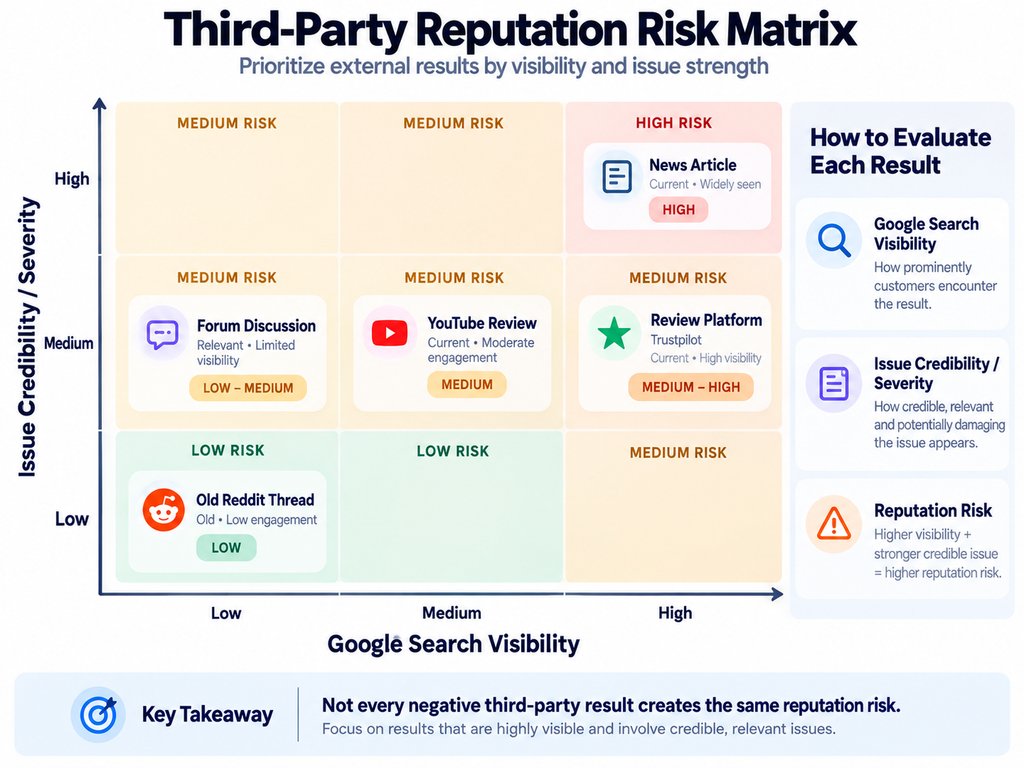
The correct objective is not to control every conversation about your brand.
It is to understand which third-party result materially affects customer trust, establish whether the criticism is accurate, and then choose between response, correction, source removal, service improvement or legitimate search-result competition.
That is the difference between branded search reputation management and simply trying to make negative content disappear.
What About Google’s AI-Generated Reputation of Your Brand?
Google’s AI-powered Search can introduce another reputation surface. A customer may ask about your company in AI Overviews or AI Mode and receive a synthesized answer that mentions strengths, complaints, policies, pricing, customer experiences, or third-party opinions.
Do not treat that output as a standalone reputation score. Treat it as an information-verification problem. You need to understand how AI Search chooses and cites supporting sources?
Google says AI Overviews provide generated summaries with links to supporting web information and explicitly warns:
“AI Overviews can and will make mistakes.”
Identify What Google’s Generated Answer Is Actually Saying
Run relevant branded searches and record the output exactly as it appears.
Capture:
- positive claims about the business;
- negative claims or warnings;
- factual errors;
- outdated information;
- statements that lack important context;
- visible or cited sources where Google provides them;
- the query that triggered the answer;
- date of the check.
Do not test only [Brand Name]. Also test natural customer questions such as:
- Is [Brand] reliable?
- Is [Brand] legitimate?
- [Brand] customer reviews
- Is [Brand] good for [service/product]?
Google’s AI Mode can break a question into subtopics and search across multiple data sources before generating a response. Google also acknowledges that AI Mode can misinterpret web content or miss context.

Trace the Underlying Information
When an AI-generated claim looks wrong, search for the wording, idea, or underlying fact across:
- your website;
- Google Business Profile information;
- recent Google reviews;
- Reddit and forums;
- news coverage;
- review platforms;
- authoritative third-party websites.
Google encourages users to verify important AI-generated information by checking the supporting web links and other Search results.
Apply the same principle from the earlier branded search reputation audit: determine whether the source information is accurate, inaccurate, outdated, incomplete, or genuinely negative.
Correct Sources Before Trying to “Optimize the AI”
If your own website contains an outdated return policy, correct it there. If your Business Profile contains incorrect information, update the profile. If a publisher uses outdated facts, pursue a factual correction where appropriate.
If reviews repeatedly describe a genuine customer-service problem, fix the underlying experience rather than looking for an “AI reputation hack.”
The practical rule is:
Fix the information ecosystem before trying to influence the generated interpretation.
Google continues to expose supporting web sources within its generative Search experiences, including AI Overviews and AI Mode.
That makes source accuracy, authority, freshness and consistency more defensible reputation-management priorities than speculative tactics designed to force a particular AI answer.
Can Fake Positive Reviews Hurt Your Reputation Too?
Yes. Businesses can damage their own Google reputation by manipulating positive reviews just as easily as attackers can damage it with fake negative reviews.
Google requires reviews to reflect genuine, unbiased customer experiences. Its Fake Engagement and Rating Manipulation policies prohibit paid reviews, incentivized ratings, conflicts of interest and coordinated activity designed to manipulate a business’s score.
Risky practices include:
| Practice | Why it creates risk |
| Buying five-star Google reviews | Reviews do not reflect genuine customer experiences |
| Giving discounts or free products for reviews | Google prohibits incentivized reviews |
| Employees reviewing their employer | Employment may create a conflict of interest |
| Review exchanges | Reciprocal ratings may not represent unbiased experiences |
| Coordinating multiple accounts | Google prohibits multi-account manipulation |
| Manufacturing sudden positive-review bursts | Unusual review patterns may signal rating manipulation |
| Pressuring customers for five stars | Manipulates the rating rather than requesting unbiased feedback |
This does not mean a legitimate review-request campaign is unsafe. The earlier section on asking customers for Google reviews without manipulation explains how to request feedback neutrally.
The distinction is intent and method:
genuine review acquisition → real customers independently describe real experiences
versus
rating manipulation → the business engineers the rating, wording or reviewer pool.
Google can remove violating reviews. It can also place restrictions on a Business Profile when it determines that the owner violated its fake-engagement policy. Possible restrictions include temporarily blocking new reviews, temporarily unpublishing existing ratings, or displaying a warning that Google removed fake reviews.
Google’s 2026 Maps protections also include systems designed to detect suspicious review patterns and temporarily pause new contributions during certain spam attacks.
There is also a human trust problem. An unnaturally perfect profile filled with repetitive, vague or concentrated five-star reviews may create skepticism even before Google takes action.
So do not define reputation recovery as:
“How quickly can we manufacture a 5.0?”
Define it as:
“How accurately does our review profile represent genuine customer experience?”
A credible 4.x profile with detailed, varied and recent customer feedback can tell potential customers far more than an artificially engineered perfect score.
How Do You Know Whether Your Google Reputation Is Actually Improving?
Do not measure Google reputation management with one number.
A rising average rating can look encouraging while recent reviews still contain the same refund complaints, a negative Reddit result still ranks prominently, or Google Search continues surfacing outdated information.
Build a baseline from the earlier Google reputation audit, then compare the same indicators over consistent periods.
Track More Than Average Rating
Use a measurement framework such as:
| Area | Metric to track | What improvement may look like |
| Review score | Average rating | Stable upward movement |
| Review volume | Total and new reviews | Sustainable genuine growth |
| Rating mix | 1–5 star distribution | Lower concentration of recent low ratings |
| Recent sentiment | Last 30/60/90 days | Fewer repeated negative themes |
| Positive themes | Staff, quality, speed, convenience | Consistent strengths remain visible |
| Negative themes | Refunds, delays, service, pricing | Frequency/recency declines |
| Responses | Response coverage and quality | More relevant, useful replies |
| Branded SERP | First-page result composition | More accurate/current information |
| Negative visibility | Position of problematic results | Reduced prominence where legitimately achievable |
| Third-party reputation | Reddit, review sites, media | Fewer unresolved recurring issues |
| Generated interpretation | AI summaries, Place Topics, snippets | Fewer inaccurate/outdated themes |
| Policy risk | Restrictions/removals/warnings | No new incidents |
| Review attacks | Frequency and severity | Fewer or faster-contained incidents |
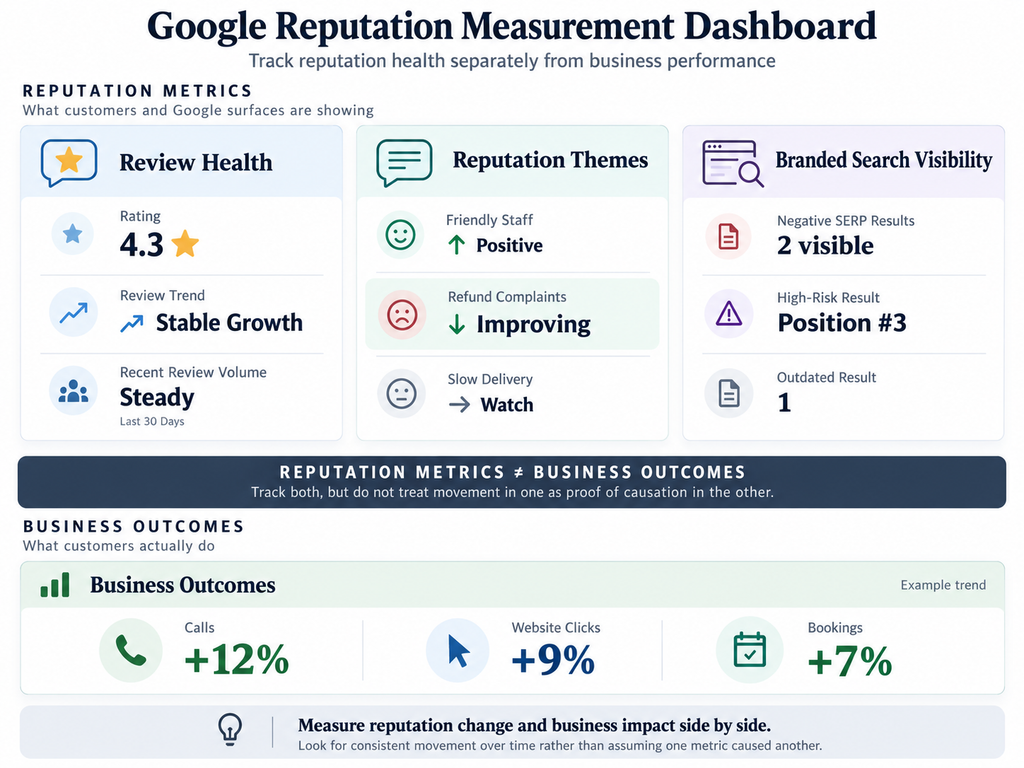
Separate Reputation Metrics From Business Outcomes
This distinction prevents weak causal claims.
Reputation metrics describe what people encounter:
- star rating;
- review sentiment;
- review themes;
- branded search results;
- third-party commentary;
- Google-generated summaries.
Business outcomes describe what customers do:
- calls;
- direction requests;
- website clicks;
- enquiries;
- bookings;
- leads;
- purchases or revenue where attribution exists.
Google Business Profile performance reporting includes metrics such as views, website clicks, calls, directions, messages and bookings for eligible profiles.
Google now also allows businesses to connect Business Profile data with Google SEO Analytics, which can help analyze interactions from local Search and Maps alongside website or app activity.
That makes a stronger reporting model possible:
Reputation change → customer interaction trend → downstream conversion data
But correlation does not automatically establish causation. If bookings increase while your rating rises, seasonality, advertising, pricing, demand or other factors may also contribute.
Report the relationship accurately:
“Rating increased from X to Y while Business Profile calls increased Z% during the same period.”
Not:
“Improving the rating caused calls to increase Z%.”
Unless your measurement design can actually support that conclusion.
The strongest sign that Google reputation management is working is not simply a higher star rating. It is a healthier combination of genuine review trends, fewer recurring reputation problems, more accurate branded-search information, lower policy risk, and stronger customer outcomes where the data supports the connection.
Build a Google Reputation Health Score Instead of Watching One Number
A 4.5 Google rating does not tell you whether recent complaints are increasing, Reddit ranks negatively for your brand, your reviews look manipulated, or your Business Profile faces policy risk.
To measure Google reputation health as a whole, combine the reputation surfaces already covered in this guide.
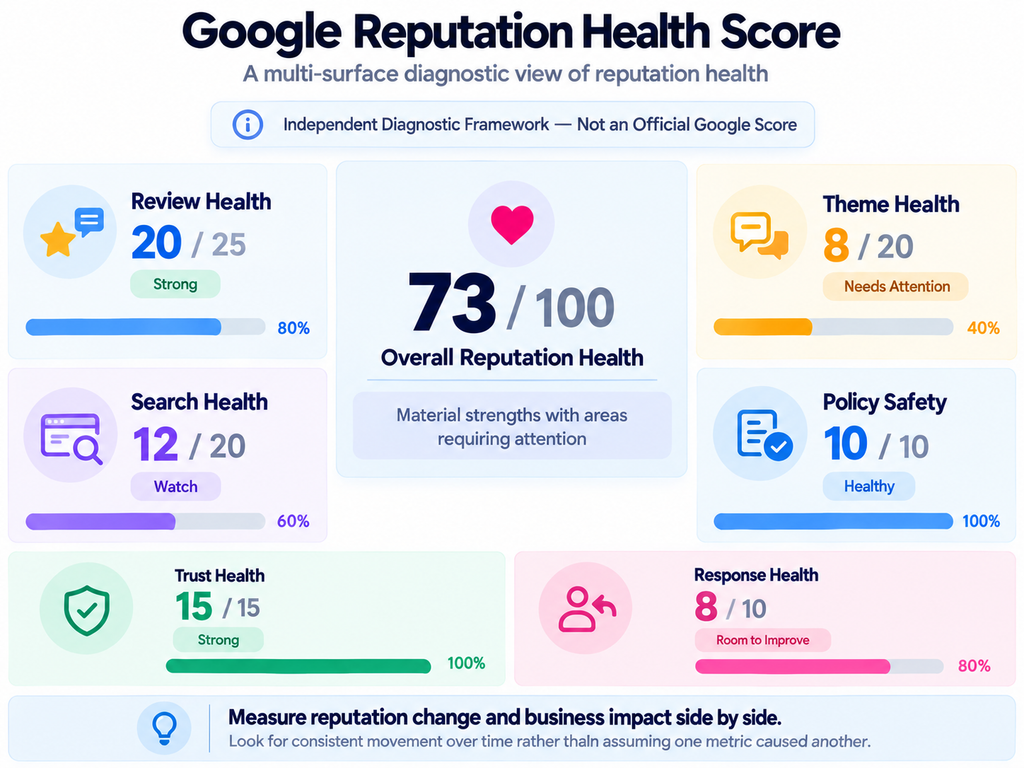
Important: The Google Reputation Health Score below is our diagnostic framework. It is not an official Google metric, Google ranking factor, or Google-issued reputation score.
Use it to compare your business against its own baseline over time, not to claim that Google assigns your company a score out of 100.
Google Reputation Health Score
Score each category from 0 to 5, then apply its weighting.
| Component | Weight | What you evaluate |
| Review health | 25 | Rating trend, distribution, recency, review flow, unusual spikes |
| Reputation-theme health | 20 | Frequency, recency and severity of recurring positive/negative themes |
| Search health | 20 | First-page branded SERP composition, negative visibility, outdated/inaccurate results |
| Trust health | 15 | Review authenticity, consistency and credibility across sources |
| Policy safety | 10 | Fake reviews, incentives, review gating, manipulation or restrictions |
| Response health | 10 | How consistently and appropriately legitimate feedback receives attention |
| Total | 100 |
How to Score Each Component
Use the same 0–5 scale throughout:
| Score | Interpretation |
| 5 | Evidence shows healthy performance with no material issue |
| 4 | Mostly healthy with one minor or isolated weakness |
| 3 | Mixed signals that need monitoring |
| 2 | Clear recurring reputation problem |
| 1 | Severe or widespread reputation weakness |
| 0 | Active incident, major policy exposure or serious unresolved failure |
For example, a business might score:
- Review Health: 4/5 × 5 = 20
- Theme Health: 2/5 × 4 = 8
- Search Health: 3/5 × 4 = 12
- Trust Health: 5/5 × 3 = 15
- Policy Safety: 5/5 × 2 = 10
- Response Health: 4/5 × 2 = 8
Total Google Reputation Health Score: 73/100
A 73 tells you more than “4.4 stars” because it shows where the weakness sits. In this example, recurring reputation themes create the largest problem.
Use these internal bands:
- 85–100: Healthy, maintain controls
- 70–84: Watchlist, address identifiable weaknesses
- 50–69: Material reputation risk
- Below 50: Priority remediation required
These bands are editorial diagnostic thresholds, not Google standards.
Build the score from evidence collected in your Google reputation audit, review-theme analysis, and branded SERP audit.
Do not chase 100 for its own sake. Use the score to answer:
Which part of our Google reputation creates the greatest current risk, and is that risk improving between audits?
When Should You Hire a Reputation Management Company?
A reputation management company becomes useful when the problem requires sustained expertise, coordination, or scale rather than a task your team can reasonably handle internally.
A specialist may add value when you face:
- several damaging results across your branded SERP;
- widespread inaccurate or outdated information across publishers;
- ongoing reputation-crisis monitoring;
- review management across many locations;
- complex Google review policy or escalation cases;
- coordinated content and search reputation remediation;
- repeated third-party reputation problems across Reddit, media, forums or review sites.
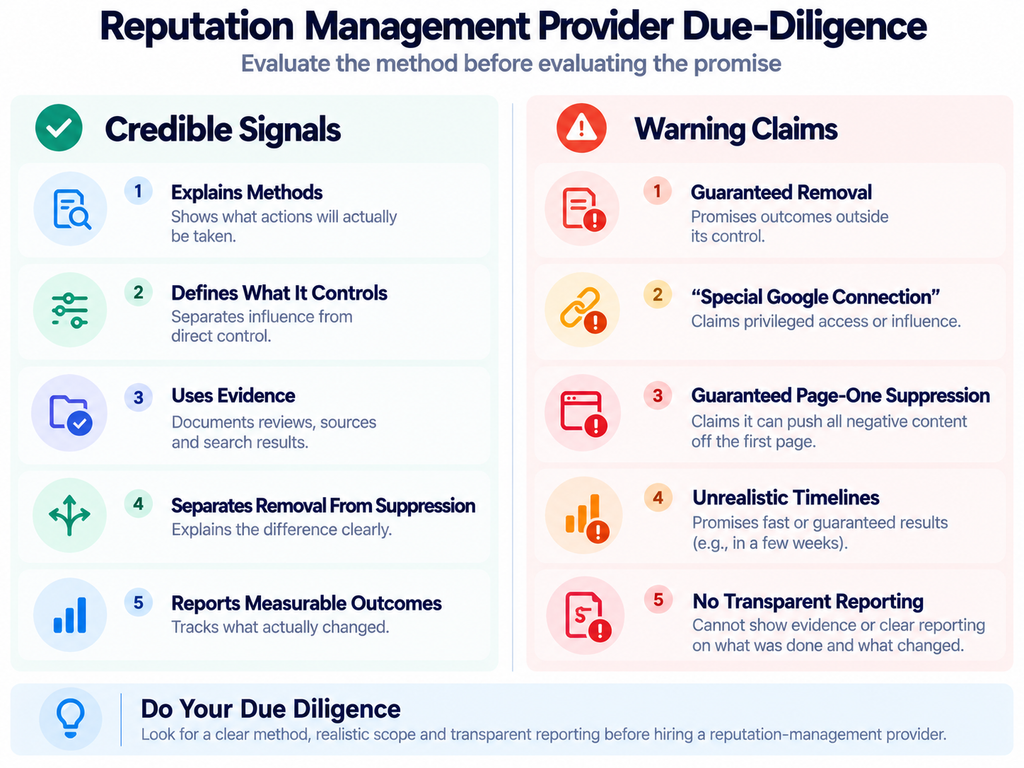
The key question is not whether the agency promises to “fix your reputation.” Ask what exactly it can control.
Claims That Should Make You Cautious
Treat these promises as due-diligence warnings:
“We guarantee removal.”
Google removes Search results and reviews only under applicable policies, legal grounds, or product processes. A third party cannot independently guarantee Google’s decision.
“We know someone at Google.”
Google explicitly tells businesses to beware of SEO providers that claim a special relationship with Google.
“We guarantee page-one suppression.”
No external provider controls Google’s ranking systems. Google says third-party tools and services do not have access to its internal ranking data and cannot guarantee performance.
“We’ll flood your profile with positive reviews.”
That creates policy risk. Google prohibits paid reviews, incentivized reviews and unusual patterns intended to manipulate ratings; violating businesses can also face Business Profile restrictions.
For U.S. businesses, the risk extends beyond Google policy. The FTC’s Consumer Reviews and Testimonials Rule covers fake reviews and certain deceptive review practices, and FTC guidance explicitly states that reputation management companies can also face liability when they create or sell fake reviews, condition incentives on sentiment, or engage in prohibited review suppression.
Legal rules differ by jurisdiction, so do not treat U.S. FTC requirements as universal law.
Questions to Ask Before Paying an ORM Provider
Ask these before signing a contract:
- What exactly are you changing? Reviews, source content, branded search results, Business Profile data, or something else?
- Are you proposing removal, correction, or suppression? Those are different strategies.
- If you claim content is removable, which Google policy, platform policy, or legal basis applies?
- What evidence do you need from us?
- What happens if the removal request fails?
- What techniques will you use to influence branded search results?
- Do you buy, incentivize, exchange, or manufacture reviews?
- Which outcomes can you control and which depend on Google, publishers, platforms, or users?
- How will you measure progress?
- Will you give us access to the evidence, reports, content and accounts involved?
Google recommends the same underlying principle when evaluating SEO providers: understand exactly what they intend to do, remain skeptical of guarantees, and make sure the provider explains its methods.
A credible ORM provider should be comfortable saying:
“We can control the process, evidence and execution. We cannot guarantee decisions made by Google, publishers, reviewers, or ranking systems.”
That is a much stronger trust signal than a promise to make every negative result disappear.
Google Reputation Decision Playbook: What to Do for Your Specific Problem
Google reputation management works best when you match the response to the actual failure mode. A genuine complaint, coordinated review attack, outdated search result and inaccurate AI summary may all damage trust, but they require different interventions.
Use this playbook after completing your Google reputation audit.
| Your problem | Diagnose | Immediate action | Long-term action |
| One genuine negative review | Customer-service issue | Investigate what happened and respond appropriately | Fix the root cause and monitor for recurrence |
| Gradually falling rating | Customer-experience issue | Run a review-theme analysis | Improve the recurring operational weakness |
| Fake Google review | Policy issue | Preserve evidence and report qualifying policy violations | Monitor review patterns and maintain incident records |
| Multiple suspicious reviews at once | Possible review attack | Preserve screenshots, URLs, timestamps and interaction records | Escalate qualifying violations and monitor new activity |
| Reviews tied to a payment/favor demand | Potential extortion | Preserve evidence and do not pay or engage | Use Google’s dedicated merchant-extortion process |
| Legitimate reviews disappearing | Moderation/profile issue | Establish whether reviews were delayed, removed or affected by profile status | Maintain policy-compliant review acquisition |
| Negative Reddit/forum result | Branded-search reputation issue | Assess accuracy, freshness, visibility and legitimacy | Correct misinformation, solve the underlying issue or build stronger relevant search assets |
| Outdated Google Search result | Freshness/source issue | Correct or remove outdated information at the source | Request a Google refresh where applicable |
| Incorrect AI-generated summary | Source-information issue | Record the claim and trace supporting information | Correct inaccurate or outdated source information |
| Artificial-looking positive profile | Credibility/policy risk | Stop incentives, purchased reviews or manipulation | Build a genuine, neutral review-request program |
Google supports several of these distinctions directly. It removes Business Profile reviews only when they violate policy, not merely because a business disagrees with them. Google also maintains a separate reporting route for review extortion involving demands for money, goods or services.
For outdated web information, Google recommends fixing the source first and provides its Refresh Outdated Content process when deleted or changed information continues appearing in Search.
For AI-generated Search content, Google itself warns that AI Overviews can make mistakes and advises users to check supporting web information. That is why an inaccurate AI statement should trigger source verification, not an “AI reputation hack.”
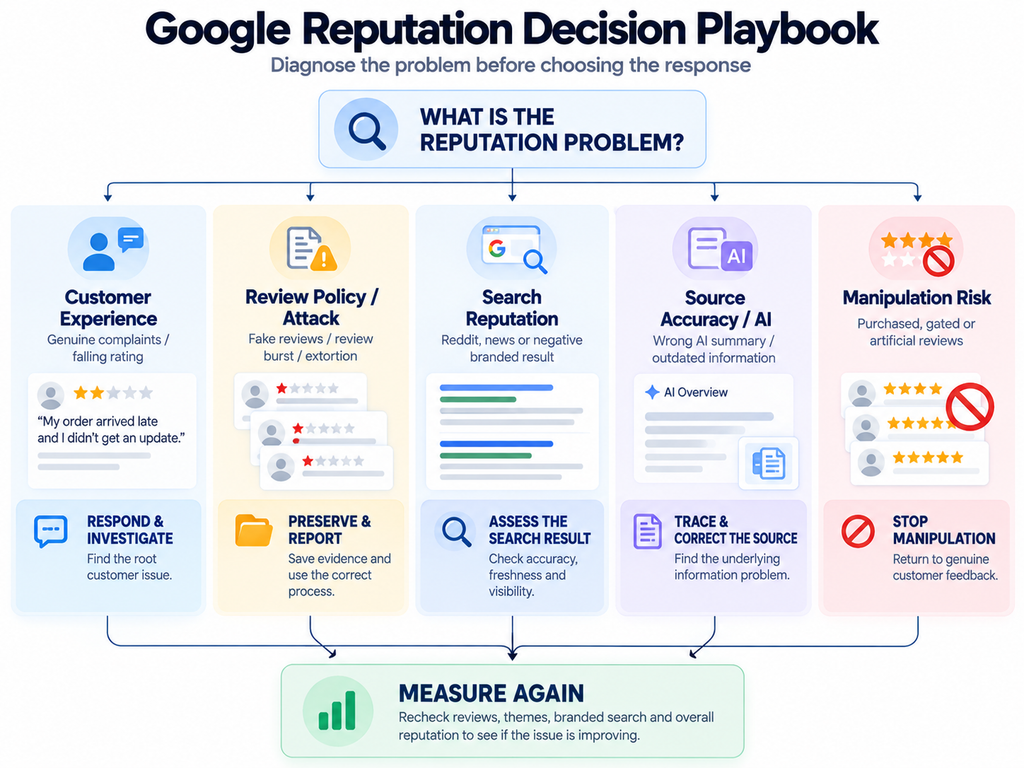
The governing rule across every scenario is:
Diagnose first. Then intervene.
Trying to solve the wrong problem can waste time or create additional reputation risk. For example, adding more positive reviews will not correct an inaccurate article, and publishing new content will not resolve a genuine refund problem.
Google Reputation Management Checklist
Use this checklist for an initial audit and repeat it after major reputation changes or incidents.
Diagnose
Protect
Google can remove violating reviews and may restrict Business Profiles involved in fake engagement, including temporarily preventing new reviews or unpublishing existing ratings.
Repair
Build
Measure
Do not evaluate these metrics independently. Compare them with the baseline from your Google Reputation Health Score and investigate what actually changed.
FAQs About Google Reputation Management
1. Can negative Google reviews be removed?
Yes, but only if they violate Google’s content policies. A genuine negative review usually stays live even if the business disagrees with it.
2. How do I remove a fake Google review?
Report the review through your Google Business Profile or Reviews Management Tool. Google will assess whether it violates policies such as fake engagement, spam, conflicts of interest or rating manipulation.
3. Why are my Google reviews disappearing?
Reviews may disappear because of policy violations, automated spam detection, profile changes or moderation. Some reviews can also be delayed before appearing on Google Search or Maps.
4. How can I improve my Google reputation?
Start by fixing recurring customer problems, requesting genuine reviews consistently, responding helpfully to feedback, keeping your Business Profile accurate and monitoring what appears when people search your brand
5. How many 5-star reviews do I need to improve my Google rating?
It depends on your current rating and total review count. Businesses with more existing reviews generally need more new 5-star ratings to noticeably change their average score.
Conclusion: The Goal Isn’t a Perfect Google Reputation
Google reputation management is not about making every search result positive. It is about making what prospective customers find accurate, representative, trustworthy and current. A legitimate complaint may need service recovery; a fake review may need reporting; a negative Reddit result may require search strategy; inaccurate information may need correction; and extortion demands need separate escalation. Diagnose first, then intervene. If your situation requires deeper ORM support, you can discuss your reputation challenges with Rank and Convert and build a response around the actual problem.