

Before a customer calls, your business details have already made an impression. According to BrightLocal’s 2026 survey of 1,227 US consumers, 44% check a business’s address or proximity when researching local options, while 34% look for complete listing information. Imagine a potential customer finding your old address or disconnected phone number instead of your competitor’s accurate details. Local business citations help customers discover your business across maps, directories and other websites. But collecting hundreds of listings isn’t the answer. Which citations actually matter, which mistakes should you fix first, and when is enough truly enough?
What Are Local Business Citations? Examples and the Two Main Types
Local business citations are online references to your business on directories, maps, local publications and other websites. A citation typically includes your business name, address and phone number, collectively known as NAP. It may also include your website, opening hours and business category. Some citations contain only part of your NAP information.
There are two main types: structured and unstructured. The difference is how your business information appears and how customers encounter it.
Structured Citations: Business Listings on Directories and Maps
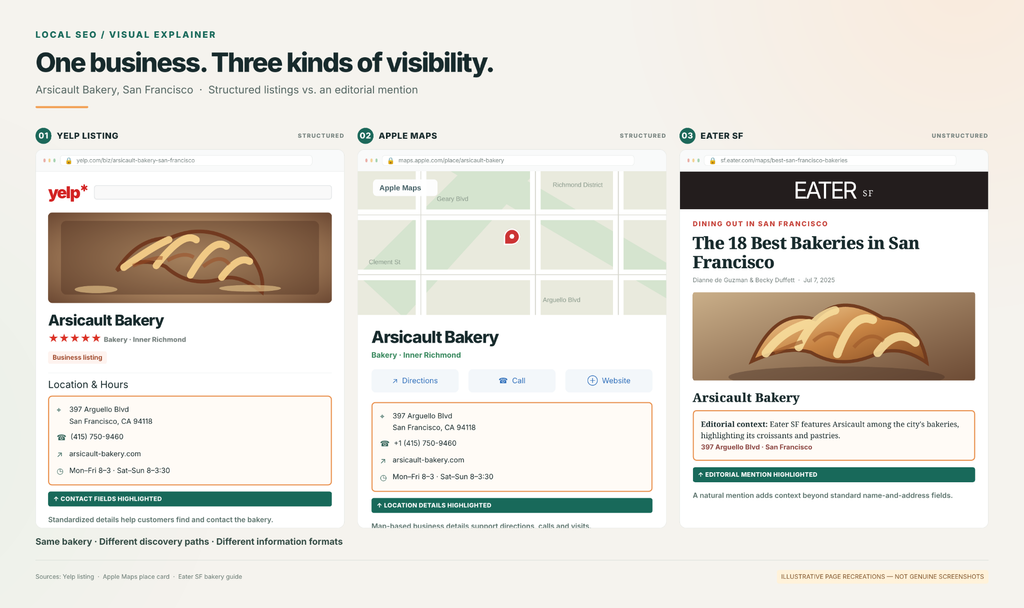
Structured citations present business information in dedicated fields, usually alongside directions, reviews and contact options. You will find them on platforms such as Yelp, Apple Maps and industry-specific directories.
Take Arsicault Bakery’s Yelp listing in San Francisco. Its listing provides the following information, which is also consistent with the bakery’s published contact details.
| Business information | Listed details |
| Business name | Arsicault Bakery |
| Address | 397 Arguello Blvd, San Francisco, CA 94118 |
| Phone | (415) 750-9460 |
| Website | arsicault-bakery.com |
| Regular hours | Monday–Friday, 8 a.m.–3 p.m.; Saturday–Sunday, 8 a.m.–3:30 p.m. |
A customer can use this structured listing to check the bakery’s location, get directions or call before visiting. The business has a similar presence on Apple Maps , another place where customers can discover it.
Unstructured Citations: Mentions in Articles, Local Publications and Industry Websites
An unstructured citation appears naturally within an article, review or other editorial content rather than in a dedicated business-listing format.
For example, Eater SF’s guide to San Francisco’s best bakeries features Arsicault Bakery and discusses its croissants and other pastries. The editorial mention identifies the business within its local food scene, while the accompanying location details help readers find it.
Unlike a standard directory entry, the mention also gives readers a reason to consider visiting. A relevant local publication or industry website can introduce your business to people who might never search for your name directly.
Local Citations vs Backlinks vs Business Listings
Although these terms overlap, they describe different things.
| Term | What it means | Does it need a link? |
| Local citation | An online reference to your business information | No |
| Backlink | A clickable link from another website to yours | Yes |
| Business listing | A dedicated profile containing business information on a directory, map or discovery platform | No |
A citation can include a backlink, but a business can be cited without receiving one. A backlink can also exist without the linking page mentioning your business address or phone number.
Google Business Profile and its optimization deserves a distinction here. It is a business-managed profile on Google’s own Search and Maps platforms, not an ordinary third-party directory. Businesses can claim and verify their profiles to manage their information.
Understanding these differences is useful, but the more important question is whether citations still justify an investment in 2026.
Do Local Business Citations Still Matter for SEO in 2026?
Yes. Local citations remain useful for business-information accuracy, customer discovery and maintaining a presence on relevant third-party websites. However, they are not a shortcut to higher Google Maps rankings.
The distinction is between helping people and search engines find reliable business information and assuming that every additional directory entry improves your position.
What Google Confirms About Local Rankings
Google identifies three main considerations when determining local rankings: relevance, distance and prominence.
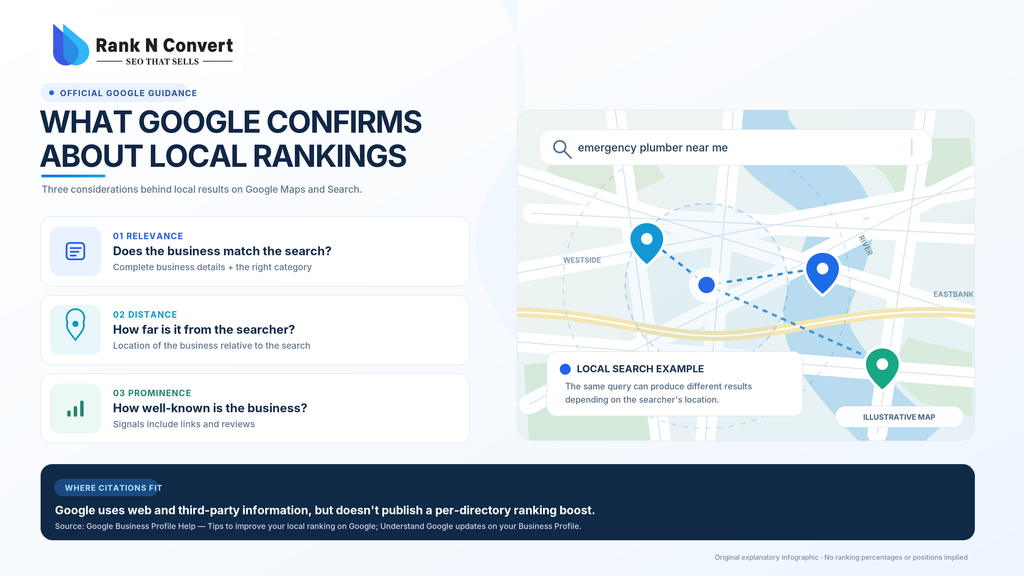
- Relevance: How closely a business matches what someone is searching for. Complete business information helps Google understand what a business offers.
- Distance: How far the business is from the searcher or the location specified in their query.
- Prominence: How well-known the business is. Google identifies links and reviews among the information that can contribute to prominence.
Google also confirms that it compiles local listing information from multiple sources, including publicly available websites, licensed third-party data, user contributions and business owners.
This explains why business information outside your own website matters. However, Google does not disclose exactly how much weight it gives an individual directory citation.
Its guidance states:
Businesses with complete and accurate info are more likely to show up in local search results.
That is a reason to maintain reliable business information, not proof that submitting your details to another 50 directories will improve rankings.
Three Practical Benefits of Accurate Citations
Accurate citations serve three distinct purposes.
1. Customer discovery: Relevant directories, maps and local publications give people additional ways to find your business, especially when they search by service or location rather than business name.
2. Reliable contact information: Correct addresses, telephone numbers and opening hours make it easier for customers to visit, call or confirm that a business meets their needs. In BrightLocal’s July 2026 US consumer research, 44% considered address or proximity during local business research, while 34% looked for complete listing information.
3. A wider source of business information: Accurate third-party references contribute to the information available about your business online. Google confirms that it uses third-party information in its local listings, although the precise ranking contribution of individual citations remains undisclosed.
These benefits are different. A directory may help customers discover you without materially affecting your Google ranking. A local publication may introduce you to a relevant audience without functioning as a conventional business directory.
What Local Citations Cannot Guarantee
The number of citations alone cannot guarantee a top position in Google Maps. Google has not published a minimum citation requirement or a formula linking additional listings to a specific ranking improvement.
The 2026 Whitespark Local Search Ranking Factors report helps put citations in context. Its research asked 47 local SEO experts to assess 187 factors across local Maps rankings, organic rankings, conversions and AI-search visibility. In its Maps assessment, structured-citation quality and authority ranked 49th, substantially below factors such as primary Business Profile category and proximity. These are practitioners’ assessments, not Google’s disclosed algorithm.
| What Google confirms | What industry research suggests | What remains unverified |
| Accurate, complete business information supports local visibility. | Relevant, accurate citation coverage is useful foundational work. | An exact number of citations required to rank. |
| Google obtains local information from several sources. | Source quality and relevance deserve attention. | The ranking weight of each directory. |
| Relevance, distance and prominence guide local rankings. | Citation work is one part of a broader local SEO strategy. | Guaranteed ranking gains from building or cleaning citations. |
The practical takeaway is to evaluate citations by their relevance and accuracy rather than their quantity. Before creating more business listings, find out whether your existing ones are correct, accessible and useful to customers.
Before Building More Citations, Audit the Ones You Already Have
Your business information can change online even when you haven’t edited it. Google confirms that it may update Business Profiles using customer reports and licensed third-party data. An old phone number or address could therefore appear on a platform you rarely check.
Before paying for new local citations, conduct a manual citation audit. The goal is to find where your business already appears, verify what customers see and identify listings that genuinely need attention.
Create One Verified Business-Information Record
Start with a master record containing your correct business name, address, phone number, website URL, primary business category and operating hours. Use your actual trading name, official website and current business details rather than copying information from an existing directory that might already be wrong.
Google’s Business Profile guidelines require businesses to use their real-world names and accurate location information. If you operate a service-area business from home and don’t receive customers there, keep your address private where platform rules require it.
Your master record is the reference for checking every existing listing. Record any legitimate variations, such as a separate branch phone number, rather than automatically treating them as errors.
Find the Listings That Already Represent Your Business
You don’t need a paid citation checker to start. Search for your business using several variations:
- Search Google for your exact business name and city, then repeat using your phone number and address.
- Check Google Maps, Apple Maps and Bing Places for existing profiles, including unclaimed listings.
- Search customer-relevant directories such as Yelp, TripAdvisor or industry-specific platforms where applicable.
- Search your previous business name, address or phone number if you’ve moved or rebranded.
Use searches such as “Your Business Name” “City” and site:yelp.com “Your Business Name” to uncover listings that might otherwise be missed.
Classify What You Find Before Changing Anything
Not every listing needs editing. Classify each result according to its actual condition.
| Listing status | What it means | Next action |
| Accurate and controlled | Information is correct and you manage the listing | Keep |
| Accurate but unclaimed | Correct details, but no verified ownership | Claim if relevant |
| Incomplete | Important customer information is missing | Complete |
| Materially incorrect | Wrong address, phone, website or other consequential detail | Correct |
| Duplicate or obsolete | An unnecessary duplicate or an old business record | Investigate |
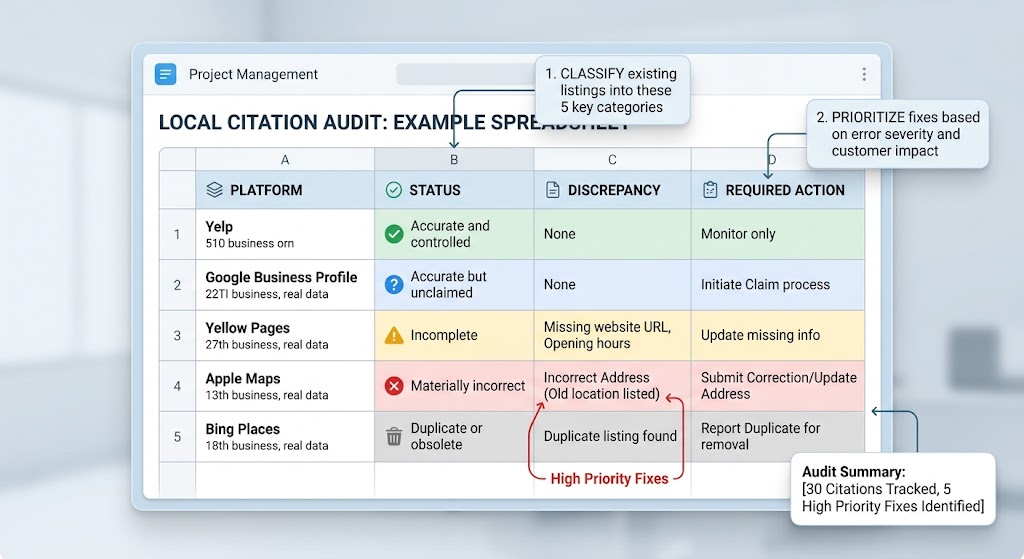
Keep an audit spreadsheet with the platform name, listing URL, displayed information, discrepancy, customer relevance, ownership access, required action and verification status. Save screenshots of important errors before requesting corrections.
Once your audit is complete, the next decision is more important than the number of listings discovered: which errors genuinely deserve your attention?
Which Citation Errors Actually Need Fixing?
A disconnected phone number and an abbreviated street name are not equivalent problems. One can immediately prevent a customer from contacting you; the other may simply be a different way of writing the same address.
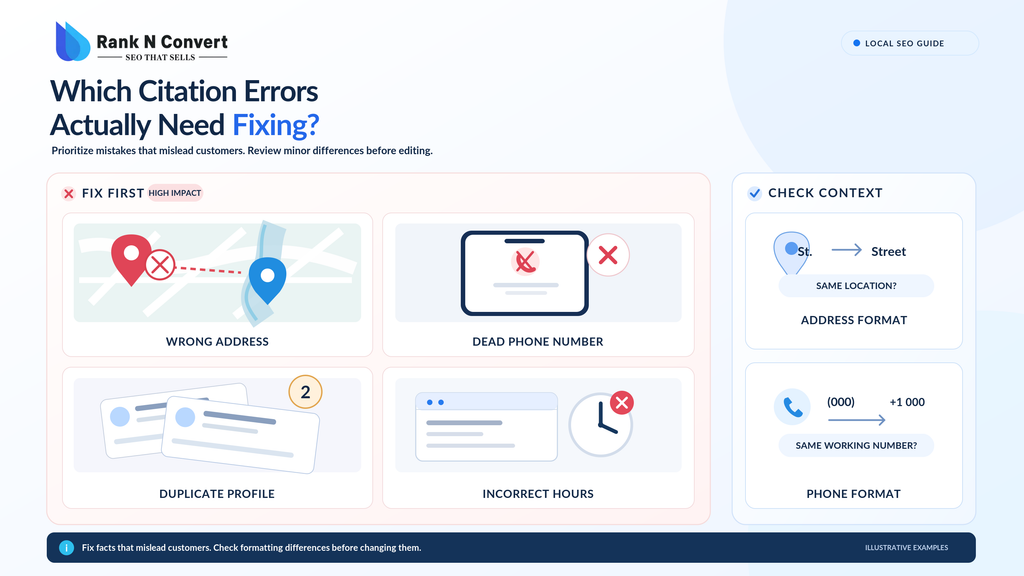
A useful citation cleanup strategy distinguishes factual errors, duplicate identities and harmless formatting differences instead of treating every NAP inconsistency as an SEO emergency.
Errors That Prevent Customers From Finding or Contacting You
Prioritize details that could send customers to the wrong place, prevent enquiries or misrepresent your business.
These include an old operating address, a disconnected telephone number, a broken website link, incorrect opening hours or a listing for a location that has permanently closed.
Check the actual customer experience before requesting corrections. Call the displayed telephone number, open the website link and confirm that map directions lead to the right entrance. For temporary changes, use the platform’s appropriate opening-hours fields rather than replacing your normal schedule. Google’s business-hours guidance explains how regular and special hours are managed separately.
Duplicate Listings and Business-Identity Conflicts
Finding two listings with similar names does not automatically mean one should be deleted.
Google’s official duplicate-profile guidance states:
You can have only one Business Profile for each business.
However, distinct eligible businesses at the same address may have separate profiles when they meet Google’s requirements. A legitimate second branch is also different from an accidental duplicate of the same location.
Before taking action, confirm whether the records represent the same business. If someone else manages your existing profile, request ownership. For genuine Google Maps duplicates, follow Google’s reporting or merging procedure instead of indiscriminately deleting profiles. An incorrect removal could affect information or reviews you intended to preserve.
Formatting Differences That Require Context Rather Than Automatic Correction
NAP consistency does not necessarily mean reproducing every character identically across the internet.
For example, 125 Main Street and 125 Main St may describe the same address. Different phone-number spacing may also be harmless if both versions connect to the correct business.
Google requires accurate business information but does not publicly document a separate ranking penalty for every minor formatting variation. Its address guidelines emphasize complete, precise addresses, including relevant unit information.
Evaluate a difference according to whether it changes the business’s identity, causes practical customer problems or conflicts with the platform’s requirements. A missing suite number may be important in a large office building even when an abbreviated street name is not.
Citation Error Priority: What to Fix First and What Can Wait
Use this discrepancy matrix to separate immediate customer-facing problems from details requiring further review.
| Citation discrepancy | Initial priority | Recommended action |
| Wrong operating address | High | Verify and correct promptly |
| Disconnected telephone number | High | Replace with a working number |
| Accidental duplicate Google Business Profile | High | Follow Google’s duplicate procedure |
| Incorrect opening hours | High | Correct the schedule |
| Obsolete website URL | High | Update the destination |
| Missing suite or unit number | Depends on location | Check whether customers can find the premises |
| St instead of Street | Usually low | Confirm both refer to the same address |
| Different phone-number formatting | Usually low | Check that the number works |
These priorities reflect customer impact and platform requirements, not experimentally proven Google ranking weights.
Google also notes that Business Profile edits may require review. Most are reviewed quickly, but some can take up to 30 days. Save your correction dates and check the live listing rather than assuming every submitted change has been published.
Once the consequential errors are resolved, you can assess whether your business is missing from any directories or local platforms that customers actually use.
Which Local Citation Sites Should You Prioritize?
Listing your business on 100 directories means little if your customers use only a handful of them. In a February 2026 survey commissioned by Data Axle and conducted by Dynata, 39% of 1,000 US consumers said they cross-check multiple sources when researching businesses.
Start with the platforms your customers use to find businesses like yours. Then add relevant industry directories, local organizations and data providers. A useful citation source should either help people discover your business, provide reliable information or reach a relevant audience.
Start With Relevant Primary Map and Business-Discovery Platforms
Your first consideration should be Google Business Profile, Apple Maps and Bing Places, where supported. They let businesses manage the information customers encounter through their respective search and mapping services.
One important update for 2026: Apple Business Connect was replaced by Apple Business on April 14, 2026. Existing Business Connect records were migrated to the new platform. Apple Business is free to start in more than 200 countries and regions, although individual features vary by market.
The following comparison gives you a starting point, not a universal list of directories every business needs.
| Platform | Relevant audience | Basic listing cost | How to get started |
| Google Business Profile | Eligible businesses serving customers locally | Free | Find, claim or add your profile |
| Apple Maps via Apple Business | Businesses with eligible locations in supported markets | Free | Register and manage your place card |
| Bing Places | Businesses in supported markets | Free | Claim or create and verify a listing |
| Yelp | Local businesses where Yelp is used, particularly in the US | Free basic page | Find your business and claim its page |
| Tripadvisor | Eligible restaurants, hotels and other hospitality businesses | Free basic listing | Find and claim your listing |
The costs and claim options above come from the platforms’ published guidance. Availability, eligible business categories and additional paid features differ.
Google Business Profile is a first-party-managed search profile rather than a conventional third-party citation. It belongs in this starting group because it controls how an eligible business manages its information on Google Search and Maps.
Add Directories That Your Actual Customers Use
A restaurant and a plumbing company should not automatically follow the same citation-building list.
A restaurant in a city popular with tourists may benefit from Tripadvisor, while a US plumber might find Yelp more relevant. Hotels should examine travel and accommodation platforms, while professional services should check directories that consumers use to find qualified practitioners.
Before submitting a listing, search the directory as a customer would. Look for your service and location. Are relevant businesses represented? Are their profiles maintained? Can visitors find useful information or take an action such as calling, requesting a quote or making a reservation?
If a directory has little relevance to your industry or country, its inclusion on a generic list of local citation sites is not a sufficient reason to use it.
Evaluate Local and Industry-Relevant Sources
National platforms are only part of the picture. Your local chamber of commerce, a recognized professional association or a respected regional business directory may reach customers who are specifically interested in your area or service.
For example, a legal practice can investigate relevant lawyer directories and professional associations in its jurisdiction. A home-improvement company might consider established local trade directories. Eligibility and professional credentials should be checked before applying.
Local newspapers and industry publications offer another opportunity, but genuine editorial mentions are different from ordinary directory submissions. A business featured in a relevant article earns an unstructured citation through coverage, not simply by entering its NAP into a form.
Understand Data Aggregators Before Using Them
Some companies collect, verify and distribute business information to other platforms. These are commonly called local data aggregators.
Data Axle’s Local Listings service distributes business details across participating publishers, including search directories and navigation applications. Its free Local Listings service offers eligible US businesses a way to submit and update their information.
Foursquare operates a different type of business-data ecosystem. Its Places dataset supplies point-of-interest information to developers and businesses building location-based products. That does not make purchasing its data products equivalent to claiming an ordinary directory listing.
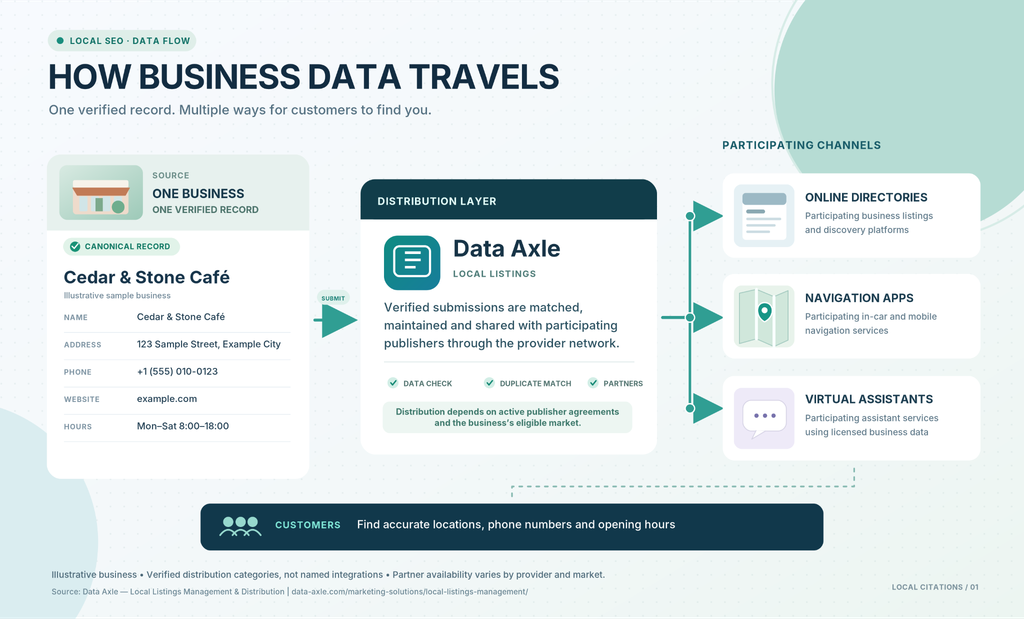
Before paying a provider, establish which publishers it currently supports, whether it covers your country and how updates or corrections reach those publishers.
Decide Whether a Paid Directory Deserves Your Money
A paid listing should offer a benefit beyond adding another citation to your total.
Check whether it attracts relevant customers, offers useful features unavailable in its free tier and allows you to retain control of your business information. Review renewal terms and what happens to your listing if you cancel.
Paying for placement does not establish that Google assigns the directory greater ranking value. If the directory cannot demonstrate meaningful audience relevance or useful features, a free listing on a more relevant platform may serve your business better.
How to Build and Correct Local Citations Without Creating New Problems
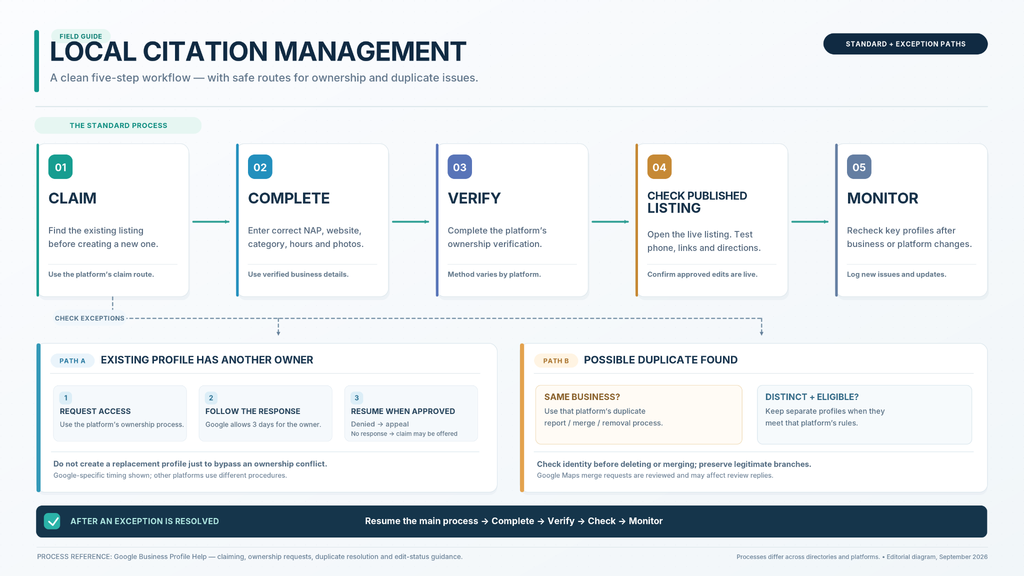
Once you’ve selected relevant citation sources, work through them individually. Claim an existing listing, complete its information, verify ownership and check the published result. Creating another profile when one already exists can introduce the duplicate problems you’re trying to avoid.
Claim an Existing Listing Before Submitting a New One
Search each platform using your business name, address and phone number before creating a profile.
If an unclaimed listing exists, use the platform’s ownership process. For example, Google’s official claiming instructions explain how to find your business on Maps, select the claiming option and complete the available verification method.
If someone else already controls your Google Business Profile, request access rather than creating a replacement. Google’s current procedure gives the existing owner three days to respond. If access is denied, you can appeal; if there is no response, you may be offered an alternative claiming option.
Verification procedures differ between directories, so follow the instructions provided by each platform.
Complete Each Listing With Accurate, Useful Information
Start with the correct business name, appropriate address or service area, working telephone number, website and business category. Add your regular opening hours and special hours where supported.
Next, complete the optional fields that help customers choose your business. Depending on the platform, these may include a description, service details, photographs, menus, amenities or booking links.
For example, Apple Maps place cards support contact details, photographs and additional actions such as ordering food or making reservations, subject to the relevant feature requirements.
Use the platform’s actual business categories and write descriptions for customers. Adding unrelated services or excessive keywords to a business name is not a legitimate citation-building technique.
Correct or Report Existing Errors Using Platform-Specific Processes
Not every correction requires the same action. Use the procedure appropriate to the listing’s ownership and condition.
- Claimed listing: Sign in and edit the inaccurate information.
- Unclaimed listing: Request ownership or complete the platform’s claiming process.
- Listing controlled by someone else: Request access through the appropriate ownership procedure.
- Incorrect listing you cannot manage: Submit a correction through the platform’s public reporting process, if available.
- Genuine duplicate: Follow the platform’s duplicate-resolution procedure.
On Google Maps, for instance, you can suggest corrections to business information even when you don’t manage the profile. However, suggesting an edit is different from gaining ownership of the listing.
Avoid submitting repeated profiles or making multiple conflicting changes while an ownership dispute is unresolved.
Keep a Record of Submitted and Verified Changes
Submitting a correction does not mean it has appeared publicly. Keep a record so you can distinguish completed work from pending requests.
Your citation management spreadsheet should contain the listing URL, platform, account owner, submission date, verification status and any outstanding issue. Save screenshots or confirmation emails for important corrections.
After a change is approved, open the public listing and check what customers actually see. Test important contact links and directions. Where possible, maintain one business-owned account and grant staff or agencies appropriate access rather than sharing passwords.
Google specifically recommends retaining control of your Business Profile when using third-party managers.
Manual Citation Building vs Tools vs Managed Services
The appropriate method depends on the number of locations you manage, the condition of your existing listings and how much ongoing maintenance they require.
| Method | Suitable situation | Main consideration |
| Manual citation building | A small business with relatively few relevant listings | Greater direct control, but requires staff time |
| Citation management software | Businesses managing many profiles or frequent changes | Check platform coverage, update capabilities and subscription terms |
| Managed citation service | Complex ownership problems, multiple locations or limited internal resources | Verify the provider’s scope, reporting and ownership arrangements |
You don’t necessarily need a paid service to manage a single location with a manageable number of listings. For multiple branches or persistent data problems, centralized management can reduce repetitive work.
Whichever method you use, retain ownership of important accounts and access to your citation records. A provider should make ongoing management easier, not leave your business dependent on credentials or listings you cannot control.
The standard process also needs to change for businesses without a public storefront, companies with multiple branches and businesses that have recently moved or rebranded.
What Changes for Service-Area Businesses, Multiple Locations and Business Moves?
The same citation setup does not work for every local business. A plumber working from home, a five-branch dental group and a café moving across town all need different approaches.
Google makes one distinction especially clear: a business that visits or delivers to customers but does not serve them at its address should remove that address from its public Business Profile and use a service area instead.
Service-Area Businesses: What If You Do Not Serve Customers at Your Address?
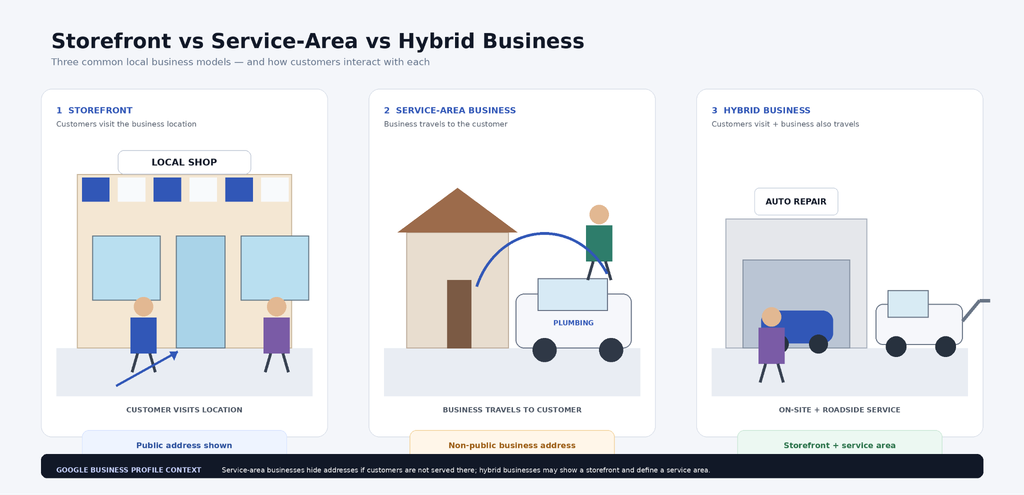
Google separates local businesses into three useful models:
- Storefront business: Customers visit the business at its physical location.
- Service-area business: The business travels or delivers to customers and does not serve them at its address.
- Hybrid business: Customers can visit the location, but the business also travels or delivers to them.
A plumber operating from a residential address, for example, should not expose that home address on Google simply to create a stronger-looking local citation. Google’s guidelines specifically instruct service-area businesses to hide addresses where customers are not served.
A genuine hybrid business is different. An auto-repair shop that receives customers at its garage and also provides roadside assistance can show its physical location while setting a service area.
Google also states that a service-area business normally receives one profile for the area it serves. Multiple profiles become appropriate only where there are genuinely separate locations with separate staff and service areas that meet Google’s eligibility rules.
Do not assume every third-party directory follows Google’s address rules. Before creating a citation for a service-area business, check whether that directory allows hidden addresses, service areas or businesses without customer-facing premises.
Multi-Location Businesses: How Should Each Branch Be Represented?
A genuine second branch is not a duplicate citation. It is a separate business location that needs its own accurate location data.
For Google Business Profile, each eligible location can have its own profile, but Google says businesses should not create more than one profile for the same location. Chains should also maintain consistent real-world names and primary categories across locations where the underlying business is the same. Google’s guidelines for chains and multiple locations
For each branch, maintain a location-specific record containing:
- physical address;
- phone number that reaches that location;
- operating hours;
- location page URL where available;
- relevant category;
- citation URLs;
- profile ownership and login access;
- verification and audit status.
Google’s guidance also says the listed phone number should connect to the individual business location, while the website should represent that location appropriately.
Businesses managing ten or more eligible locations can use Google’s bulk location management tools rather than updating every profile separately. Google’s bulk location management guidance
The same discipline should extend beyond Google. If one branch closes, moves or changes its number, update that location’s records rather than changing every citation associated with the brand.
Moving or Rebranding: What Happens to Old Citations?
A move creates one of the clearest reasons to conduct citation cleanup because the old address may remain visible long after the business has relocated.
Start with the business’s own website and the major platforms customers rely on. Then work outward to important directories, maps, industry profiles and remaining citations discovered in your audit.
For Google specifically, the instruction is unambiguous:
“Do not create a new Business Profile because of a change in a physical location or ownership.”
If the same business relocates, Google says to update the existing profile with the new address rather than create another profile for the new location. The profile may need to be verified again after the address changes. Google’s guidance for relocated businesses
Rebranding requires more care. Google permits certain minor name changes and qualifying multi-location rebrands on the existing profile. If the change is substantial enough that Google considers it a new business, its guidelines call for closing the old profile and creating a new one.
For other citation platforms, check their own update and ownership procedures rather than assuming Google’s process applies.
A sensible update order is:
- Verify the new real-world business information.
- Update the website and location page.
- Update Google and other major maps/search platforms.
- Update important industry and customer-facing directories.
- Search for the old address, phone number and business name.
- Correct remaining high-value outdated citations.
Call Tracking: When Are Different Phone Numbers Intentional?
Different phone numbers are not automatically a citation error.
A business may intentionally use a tracking number to measure calls from a particular platform or campaign. The important question is whether the number reliably connects customers to the correct business and complies with that platform’s rules.
Google says a Business Profile phone number should connect as directly as possible to the individual business location, be under the business’s control and preferably use a local number rather than a central call centre. Google also allows up to two additional phone numbers. Google’s current Business Profile phone guidance
So during a citation audit, do not flag every unfamiliar number as incorrect. Call it first. Determine whether it is an intentional tracking number, a valid secondary number or an obsolete line.
| Business situation | Citation approach | Main risk to avoid |
| Storefront | Publish the genuine customer-facing location | Incorrect address or hours |
| Service-area business | Follow each platform’s address/privacy rules | Exposing a non-customer-facing home address |
| Hybrid business | Show eligible storefront and define service area | Treating it as purely storefront or purely service-area |
| Multiple locations | Maintain a separate record for each eligible branch | Mixing branch phone numbers, URLs or addresses |
| Business move | Update the existing business identity across priority sources | Creating unnecessary duplicate profiles |
| Rebrand | Determine whether it is the same business before changing records | Leaving conflicting old and new identities online |
| Call tracking | Verify routing and platform compliance | Mistaking a valid tracking number for stale data |
Once these situations are handled correctly, the obvious question is: how many citations do you actually need?
How Many Local Citations Are Enough—and When Should You Stop?
There is no credible universal target such as 30, 50 or 100 local business citations.
That matters because citation quantity is easy to measure, while citation usefulness is not. In Whitespark’s 2026 survey of 47 local SEO practitioners, quality and authority of structured citations ranked 49th among the surveyed Local Pack/Maps factors, while quantity of structured citations ranked 110th. These are expert assessments based on industry experience—not Google’s published algorithm—but the difference reinforces why a citation strategy should not revolve around raw volume. Whitespark’s 2026 Local Search Ranking Factors study
Why There Is No Universal Citation Target
Two businesses can need very different citation coverage.
A neighbourhood restaurant may care about major map platforms, food discovery sites and local publications. A solicitor or medical practice may have professional directories that matter far more than generic business directories. A business in the UK, UAE or Australia will also face a different citation ecosystem from one in the US.
The useful question is therefore not:
“How many citations do I have?”
It is:
“Am I represented accurately on the sources that customers and relevant platforms actually use?”
Even citation specialists increasingly frame the issue around relevance and quality rather than a fixed total. BrightLocal’s citation guidance advises businesses to balance citation quantity with the quality and relevance of available opportunities rather than chase a universal number. BrightLocal’s guidance on citation quality and quantity
A Practical Stopping Framework
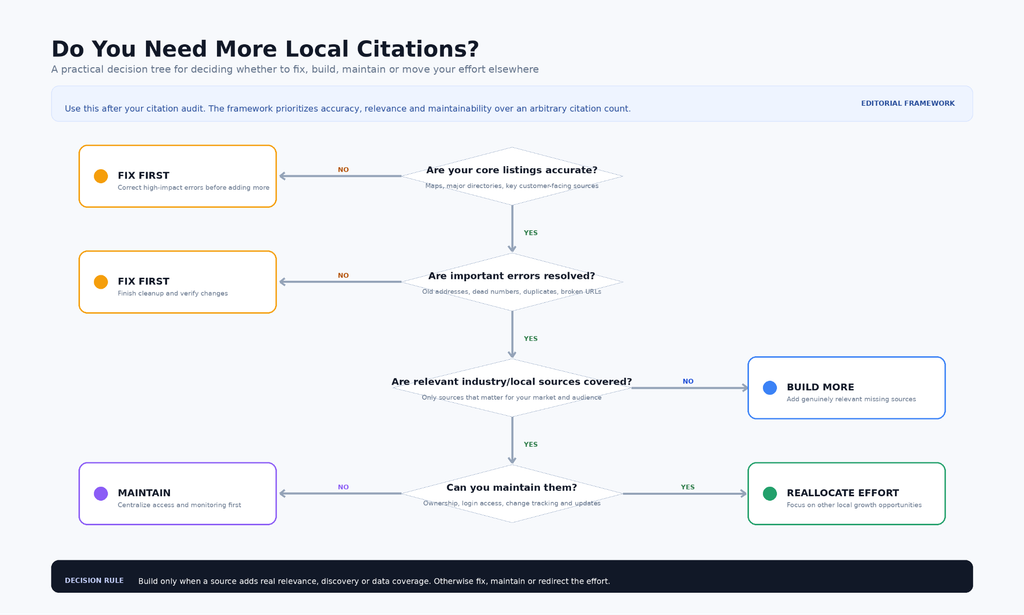
You can usually reduce active citation building once four conditions are reasonably satisfied:
1. Core platforms are covered.
Your business has accurate, controlled profiles on the major search, map and discovery platforms relevant to your market.
2. Important citation errors are resolved.
Old addresses, disconnected numbers, wrong URLs and genuine duplicates no longer dominate your search results.
3. Relevant local and industry sources are covered.
You appear on directories, associations or platforms that people in your location or industry genuinely use.
4. You can maintain what you have.
Someone knows where the listings are, who owns them and how to update them when the business changes.
If those conditions are met, creating another profile on an obscure directory may deliver less value than improving something customers interact with directly.
When Additional Citation Work May Have Lower Priority
Citation building competes with other local SEO work for the same time and budget.
Whitespark’s 2026 practitioner survey placed factors such as primary Google Business Profile category, searcher proximity, business hours and Google review ratings above structured citation quality in its Local Pack/Maps assessment. Again, that survey reflects expert judgment rather than Google’s disclosed weighting, but it illustrates why local SEO for small businesses should not become an endless directory-submission project.
Consider reallocating effort when:
- your important listings are already accurate;
- your industry-specific citation opportunities are covered;
- new directories have little real customer relevance;
- your Google Business Profile is incomplete or poorly maintained;
- important location or service pages need improvement;
- customer reviews need attention;
- locally relevant links or editorial mentions offer stronger opportunities.
That does not mean citations are “finished forever.” Business information changes. Platforms change. New directories become relevant and old ones disappear. Treat citation management as maintenance plus selective expansion, not a race toward an arbitrary total.
A simple rule works well: keep building when a new source adds meaningful discovery, relevance or business-data coverage; stop when you are adding listings mainly to increase the number.
The next step is to measure whether the citation work you have already done produced anything useful beyond a larger spreadsheet.
How Can You Measure Whether Citation Building Worked?
Fixing 20 business listings is progress, but did it help anyone find or contact your business? The answer requires more than counting completed submissions.
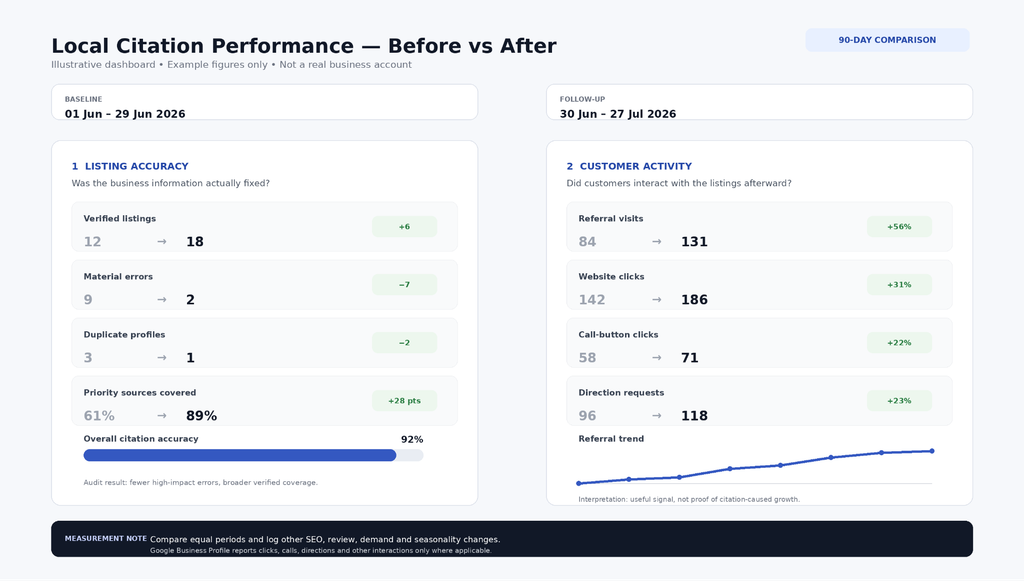
Measure two things separately: citation accuracy and customer activity. The first shows whether your information is reliable. The second helps you understand whether your listings are generating useful business interactions.
Record a Baseline Before Making Changes
Before correcting or building citations, save your existing audit results and record the performance of your major business profiles.
Use Google Business Profile’s performance report to track available profile interactions and Google Search Console to monitor your website’s organic clicks, impressions and search queries.
Record your starting metrics, the date each correction goes live and any other marketing changes made during the same period. Compare equivalent periods where possible, accounting for weekdays, holidays and seasonal demand.
Measure Accuracy and Customer Actions Separately
A successful citation campaign should improve business information, but it should also be evaluated against measurable customer activity.
| What to measure | Metric | Where to check |
| Listing accuracy | Important errors corrected | Citation audit |
| Listing coverage | Relevant, verified profiles | Platform dashboards |
| Duplicate resolution | Genuine duplicates resolved | Audit and platform records |
| Website visits | Referral sessions | Google Analytics |
| Phone enquiries | Recorded calls or call-button clicks | Call tracking or platform reports |
| Directions | Direction requests | Supported map platforms |
| Bookings | Completed reservations | Booking system |
For directory traffic, check referral sources in Google Analytics. Where a platform permits tracking parameters, use consistent UTM-tagged links to identify visits from individual listings.
Be careful when interpreting platform reports. Google Business Profile counts call-button clicks, not confirmed telephone conversations. Direction requests do not establish that someone visited your premises. Booking data is available only where supported integrations exist.
Why Ranking Changes Do Not Prove Citation Impact
Suppose your local rankings improve after correcting several outdated listings. That does not establish that citation cleanup caused the improvement.
Your competitors may have changed their websites, you may have collected new reviews, or local demand may have increased. Google also considers searcher distance, relevance and prominence when producing local results.
Keep a change log so you can distinguish what you corrected from what happened afterward. If several SEO activities took place simultaneously, report the combined outcome rather than assigning the improvement entirely to citations.
Decide What Deserves Ongoing Monitoring
Your maintenance schedule should reflect how often your business information changes. Recheck important listings after moving, changing phone numbers, updating opening hours or receiving complaints about incorrect details.
For businesses with stable information, monitor essential platforms and investigate new discrepancies when they appear. There is little value in repeatedly rebuilding accurate listings simply to demonstrate activity.
The same measurement discipline becomes even more important when evaluating the emerging role of citations in AI-assisted local business discovery.
Can Local Citations Help Businesses Appear in AI Search?
Yes, third-party business listings and mentions can provide information that AI search tools use when recommending local businesses. But appearing in a directory does not guarantee that ChatGPT, Google AI Mode or another AI platform will recommend you.
In a September 2026 study of approximately 200,000 localized AI searches, BrightLocal found that business websites accounted for 42% of nearly 2 million source citations across ChatGPT, Google AI Mode and Google AI Overviews. Directories and other third-party platforms also appeared as sources. The findings show why your own website and relevant external mentions deserve attention together.
Structured Business Information vs Contextual Third-Party Mentions
AI search can encounter your business through several kinds of online information. A directory listing supplies factual details such as your address, services and contact information. An independent article may provide additional context about your expertise, reputation or suitability for a particular customer.
For example, a dental clinic’s directory profile may establish its location and opening hours. A genuine article discussing emergency dental services in that city could help answer a more specific question about treatment availability.
Neither source guarantees an AI recommendation. The practical goal is to make accurate, relevant information available wherever customers and search systems may encounter your business.
What Current Practitioner Research Suggests
Whitespark’s 2026 Local Search Ranking Factors survey placed expert-curated business lists first and the quality of unstructured citations fourth among factors respondents believed influenced AI search visibility. Its September 2026 citation playbook recommends identifying the directories and third-party publications appearing in traditional and AI search results for relevant business queries.
These findings suggest that relevant industry coverage, local publications and credible recommendations deserve investigation alongside conventional business listings. However, Whitespark’s findings are practitioner assessments, not a verified ranking formula for AI platforms.
How to Investigate Your Actual AI Discovery Landscape
Rather than submitting your business to every directory mentioned in an AI optimization guide, examine which sources appear for searches relevant to your customers.
Start with three practical steps:
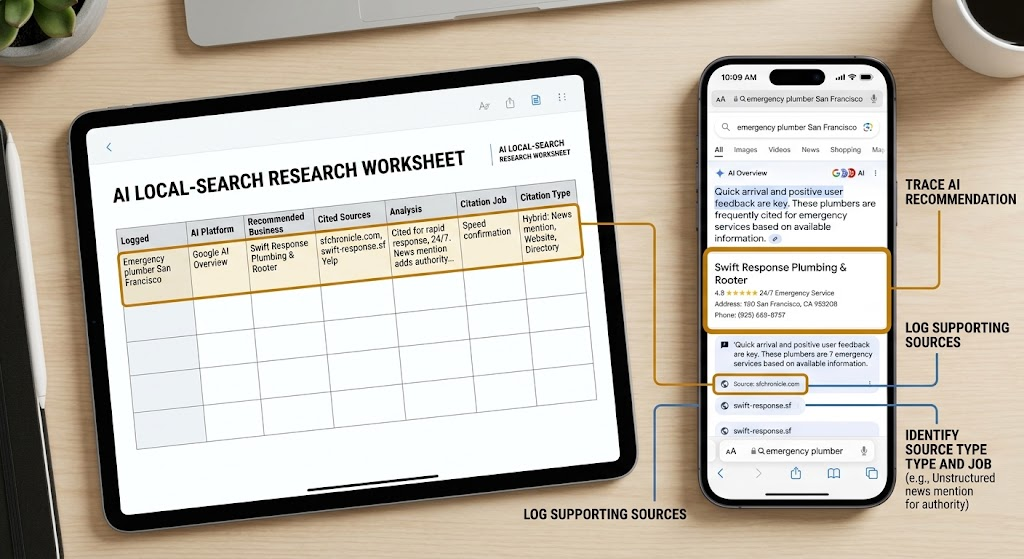
- Test realistic searches such as “emergency plumber in Manchester” or “family-friendly restaurants near Dubai Marina” across the AI search tools relevant to your market.
- Record the businesses recommended and the external sources cited, where available. Identify whether those sources are directories, business websites, reviews or independent publications.
- Repeat the same searches over time, keeping the location and wording consistent, and investigate relevant sources where comparable businesses appear but yours does not.
Use a simple worksheet to record your observations.
| Record | What to capture |
| Search conditions | Exact prompt, location, date and AI platform |
| Business visibility | Businesses mentioned and whether yours appeared |
| Supporting sources | Visible citation URLs and source types |
| Follow-up | Relevant missing profiles, outdated details or genuine editorial opportunities |
Results can change between repeated searches and platforms. BrightLocal’s September study found substantial differences in which local businesses appeared across AI systems, even when researchers tested comparable queries. ChatGPT also warns that search citations may be incomplete or incorrect.
Treat this exercise as a way to discover relevant information sources, not proof that any particular listing causes AI visibility. The findings should help you decide whether your next step is correcting an existing citation, improving your own website or pursuing genuinely useful third-party coverage.
What Should You Do Next? A Citation Action Plan for Your Business
Your next step depends on what’s already wrong—or missing. A new business needs accurate profiles on relevant platforms. An established business with an outdated address needs corrections, not another round of directory submissions.
Use your citation audit to identify the action that fits your situation.
| Current situation | First action | What to do next |
| New local business | Establish accurate profiles on relevant maps and discovery platforms | Add industry and local directories your customers use |
| Existing business with errors | Correct wrong addresses, phone numbers and other material discrepancies | Verify that corrections appear publicly |
| Business that recently moved | Update its existing profiles with the new location | Find and correct citations showing the old address |
| Business with several branches | Audit each eligible location separately | Centralize ownership and maintain branch-specific records |
| Business with accurate, relevant coverage | Maintain existing listings | Focus on other opportunities to attract local customers |
For businesses that have moved, Google’s duplicate-profile guidance specifically recommends updating the existing Business Profile rather than creating another profile solely because the address changed.
Before investing in more local citation building, make sure someone in your business can access important listings and maintain the information when it changes. Your citation audit should tell you where the next improvement is needed not merely how many directories contain your name.
Frequently Asked Questions About Local Business Citations
1. Are Local Citations Still Important for SEO in 2026?
Yes. Accurate citations support customer discovery and reliable business information. However, Google does not guarantee higher rankings simply because you submit more directory listings.
2. How Many Local Citations Does a Business Need?
There is no universal target. Focus on relevant platforms in your country and industry, correct existing errors and prioritize directories your customers actually use.
3. Do Local Citations Need to Include a Backlink?
No. A citation can mention your business without linking to your website. Backlinks and citations serve different purposes, although one listing can contain both.
4. Are Free Local Citation Sites Worth Using?
Yes, when they reach relevant customers and allow accurate business information. An appropriate free directory can be more useful than an unrelated paid listing.
5. Do NAP Differences Affect Google Maps Rankings?
Google requires accurate business information but does not publish a penalty for every formatting variation. Prioritize incorrect addresses, disconnected numbers and other consequential errors.
6. Should I Delete Duplicate Business Listings?
Not automatically. Confirm whether the listings represent the same business. For Google Business Profile, follow its official duplicate-resolution procedure to avoid removing legitimate information.
7. How Long Does It Take for Citation Changes to Appear?
It varies by platform. Google says Business Profile edits usually take up to 10 minutes to review, although some take up to 30 days.
8. Do I Need a Local Citation Building Service?
Not necessarily. Manual management may suit one location. A service becomes more useful when you have several branches, persistent errors or limited staff time.
Conclusion: Focus on Accurate, Relevant Citations Rather Than More Listings
A useful local citation strategy starts with accurate information, not a directory count. Maintain your core profiles, correct errors that affect customers and build new citations only where they offer genuine local or industry relevance. Keep records you can update as your business changes. If your audit reveals wider problems with local visibility, Rank N Convert can help turn those findings into a focused local SEO strategy. The goal is simple: make your business easier to find, contact and choose.